Can You Freeze Dry Italian Sausage?
Can You Freeze Dry Italian Sausage? Yes, but only after you cook it. That’s the short answer.
Raw sausage is risky because freeze dryers don’t generate heat.
Freeze drying removes 70 to 80 percent of moisture, which halts spoilage. It does not kill bacteria or parasites. The USDA Food Safety and Inspection Service points to cooking as the only safe path for home-preserved ground meats.
So the process starts in a skillet, not in a freeze dryer.
Quick Answer
Can You Freeze Dry Italian Sausage? Yes, if you cook it first. Raw sausage is unsafe because freeze drying lacks heat.
Cooked crumbles work best. They rehydrate well and stay shelf-stable for years. As of 2026, home freeze dryers handle this easily.
Why Freeze-Drying Raw Italian Sausage Is a Food-Safety Mistake
Freeze drying uses sublimation. Ice turns directly into vapor under vacuum. It never produces enough heat to kill pathogens.
Raw sausage can carry Salmonella, E. coli, or Trichinella. Pork is the source of Trichinella, so this isn’t theoretical.
If you load raw links into a freeze dryer, you’re making dangerous meat shelf-stable. You’re not making it safe. Cook the sausage to 160°F first.
That’s the only reliable way to kill those organisms.
As of 2026, the USDA still advises cooking ground and bulk meats before home preservation methods that don’t use high heat. The USDA Food Safety and Inspection Service publishes clear guidance. We recommend reviewing it before you start.
There’s also a hidden moisture problem. Raw sausage has fat and water trapped in the casing. The surface may look dry while the center stays soft.
Casings also make drying uneven.
If this is your first batch, don’t become the cautionary tale. Cook first. Crumble second.
Freeze-dry third.
What Happens to Italian Sausage in a Freeze Dryer
Freeze drying changes Italian sausage more than you’d expect. Moisture leaves, but fat stays behind. The texture turns dry and brittle.
Flavor concentrates and holds up well.
If you keep the casing on, you’ll be disappointed. Casings turn rubbery or tough after rehydration. Crumbled cooked sausage gives the best results.
It also dries evenly.
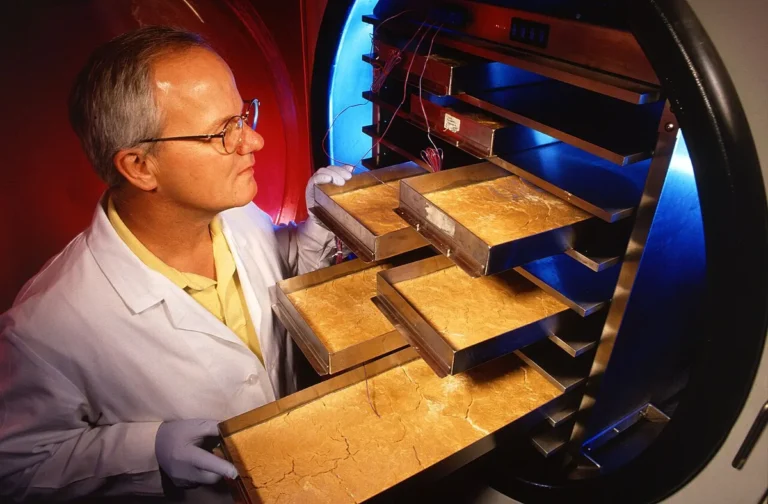
The photo below shows the process in action.
Image source: Wikimedia Commons / Saumya729 (CC BY-SA)
Fully dried pieces snap cleanly when you bend them. No moisture means no flexibility. The finished sausage weighs about 70 percent less than the original.
Rehydrate in warm water for five to ten minutes. The texture is close enough for sauces, soups, and skillet meals. Hot Italian keeps its heat.
Sweet Italian keeps its fennel sweetness.
Plan around the fat. Fat absorbs water slowly and can turn rancid. Store the sausage well and use it within a couple of years for the best taste.
How to Freeze-Dry Italian Sausage Safely: Step-by-Step
Here’s the exact process we recommend.
- Cook the sausage fully. Brown it in a skillet until it reaches 160°F. Check with a meat thermometer, not your eyes.
- Drain and blot the fat. Grease is the enemy of freeze drying. Pat the crumbles dry with paper towels.
- Prep the trays. Spread the crumbles in a single layer with space between pieces.
- Pre-freeze. Set the trays in the freezer for three to four hours. Pre-frozen food keeps its shape.
- Load and run. Use the meat cycle if your machine has one. Expect 20 to 36 hours in most home units.
- Test for dryness. Break a piece in half. It should crack, not bend. Weigh a few pieces twice. Stable weight means done.
- Package right away. Use mylar bags and oxygen absorbers. Seal, label, and store in a cool dark place.
Here’s a quick reference table with the key numbers.
| Step | Target |
|---|---|
| Cook | 160°F internal |
| Pre-freeze | 3-4 hours |
| Cycle | 20-36 hours |
| Dryness test | Stable weight, clean snap |
| Packaging | Mylar bag + oxygen absorber |
This process works for sweet or hot Italian sausage. It also works for other seasoned pork crumbles. Just keep the pieces small and the fat low.
The Fat Problem: Shelf Life, Rancidity, and Storage
Italian sausage is roughly 20 to 30 percent fat. That matters more than most people think. Fat doesn’t leave during freeze drying.
It stays in the meat and can turn rancid.
Rancid sausage won’t make you sick. It just tastes terrible and smells like old glue. Oxygen triggers the process.
So packaging is everything.
Mylar bags with oxygen absorbers are the best choice for long storage. Vacuum-sealed mason jars work, too. Keep the bags below 70°F.
A cool closet beats a warm pantry.
Leaner sausage stores longer. If you’re buying pork specifically for freeze drying, look for blends with 15 to 20 percent fat. Avoid sausage with added fat or cheese.
Properly packaged, freeze-dried sausage stays safe for years. But flavor peaks early. Use it within 12 to 24 months for the best taste.
After that, it’s edible but less enjoyable.
When Freeze-Dried Italian Sausage Is (and Isn't) the Right Choice
Freeze-dried Italian sausage shines in specific situations. It's perfect for camping, emergency kits, and pantry meals. It's not ideal if you want to use it within a few weeks or if you have plenty of freezer space.
If you're backpacking, this is a game-changer. A pound of cooked crumbles drops to about 3 ounces. You get protein without the weight or cold storage.
For hikes, that's huge.
Freeze-dried sausage also wins for convenience. Reach into a mylar bag, grab a handful, and you're done. No thawing, no waiting.
It's perfect for quick pasta sauce or a lazy breakfast hash.
For short-term use, skip it. Frozen sausage tastes fresher and costs nothing extra in time. Freeze-dry if you're planning for months ahead.
For next Tuesday's dinner, the freezer works better.
Here's how the options stack up.
| Method | Shelf Life | Weight | Texture | Best For |
|---|---|---|---|---|
| Freeze-dried | 15-25 years | Very light | Crunchy to chewy | Emergency storage, camping |
| Frozen | 4-6 months | Heavy | Original | Weekly meals |
| Canned pressure | 2-5 years | Heavy | Soft | Shelf-stable stock |
If you want to explore other foods that handle lyophilization well, check out our guide on can you freeze dry anything. Avocados are another interesting case, though they behave very differently than sausage.
My rule of thumb: freeze-dry only what you're storing for emergencies or trips. Keep using fresh and frozen for your daily routine. That's the sweet spot.
Freeze-Drying Italian Sausage: FAQs
Can you freeze-dry raw Italian sausage?
No. Raw sausage is unsafe to freeze-dry at home. Freeze drying doesn't generate heat, so bacteria and parasites survive.
Cook the sausage to 160°F before processing. Always err on the side of safety.
How long does freeze-dried sausage last?
Properly packaged, it stays safe for 15 to 25 years. Flavor peaks earlier, around 12 to 24 months. The National Center for Home Food Preservation recommends cool, dark, dry storage for maximum shelf life.
Does it rehydrate and taste like normal sausage?
Close, but not identical. Rehydrate crumbles in warm water for five to ten minutes. The texture is softer than fresh sausage but works well in sauces, soups, and casseroles.
Seasoning holds up great.
Do you need to keep sausage casings on?
Remove them. Casings turn rubbery or tough after freeze-drying. Crumble the cooked meat instead.
It dries evenly and rehydrates faster. You'll get better results every time.
Is freeze-dried sausage cheaper than buying it?
Home freeze-dried is cheaper than commercial freeze-dried sausage. But the electricity and machine cost add up. If you already own a freeze dryer, the marginal cost is low.
If you're buying one just for this, it's not worth it. Try it after you've processed other foods first.
Final Verdict: Is It Worth the Time and Energy?
Yes, if you're preparing for emergencies or outdoor adventures. No, if you just want a quick way to preserve a few pounds. Freeze-dried Italian sausage is a solid staple for long-term storage.
The process isn't hard. Cook the sausage, crumble it, drain the fat, and load the trays. A 20 to 36 hour cycle does the work.
You're trading time for shelf life.
If you already have a freeze dryer, absolutely do a batch. Buy lean Italian sausage, cook it thoroughly, and package it well. You'll thank yourself when you pull a bag out months later.
If you don't own a freeze dryer, don't buy one just for sausage. Borrow time on a friend's machine or stick with freezing. Fresh sausage is perfectly good for most home cooks.
For us, the verdict is clear. Freeze-dried Italian sausage is a useful, practical pantry item. Cook it first, store it smart, and you'll have reliable protein on the shelf for years.

Hayden is a passionate urban farmer dedicated to cultivating sustainable food sources. He specializes in growing tomatoes and basil, and his favorite moments are spent in his garden, basket in hand, harvesting the fruits of his labor.