20 Vegetable Garden Design Ideas That Are Beautiful and Productive
Botanical Horticulturist & Food Preservation Specialist at Brittle Bloom · Certified Master Gardener & Master Food Preserver · 12+ Years in Plant Propagation & Food Preservation
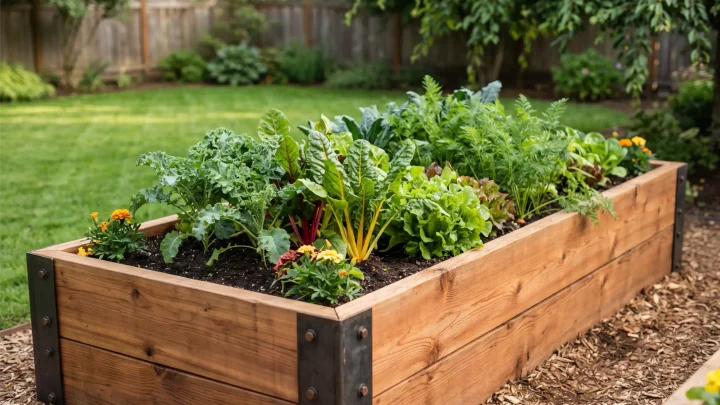
A productive vegetable patch does not have to be tucked out of sight behind a shed. With thoughtful vegetable garden design, edible crops can look just as refined as a traditional flower border while supplying fresh harvests all season long.
Whether you are working with a sunny balcony, a narrow side yard, or an open backyard lawn, the right layout balances plant health, easy access, and visual appeal.
elow, you will find 20 distinct designs organized from compact small-space setups and structured raised beds to architectural focal features and full landscape-integrated layouts. Because sunlight, soil, and frost dates vary widely, always adapt plant choices and timing to your local climate zone.
Compact and Small-Space Vegetable Garden Design Ideas
1. Tiered Cedar Planter Steps
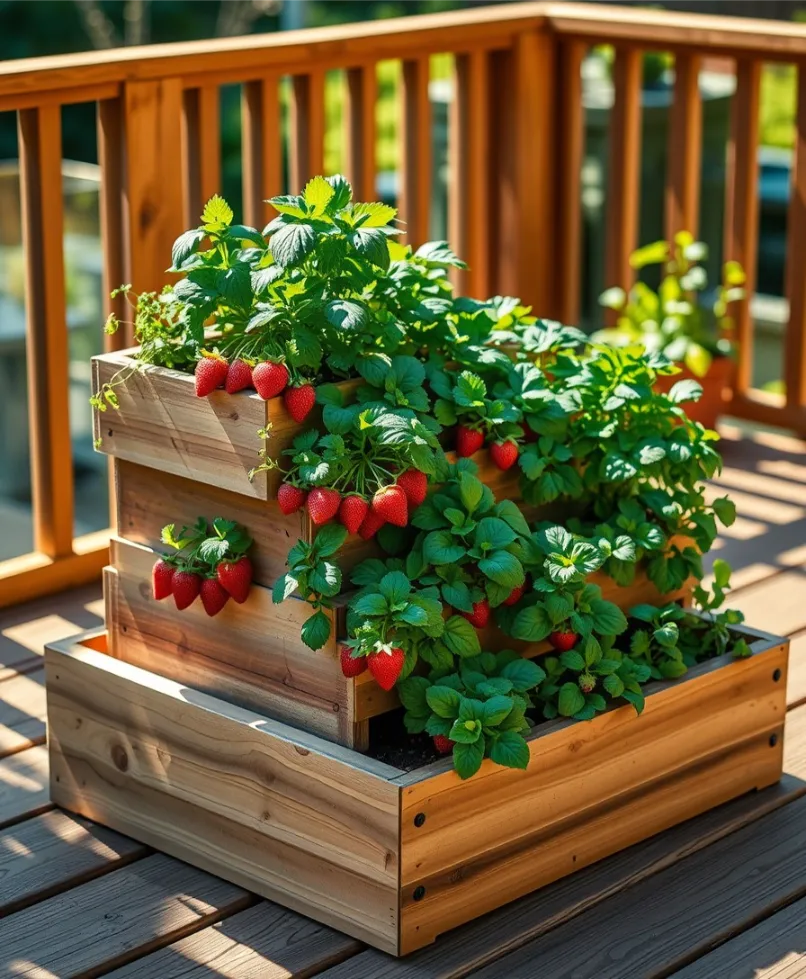
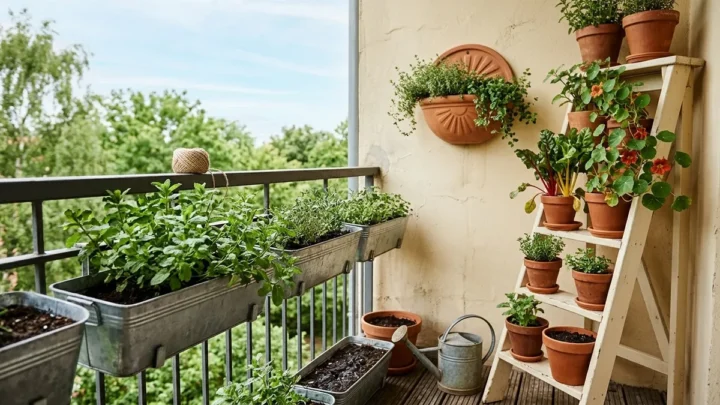
Tiered wooden planters arrange three to four narrow planting troughs like a staircase, turning a small footprint into a cascading wall of edible greenery.
This graduated height ensures tall crops at the back do not shade out compact herbs and greens in front while creating an instant architectural accent against a patio wall.
- Best for: Small patios, sunny decks, and renters who need freestanding structures.
- Practical details: Typically 3 to 4 feet wide and 3 to 4 feet deep; built from untreated rot-resistant wood like cedar or redwood; medium cost; suits strawberries, bush beans, radishes, lettuce, and culinary herbs; requires 6 to 8 hours of direct sun; check moisture daily since elevated wooden tiers dry faster than in-ground beds.
- Common mistake to avoid: Placing heavy, water-soaked tiered planters on upper balconies without first confirming the structure’s load-bearing capacity.
Helpful reader for Vegetable Gardening for Beginners: The Complete Guide
2. Vertical Trellis Wall with Underplanted Greens
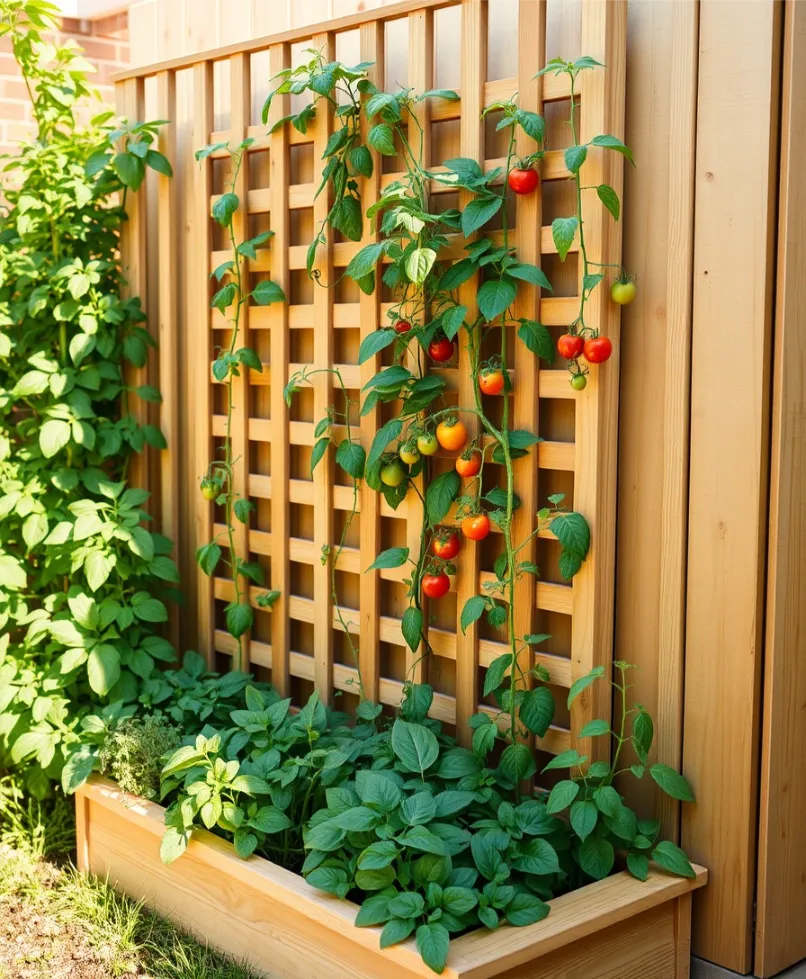
Mounting sturdy wooden lattice, wire mesh panels, or tensioned cables along a sunny fence or exterior wall turns vertical air space into high-yield real estate.
Vining crops climb upward to form a lush living tapestry, while their foliage casts light, dappled shade over cool-season greens planted directly at the base.
- Best for: Narrow courtyards, townhome patios, and tight urban yards.
- Practical details: Needs a 18-to-24-inch-deep planting bed or deep trough along the wall; uses galvanized wire panels or cedar lattice; low to medium cost; ideal for pole beans, snap peas, mini cucumbers, and cherry tomatoes above spinach or arugula; orient facing south or west (in the Northern Hemisphere) for maximum sun; water deeply at the root zone.
- Quick tip: Leave a 3-to-4-inch gap between the trellis and house siding to maintain healthy airflow and protect exterior walls from trapped moisture.
3. Balcony Rail and Pocket Salad Bar
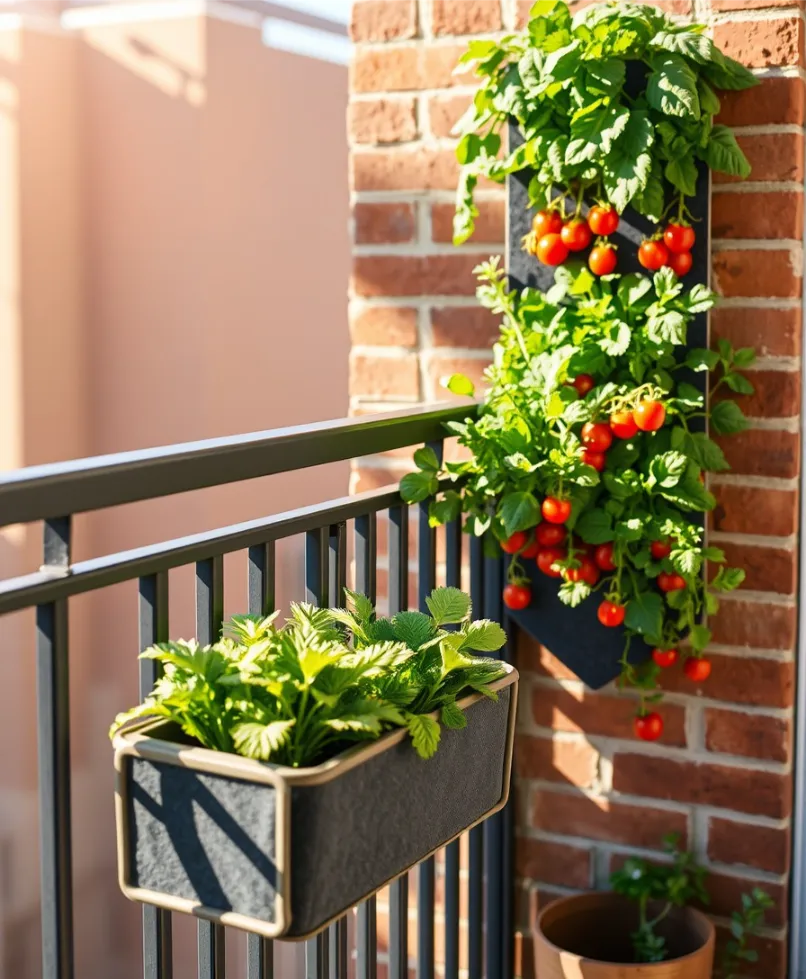
Combining clip-on railing troughs with breathable felt or modular wall pockets transforms a standard apartment balcony into a clean, modern salad station.
Because leafy crops stay at eye and waist height, harvesting takes seconds and stays well above pet level and ground-dwelling pests.
- Best for: Apartment balconies, porches, and beginner gardeners seeking quick wins.
- Practical details: Fits railings as narrow as 4 to 6 feet; uses lightweight resin troughs, metal rail planters, or UV-resistant fabric pockets; low cost; best for cut-and-come-again lettuce, baby kale, scallions, chives, and dwarf cherry tomatoes; thrives on 4 to 6 hours of sunlight; requires frequent watering and slow-release organic fertilizer due to shallow root volumes.
- Common mistake to avoid: Filling balcony containers with heavy garden topsoil instead of a lightweight, well-draining potting mix, which compacts quickly and slows root growth.
4. Narrow Side-Yard Strip Garden
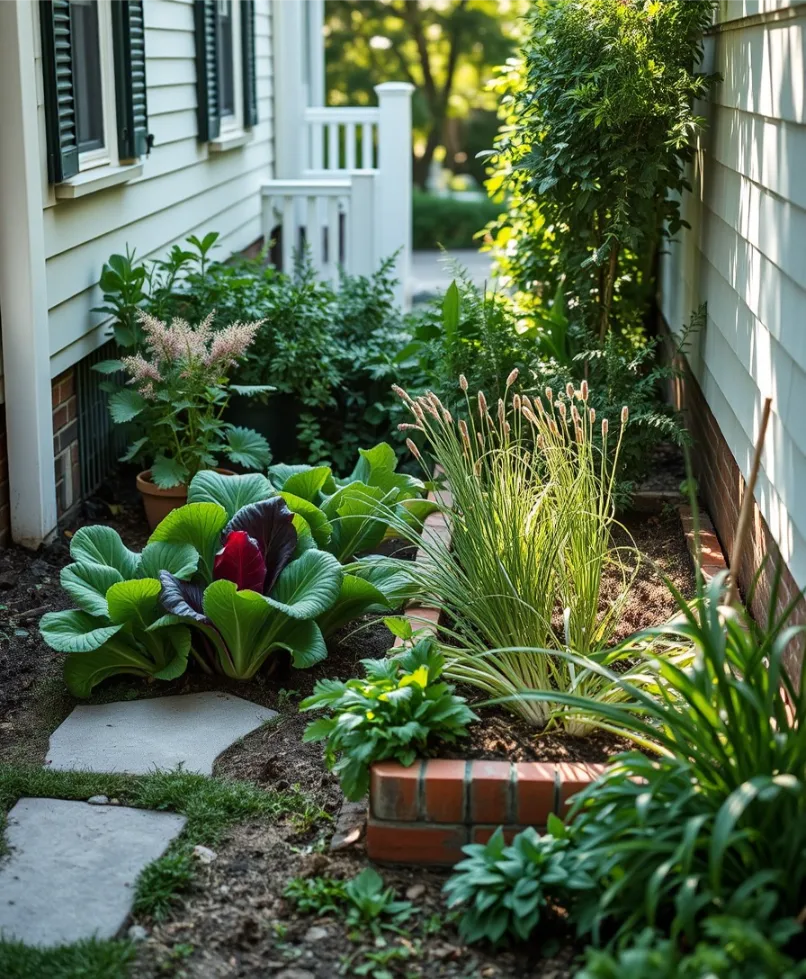
That neglected three-foot strip between a house and a property-line fence can become a tidy, productive corridor when framed with clean edging and stepping stones.
Keeping plantings linear and disciplined turns an awkward pass-through into a charming cottage walkway lined with edible texture.
- Best for: Suburban side yards, driveway edges, and long narrow lots.
- Practical details: Beds 18 to 24 inches wide alongside a 24-inch stepping-stone path; edged with brick, steel, or cedar boards; low cost; works well for bush zucchini, upright Swiss chard, green onions, carrots, and herbs; track sunlight carefully first, as neighboring structures may limit direct light to 4 to 5 hours; drip tape or soaker hoses keep watering clean and narrow.
- Quick tip: Choose upright or compact bush cultivars rather than sprawling vines so the walkway remains easy to navigate without stepping on stems.
5. Rolling Mobile Kitchen Cart Garden
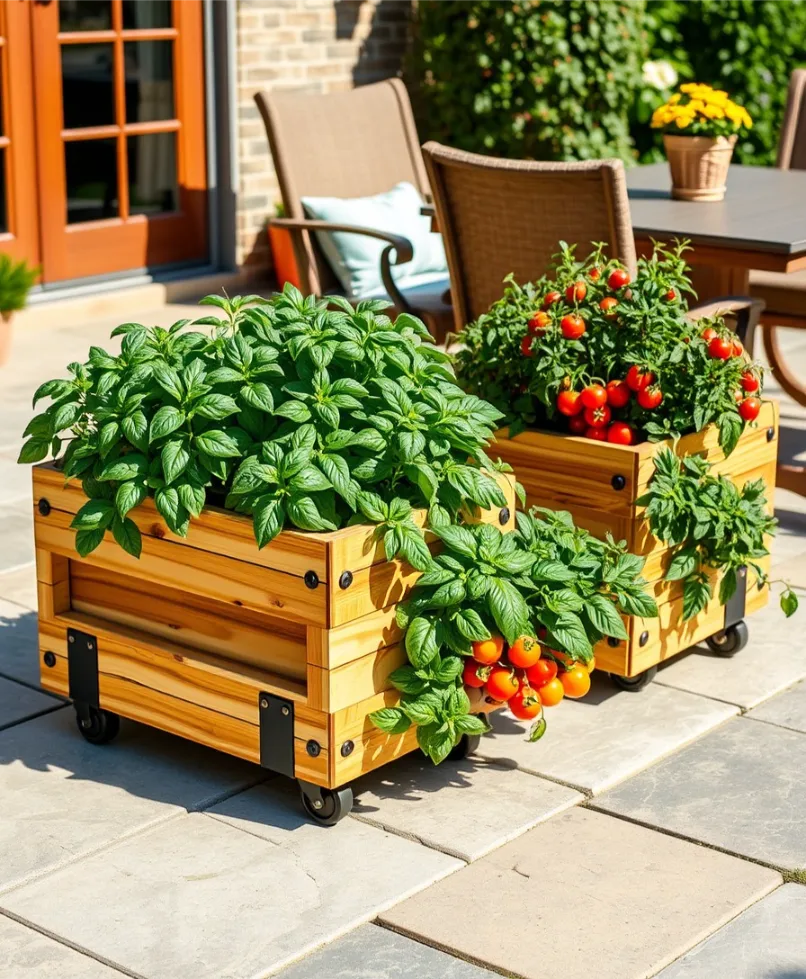
Deep wooden or galvanized troughs mounted on locking heavy-duty casters let you roll your garden right along with shifting seasonal sunlight.
Grouped beside an outdoor dining table, mobile planters double as living privacy screens and put fresh snipping herbs within arm’s reach of the grill.
- Best for: Shady patios with moving sun pockets, paved driveways, and renters who plan to move.
- Practical details: Planters roughly 2 by 4 feet and at least 12 to 18 inches deep; built from untreated cedar or food-safe metal troughs with drainage holes; medium cost; suitable for peppers, bush tomatoes, basil, thyme, and mesclun mixes; aim for 6 to 8 hours of sun by rolling as needed; mulch the surface with straw or shredded leaves to slow evaporation.
- Common mistake to avoid: Skipping locking swivel casters—unlocked carts can shift unexpectedly in strong wind or on slightly sloped patios.
Structured Raised Bed and Backyard Vegetable Garden Layouts
6. Classic French Potager Four-Square Layout
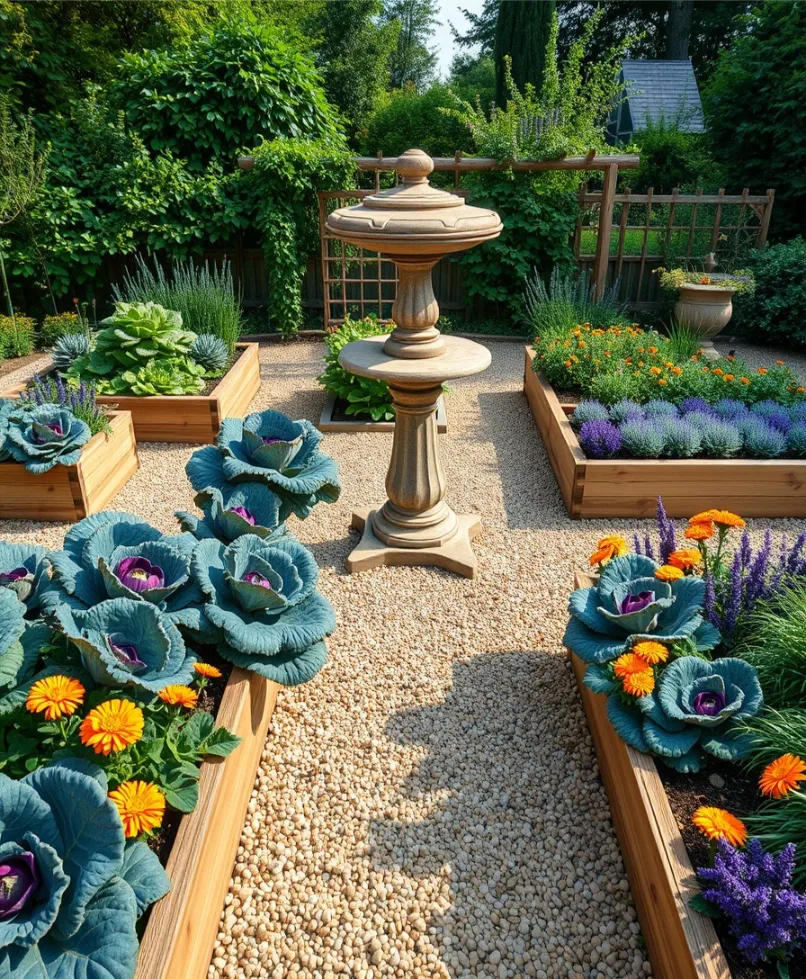
Inspired by historic French kitchen gardens, the four-square potager divides a square or rectangular space into four symmetrical raised beds separated by crisp intersecting pathways.
Anchoring the central crossroads with a stone birdbath, sundial, or obelisk gives the entire backyard garden layout timeless structure, even in winter when beds rest bare.
- Best for: Traditional backyards, formal design lovers, and gardeners who appreciate tidy symmetry.
- Practical details: Often 12 by 12 feet to 20 by 20 feet overall, with four 4-by-4-foot or 4-by-6-foot beds and 3-foot-wide gravel or brick paths; cedar, stone, or brick walls; medium to high cost; pairs vegetables like purple cabbage and artichokes with marigolds, lavender, and zinnias; needs 6 to 8 hours of sun; drip irrigation hides neatly beneath pathway gravel.
- Quick tip: Repeat one signature border plant—such as curly parsley or dwarf French marigolds—along the outer corners of all four beds to tie the entire layout together visually.
7. Keyhole Composting Garden Bed
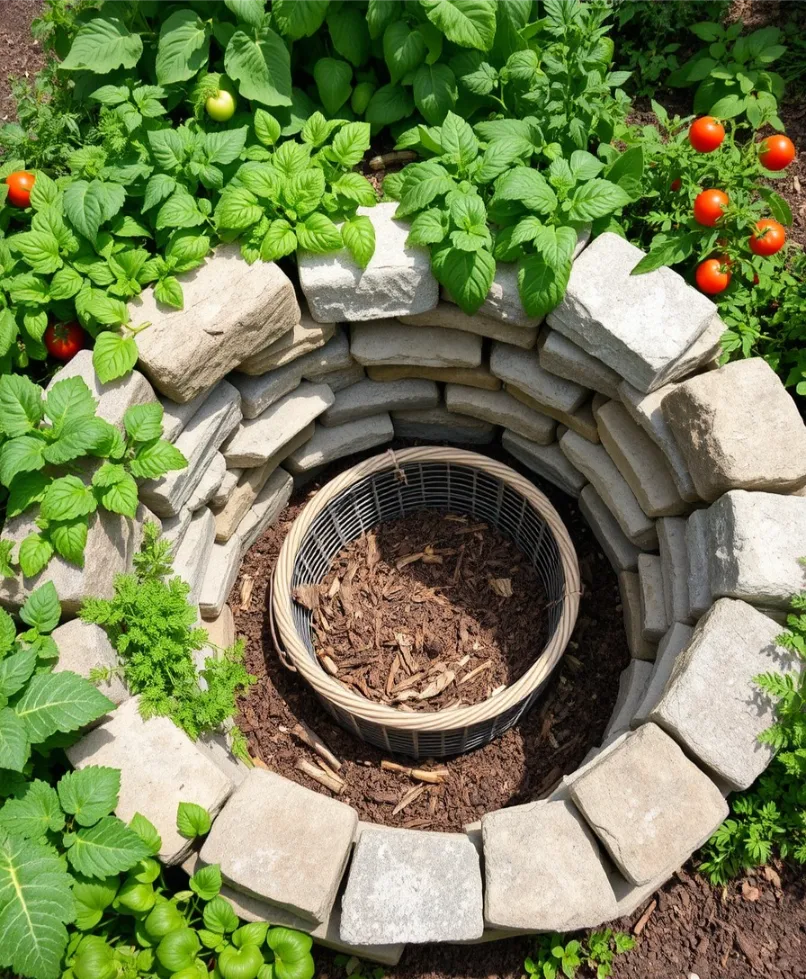
A keyhole bed is a circular raised bed—usually six feet in diameter—with a wedge-shaped notch cut into one side so you can step toward the center to harvest comfortably.
Directly in the middle sits a recessed wire basket filled with kitchen scraps and brown yard debris, slowly feeding surrounding soil moisture and nutrients as it decomposes.
- Best for: Eco-conscious growers, hot or dry climates, and compact sunny lawns.
- Practical details: Roughly 6 feet across and 2 to 3 feet tall; built from stacked dry stone, brick, or bent cedar slats; medium cost; ideal for nutrient-hungry crops like tomatoes, squash, and leafy greens near the center, with herbs along the drier perimeter; requires full sun (6 to 8 hours); pour water directly through the central compost cage to distribute moisture outward.
- Common mistake to avoid: Adding meat, dairy, or diseased plant foliage to the central composting basket, which attracts rodents and can spread soil-borne pathogens.
8. U-Shaped Wraparound Raised Bed
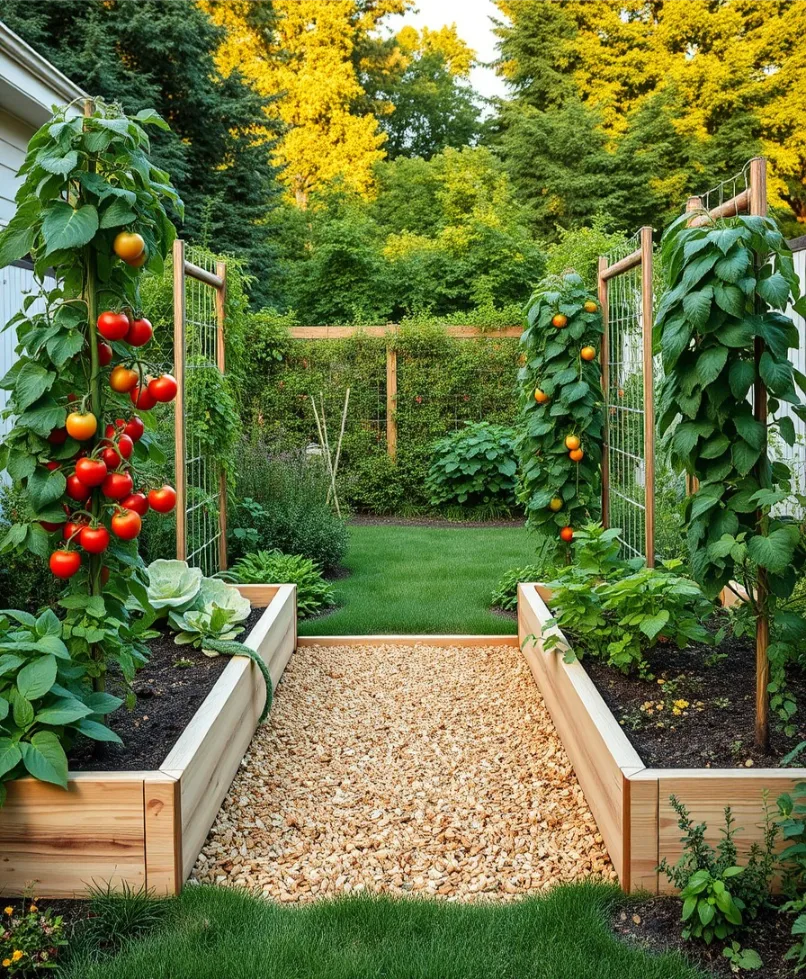
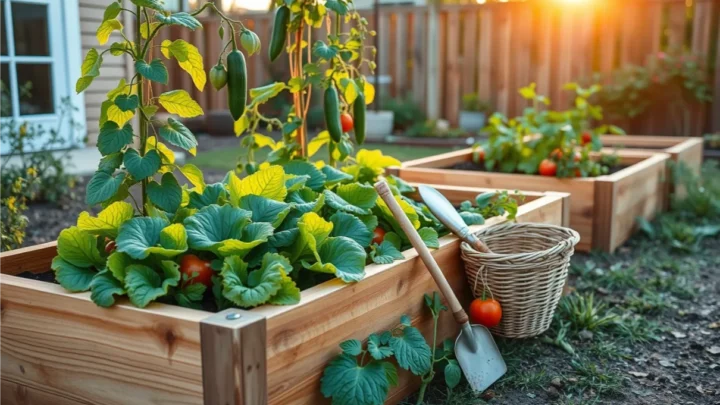
Connecting three rectangular raised beds into a continuous horseshoe creates a dedicated harvesting cockpit where every plant sits within easy arm’s reach.
This raised bed vegetable garden layout eliminates excess pathways, giving you noticeably more growing square footage than separate boxes in the exact same footprint.
- Best for: Mid-sized backyards, ergonomic gardening, and busy growers who want streamlined upkeep.
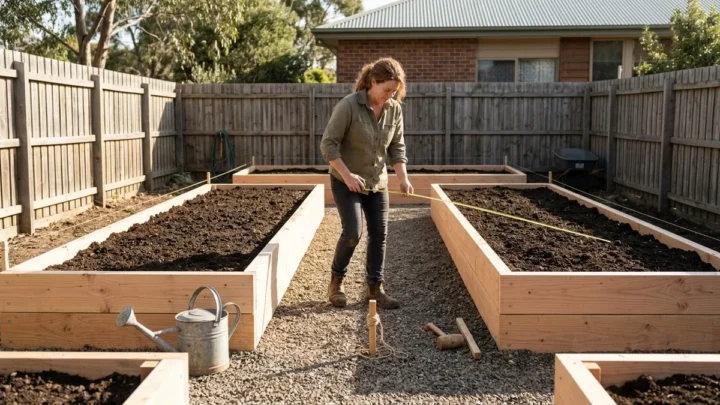
- Practical details: Overall footprint around 8 by 10 feet with 2-to-3-foot-wide planting arms and a 3-to-4-foot center aisle; built from untreated 2-inch-thick timber; medium cost; place tall trellised crops along the back bar (north side in Northern Hemisphere) and low greens along the side arms; full sun; wood-chip mulch in the center aisle prevents muddy shoes.
- Quick tip: Keep the interior aisle at least 36 inches wide so a standard wheelbarrow or garden cart can roll smoothly right into the center.
9. L-Shaped Corner Pocket Garden
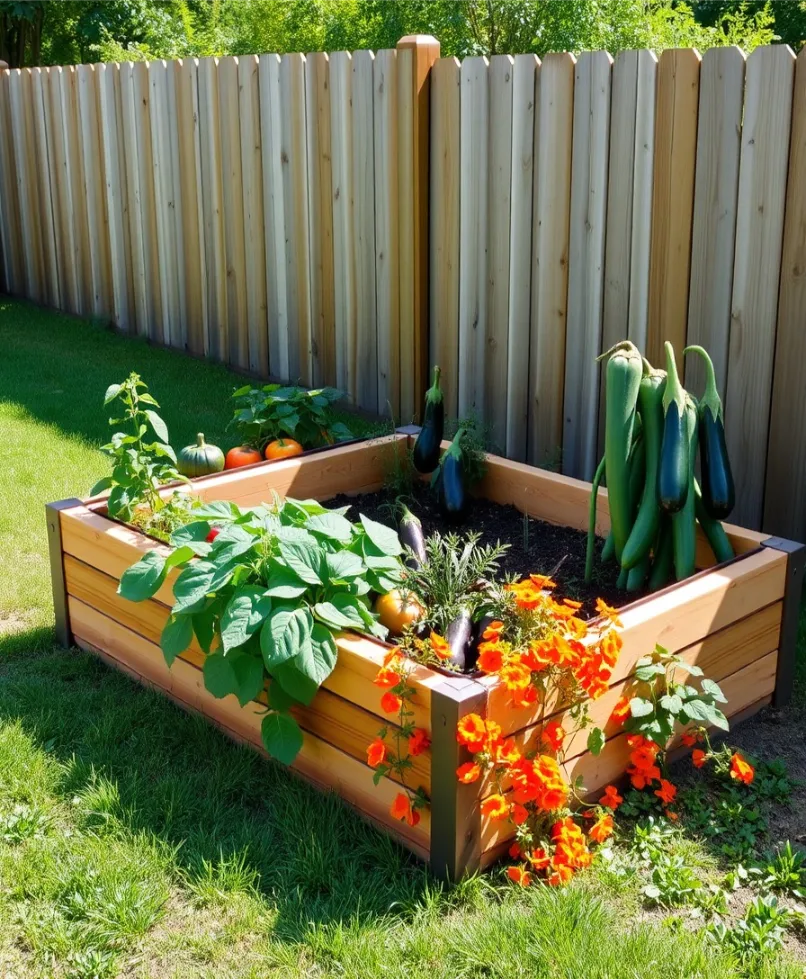
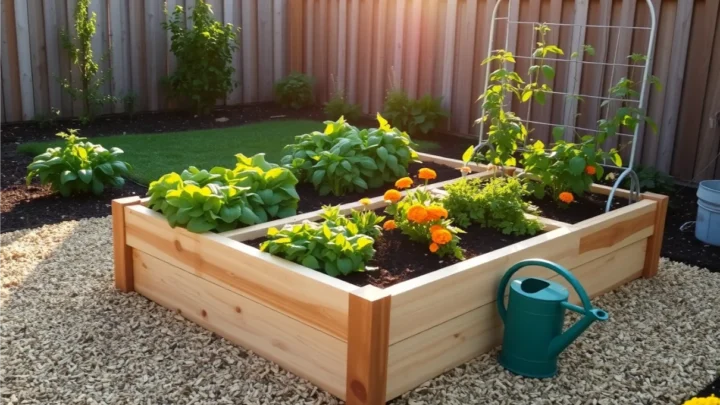
Tucking an L-shaped bed cleanly into an unused fence corner frames a lawn or patio seating area while making productive use of dead space.
The ninety-degree bend naturally creates sheltered microclimates where tender herbs and early spring greens stay protected from brisk winds.
- Best for: Family yards that need open lawn space for kids or pets, and corner patio borders.
- Practical details: Two perpendicular arms, each 2 to 3 feet deep and 6 to 10 feet long; constructed from timber, retaining wall blocks, or metal edging; low to medium cost; great for mixing peppers, bush beans, eggplants, and trailing nasturtiums; verify that corner fencing does not block midday sun; install simple corner-routed soaker lines.
- Common mistake to avoid: Making the inner corner bed wider than 3 feet deep, which makes reaching the far back corner impossible without stepping on and compacting the soil.
10. Corrugated Metal and Timber Modern Grid
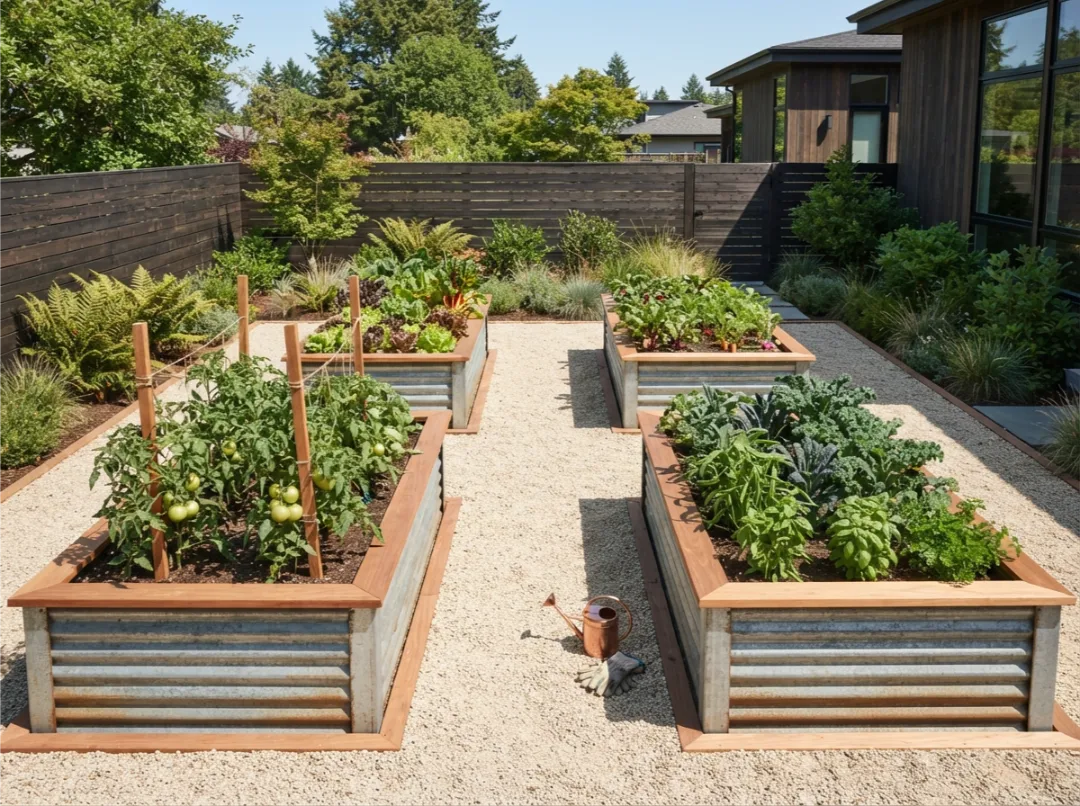
Pairing clean-lined corrugated galvanized or powder-coated metal beds with crisp pea gravel or slate pathways delivers an editorial, contemporary kitchen garden aesthetic.
Metal raised beds resist rot far longer than thin softwood boards and warm soil quickly in spring, helping early cool-season crops establish faster.
- Best for: Modern homes, long-term low-maintenance setups, and larger open yards.
- Practical details: Modular beds typically 3 to 4 feet wide by 6 to 8 feet long and 17 to 32 inches tall; food-safe coated steel panels or wood-framed corrugated metal; medium to high cost; excels for root crops like carrots and beets thanks to deep loose soil, plus tomatoes and brassicas; full sun; install dedicated drip emitters in each box for uniform watering.
- Quick tip: Choose lighter-colored metal finishes in very hot summer climates to help keep outer soil edges from overheating during heat waves.
Architectural and High-Impact Focal Designs
11. Arched Cattle Panel Tunnel Walkway
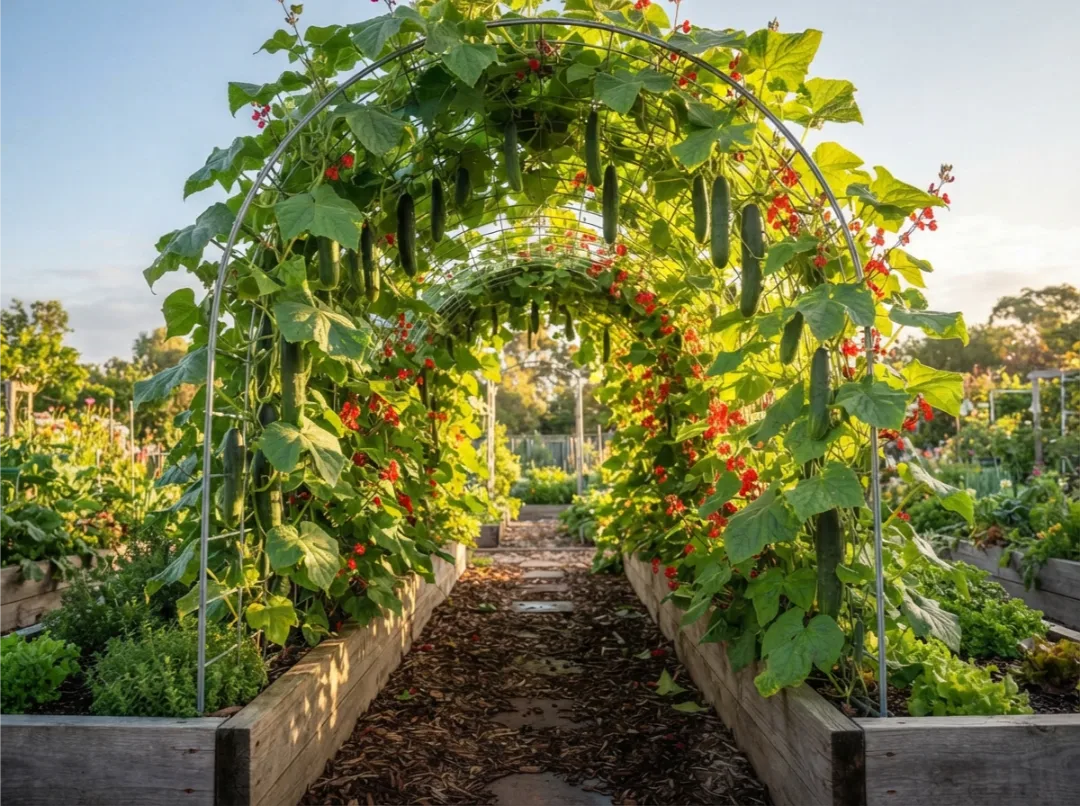
Spanning sturdy 16-foot galvanized steel cattle panels between two parallel raised beds forms a dramatic green tunnel overhead.
Walking beneath hanging cucumbers, tromboncino squash, and scarlet runner beans feels magical, while elevating heavy fruits improves air circulation and dramatically reduces rot and soil splash.
- Best for: Gardeners craving vertical drama, high yields in tight widths, and visual wow factor.
- Practical details: Two parallel beds spaced 4 to 5 feet apart; arched 50-inch-wide utility panels secured with metal T-posts and heavy ties; medium cost; suited for pole beans, sweet peas, small melons (supported with cloth slings), gourds, and vining cucumbers; full sun (8+ hours preferred); water deeply at the bed edges where vines root.
- Common mistake to avoid: Choosing flimsy decorative garden arches that buckle under the mid-summer weight of mature squash or melon vines.
12. Circular Mandala Sun Trap Garden
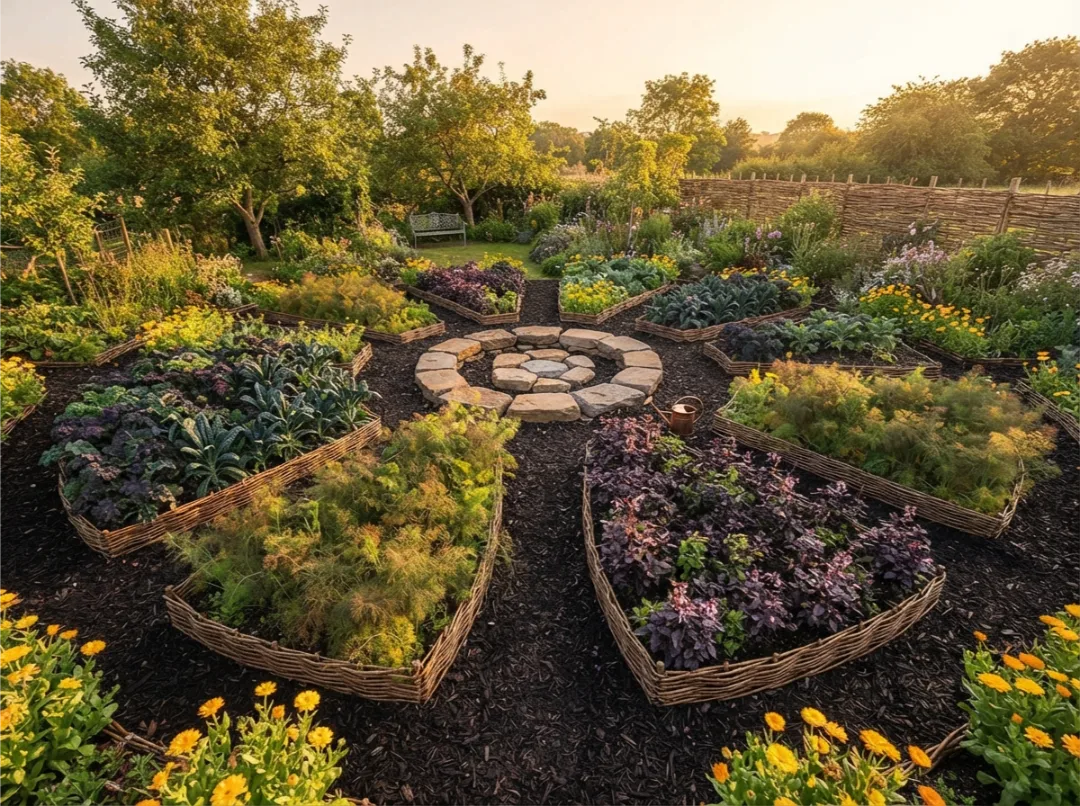
Drawing from permaculture principles, a mandala garden arranges curved, petal-like planting beds radiating around a central circular bed or seating pad. The gentle sweeping curves soften rigid backyard fence lines and naturally encourage diverse polyculture plantings that look like living botanical art from an upstairs window.
- Best for: Creative landscapers, wide open yards, and organic companion planters.
- Practical details: Usually 15 to 25 feet in diameter; shaped with flexible steel edging, brick, woven willow wattle, or mounded soil; low to medium cost; blends purple basil, bronze fennel, kale, bush tomatoes, and calendula in sweeping drifts; full sun; curving pathways lined with bark mulch or clover simplify foot access.
- Quick tip: Lay out the exact circles and keyhole paths with a garden hose or flour before digging so you can test every reach distance on foot first.
13. Hügelkultur Sculptural Mound Beds
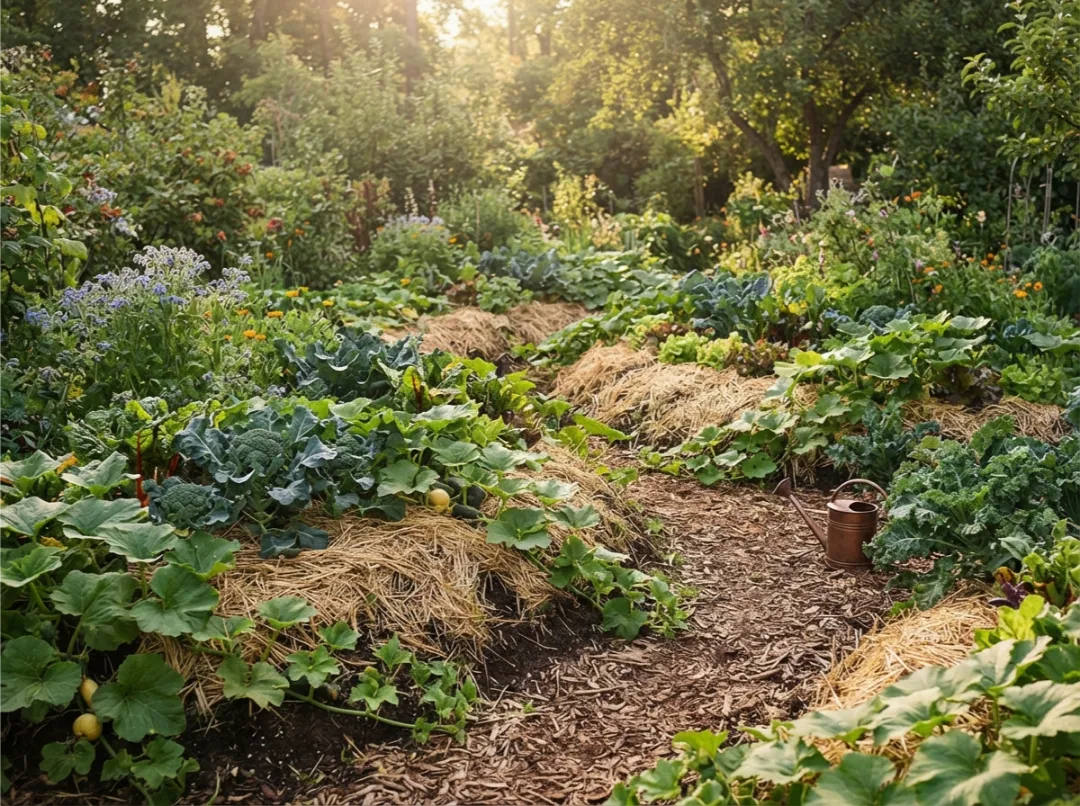
Hügelkultur beds are gently rolling, organically curved mounds built by layering untreated logs, branches, and woody trimmings beneath compost and topsoil.
As the buried wood slowly breaks down over years, it acts like an underground sponge—retaining rainwater, enriching soil life, and turning a flat yard into a lush, contoured landscape.
- Best for: Properties with fallen branches or woody debris, drought-prone regions, and naturalistic yards.
- Practical details: Mounds roughly 3 to 4 feet wide at the base and 2 to 3 feet high; uses locally gathered hardwood logs (avoid black walnut, which releases growth-inhibiting juglone), compost, and straw mulch; low cost; well suited for squash, potatoes, brassicas, and leafy greens once the bed settles; full sun; requires less frequent watering after the first season.
- Common mistake to avoid: Planting heavy-feeding vegetables directly into fresh, uncomposted wood chips at the surface, which can temporarily tie up soil nitrogen near young roots.
14. Espalier Fruit and Vegetable Border
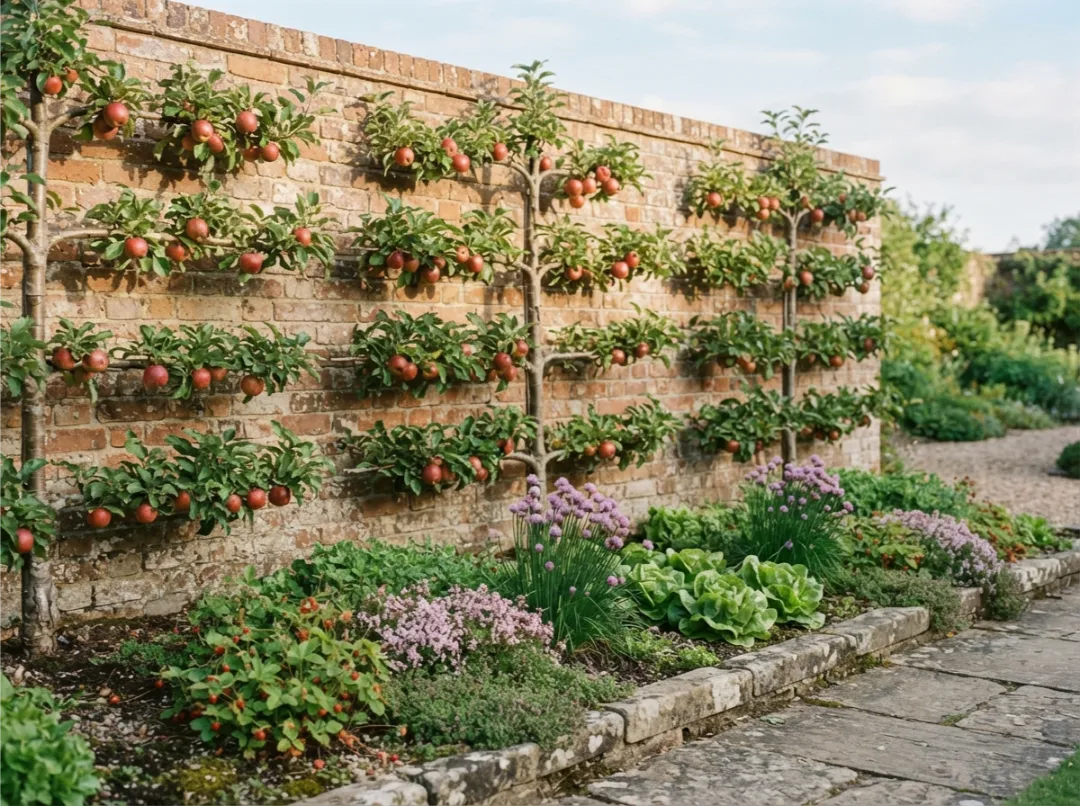
Training dwarf apple, pear, or fig trees flat against horizontal wires along a sunlit wall creates an unmistakable European estate aesthetic.
Planting neat geometric strips of culinary herbs, alpine strawberries, and compact bush vegetables directly beneath the trees makes every square inch along the wall doubly productive.
- Best for: Sunny brick or stucco walls, narrow backyards, and gardeners investing in multi-year beauty.
- Practical details: Requires a sunny wall at least 8 to 12 feet long and a 2-to-3-foot planting strip at its base; uses masonry anchors, stainless tension wire, and turnbuckles; medium to high cost; dwarf espalier fruit trees above thyme, chives, bush beans, and lettuces; needs 6 to 8 hours of reflected sun; consistent drip watering prevents shallow-rooted underplantings from competing with tree roots.
- Quick tip: Consult your local university cooperative extension service before buying fruit trees to select disease-resistant, climate-appropriate dwarf rootstocks and verify pollination needs.
15. Teepee and Obelisk Feature Beds
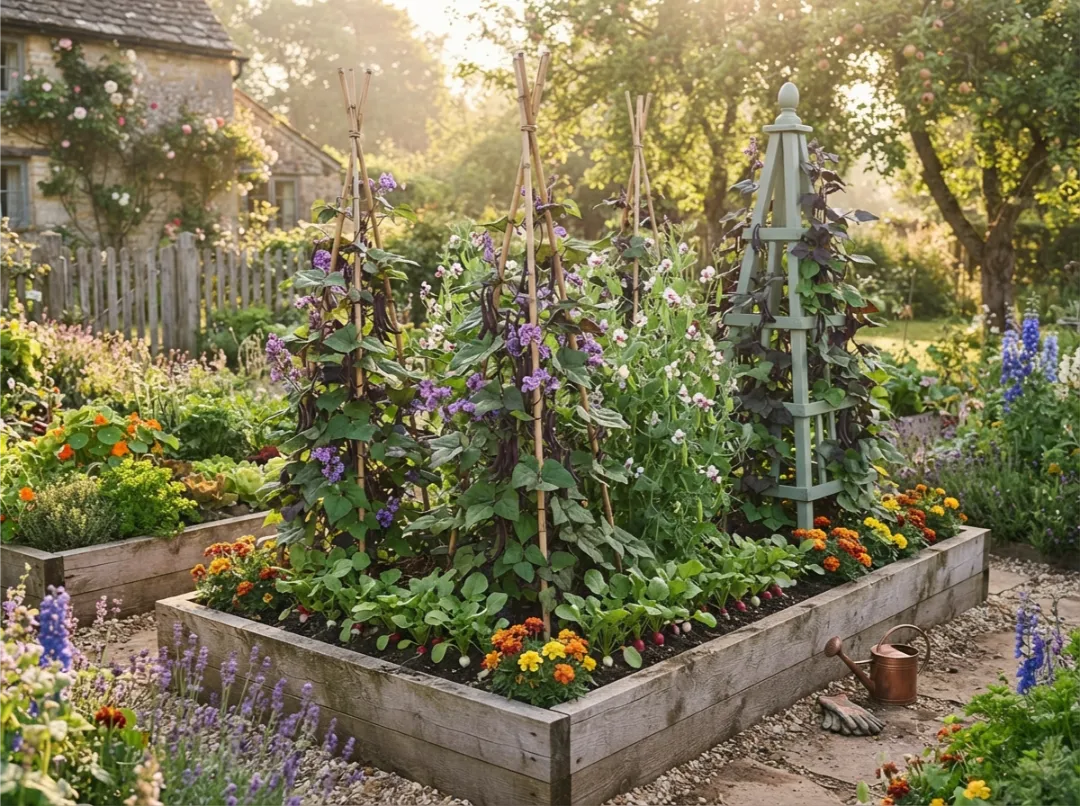
Placing sculptural bamboo teepees or painted wooden obelisks inside rectangular or square beds introduces instant vertical rhythm across a garden.
These freestanding towers turn climbing crops into ornamental pillars while opening up sun-drenched pockets around their bases for quick-maturing root vegetables and edible flowers.
- Best for: Cottage-style yards, family gardens with kids, and flexible seasonal layouts.
- Practical details: Individual towers measure 2 to 3 feet wide at the base and 6 to 8 feet tall; made from thick bamboo poles lashed with jute twine, willow saplings, or cedar lumber; low cost; ideal for purple pole beans, sugar snap peas, Malabar spinach, and flowering nasturtiums over radishes and baby carrots; full sun; secure poles at least 8 to 12 inches deep into soil.
- Common mistake to avoid: Leaving space gaps too wide at the base—group climbing seeds around each upright pole so young tendrils can immediately grab hold without sprawling across neighbors.
Landscape-Integrated and Ornamental Edible Designs
16. Edible Front Yard Cottage Border
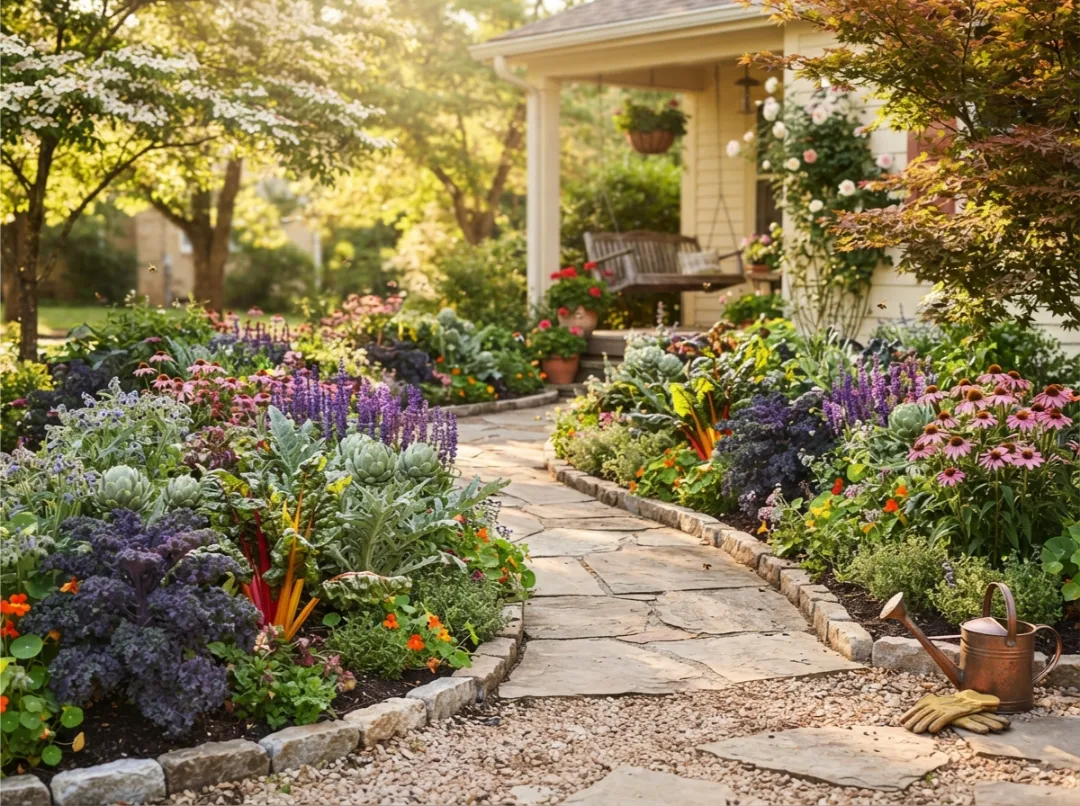
Blending showstopping vegetables directly into front-yard flower beds proves that food crops belong in prime sunny real estate. Deeply ruffled purple kale, glowing rainbow Swiss chard, silvery artichokes, and ruby-stemmed rhubarb deliver vibrant color and foliage contrast that rival classic ornamental perennials.
- Best for: Homes where the front yard gets the best sunlight, and lovers of relaxed edible landscaping ideas.
- Practical details: Curved borders 3 to 5 feet deep along walkways or porches; framed with stone edging or crisp spade-cut lawn edges; low to medium cost; combine ornamental edibles with perennial salvias, echinacea, and creeping thyme so beds stay attractive after harvests; 6 to 8 hours of sun; drip lines tucked beneath dark mulch keep curb appeal neat.
- Quick tip: Check municipal ordinances or HOA guidelines before transforming a front lawn, and use tidy edging plus evergreen herbs like rosemary (in mild zones) or sage to keep beds looking polished year-round.
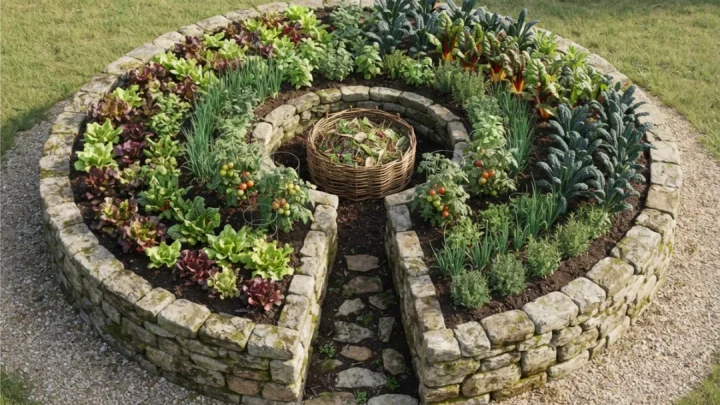
17. Stone Herb Spiral and Kitchen Mound
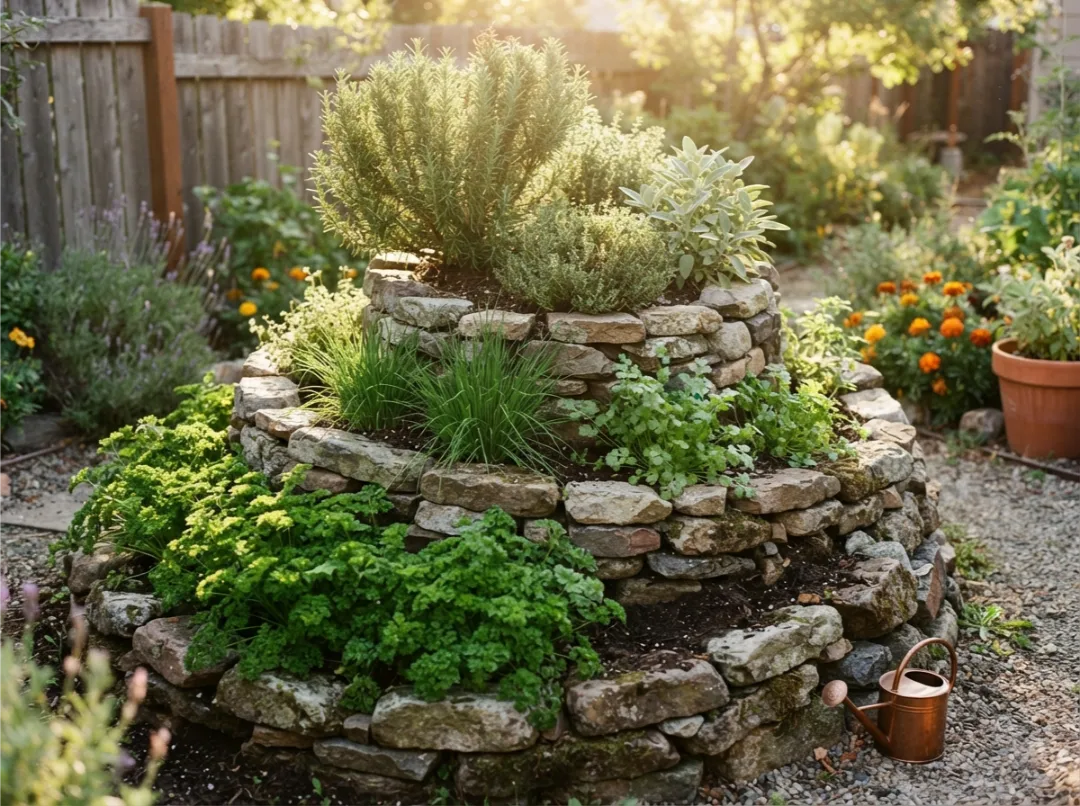
An herb spiral coils upward like a snail shell from ground level to roughly three feet high, creating distinct sunlight, drainage, and moisture zones within a six-foot circle. Mediterranean herbs thrive in the dry, sun-baked top soil, while moisture-loving greens and parsley flourish around the cooler, damper lower curve.
- Best for: Culinary enthusiasts, small sunny corners near the kitchen door, and permaculture fans.
- Practical details: Footprint of 5 to 6 feet in diameter; built with dry-stacked fieldstone, reclaimed brick, or landscape pavers; low to medium cost; plant rosemary, thyme, oregano, and sage near the summit, chives and cilantro mid-way, and parsley, mint (contained in a buried pot), or baby spinach near the base; full sun; water from the top so gravity naturally moisturizes lower tiers.
- Common mistake to avoid: Planting aggressive spreaders like mint directly into the open spiral soil without a bottomless container barrier, as its runners will quickly overtake delicate neighbors.
18. Terraced Hillside Vegetable Steps
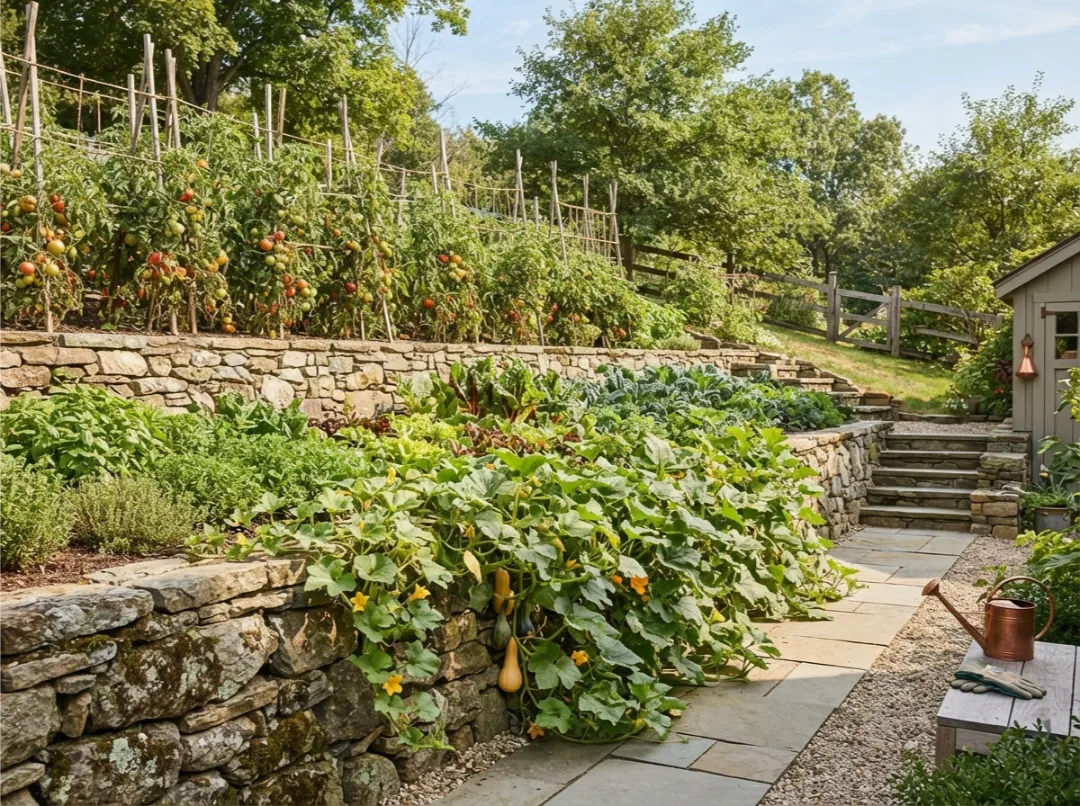
Sloped yards often suffer from water runoff and awkward mowing, yet converting a sunny incline into stepped retaining terraces turns a landscaping headache into a dramatic amphitheater of food. Each level terrace holds deep, rich soil and slows rainwater so crops absorb moisture evenly instead of watching topsoil wash downhill.
- Best for: Sloped properties, hillside homes, and sun-facing embankments.
- Practical details: Individual tiers 3 to 4 feet deep with 12-to-24-inch retaining walls; constructed with interlocking concrete blocks, natural stone, or heavy timber; high cost (often requiring careful drainage behind walls); well suited for sprawling crops like winter squash cascading over walls alongside tomatoes, peppers, and bush berries; full sun; step-down drip irrigation handles elevation changes cleanly.
- Quick tip: Always install gravel backfill and perforated drainage pipe behind retaining walls taller than two feet to prevent hydrostatic water pressure from bowing the wall over time.
19. Three Sisters Polyculture Mounds
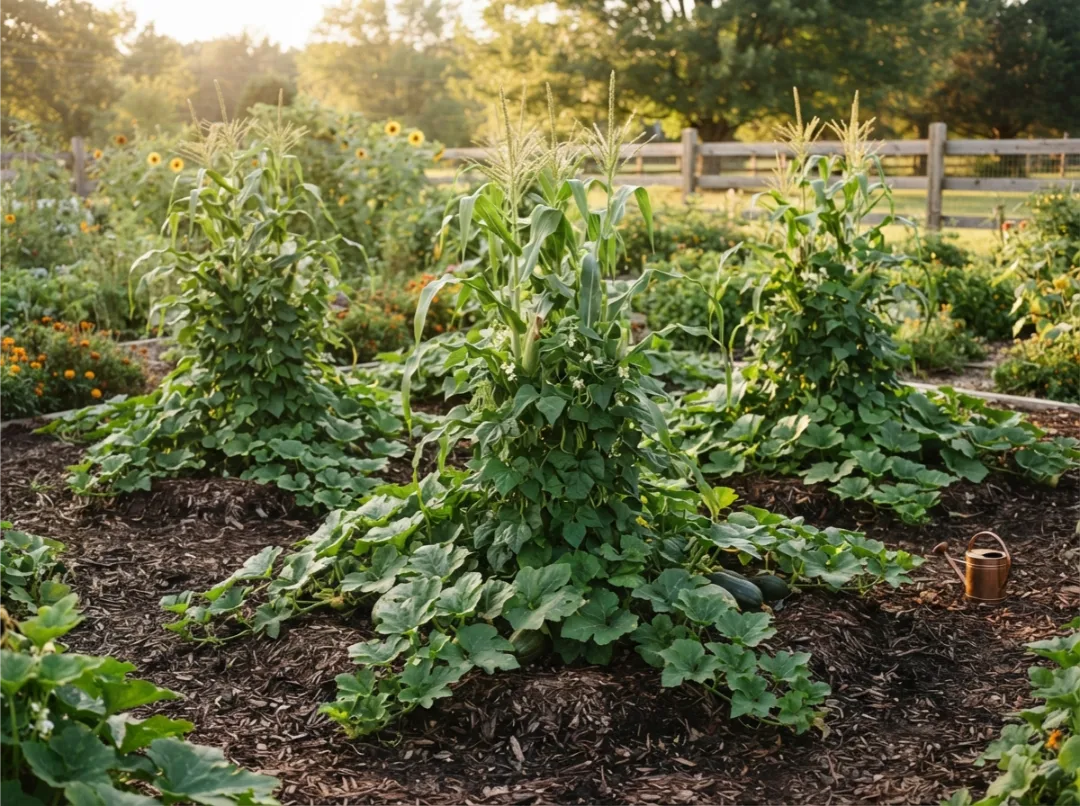
Rooted in centuries-old Indigenous agricultural wisdom across North America, the Three Sisters layout pairs sweet corn, climbing dry or pole beans, and spreading winter squash in broad, rounded soil mounds.
Corn stalks serve as living trellises, beans host nitrogen-fixing soil bacteria, and prickly squash leaves form a living mulch that shades soil and cools roots.
- Best for: Generous backyard plots, naturalistic gardeners, and fans of ecological companion planting.
- Practical details: Broad, flat-topped mounds 3 to 4 feet wide spaced 4 to 5 feet apart; formed directly from enriched native soil and compost—no lumber needed; low cost; requires corn, climbing pole beans (not bush beans), and vining squash or pumpkins; demands full sun (8 hours) and generous summer moisture.
- Common mistake to avoid: Planting all three crops on the exact same day—sow the corn first and wait until stalks reach roughly 6 inches tall before planting beans and squash so the vines do not smother emerging corn seedlings.
20. Pollinator Framed Courtyard Kitchen Garden
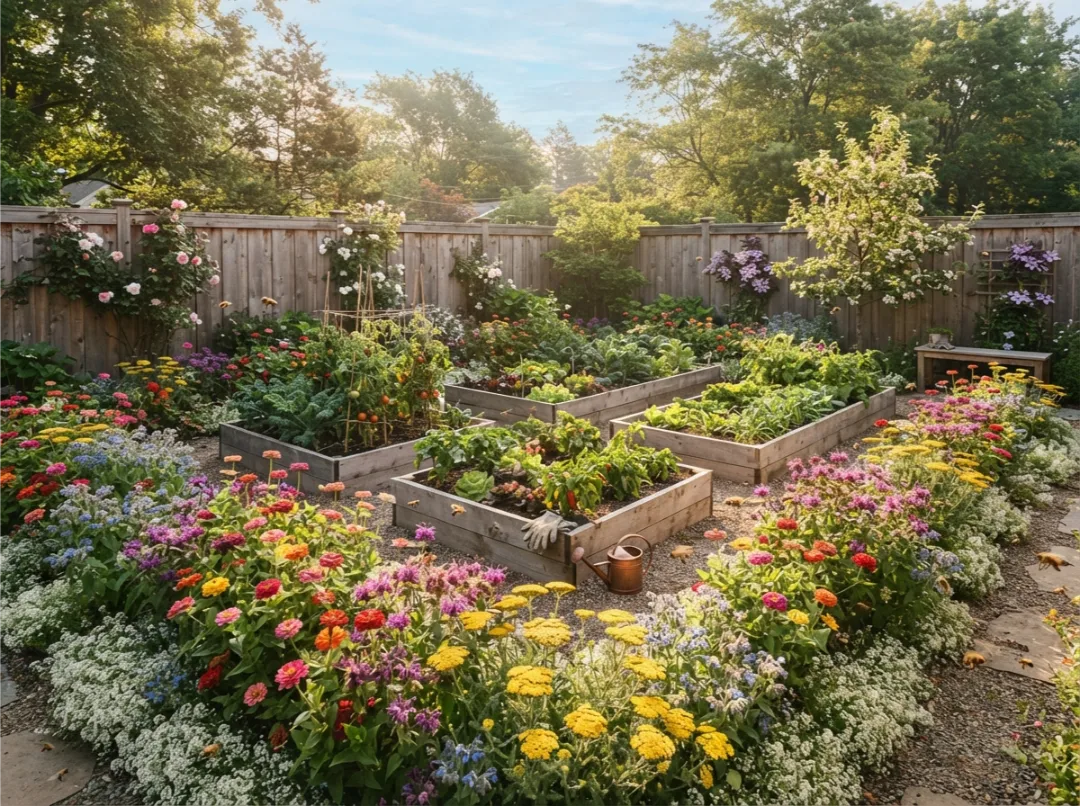
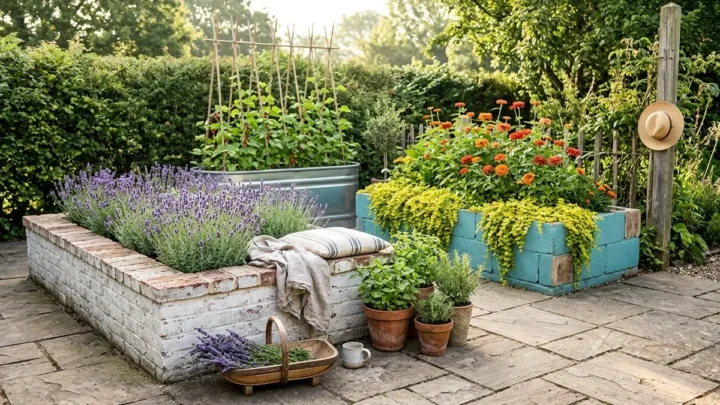
Surrounding a central group of simple vegetable beds with a dedicated four-foot perimeter border of flowering perennials transforms a kitchen garden into a buzzing, self-sustaining sanctuary. Native blooms draw bees, hoverflies, and lacewings right to fruiting crops like squash, tomatoes, and peppers, boosting pollination while helping keep common garden pests in check naturally.
- Best for: Dedicated backyard retreats, wildlife-friendly gardeners, and organic vegetable growers.
- Practical details: Works in spaces 14 by 14 feet or larger; pairs simple wooden or in-ground center vegetable beds with an outer border of regionally native flowers like bee balm, yarrow, sweet alyssum, borage, and zinnias; medium cost; needs 6 to 8 hours of direct sunlight; provide a shallow pebble-filled water dish for beneficial insects.
- Quick tip: Avoid broad-spectrum chemical insecticides anywhere near pollinator borders; if pest pressure arises, use integrated pest management (IPM) methods recommended by local extension guides and always read product labels carefully before applying any treatment.
How to Choose the Right Vegetable Garden Design
With 20 different layouts on the table, narrowing down the right fit comes down to four grounded realities of your space rather than chasing trends.
- Track your sunlight first: Before buying a single board or seed packet, observe your yard or balcony across an entire clear day. Fruiting crops like tomatoes, peppers, beans, and squash generally need 6 to 8 hours of direct sunlight daily, according to university cooperative extension guidelines. If your space only receives 4 to 6 hours, lean toward leafy greens, herbs, and root crops in a balcony salad bar, narrow side-yard strip, or rolling cart.
- Match the layout to your maintenance bandwidth: Intricate potager grids and terraced beds look stunning, yet they require regular weeding, edging, and seasonal replanting to look their best. If your schedule is tight, a U-shaped raised bed, corrugated metal grid, or keyhole bed concentrates soil care and watering into a compact, easy-to-manage zone.
- Factor in water access and soil quality: Hauling watering cans across a large yard gets tiring fast in midsummer. Position your garden close to an outdoor spigot whenever possible. If your native soil is heavy clay, rocky, or potentially contaminated (common near older homes), raised beds or containers filled with clean compost-blended soil offer a safer, faster start. Consider sending a native soil sample to your local cooperative extension lab before planting directly in-ground.
- Design for your climate zone and season: Hot, dry regions benefit enormously from moisture-holding designs like keyhole beds, hügelkultur mounds, and mulched courtyard layouts. Cool, damp climates shine with elevated metal or cedar raised beds that drain quickly and warm up earlier in spring. Always confirm your USDA Hardiness Zone (or local regional climate map) and average last spring frost date before finalizing your planting plan.
Frequently Asked Questions
How much space do I actually need for a productive vegetable garden?
You can grow a meaningful harvest in as little as 10 to 16 square feet—the size of one 4-by-4-foot raised bed or a tiered patio planter—if you focus on high-yield, space-smart crops like pole beans, bush tomatoes, Swiss chard, and culinary herbs. For a family hoping to harvest diverse summer and fall produce regularly, a layout offering 100 to 200 square feet of actual planting space (excluding pathways) is a comfortable, manageable sweet spot.
What is the best orientation for a vegetable garden layout?
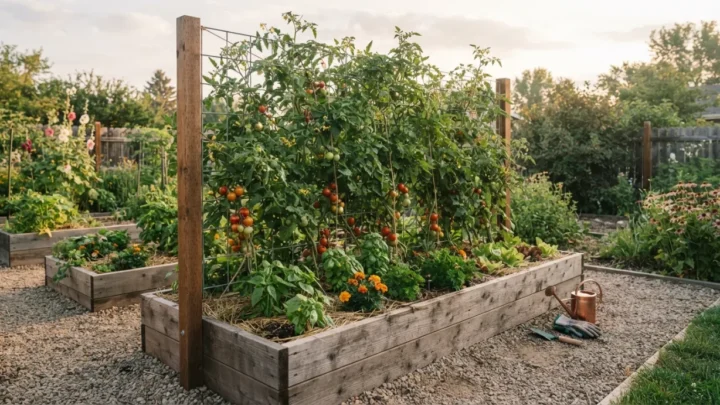
In the Northern Hemisphere, running rows or taller vertical structures (like cattle panel arches, teepees, or trellises) along the northern edge of your garden prevents tall crops from casting shade over shorter plants to the south. In the Southern Hemisphere, reverse this by placing tall crops on the southern edge. Always check for shadows cast by nearby trees, fences, and buildings as the sun shifts from spring to autumn.
Which materials are safest for building raised vegetable garden beds?
Naturally rot-resistant, untreated woods such as cedar, redwood, cypress, and black locust are top choices for edible gardens. Food-safe coated galvanized steel, natural stone, concrete blocks, and untreated brick are also durable options. Avoid railway ties (creosote-treated) and older chemically treated lumber near food crops; if using modern pressure-treated wood, check current local extension recommendations and product labels carefully.
How can I make a vegetable garden look attractive during winter or off-seasons?
Focus on strong permanent “bones”—the hardscape elements that stay visible when annual crops fade. Crisp raised bed frames, gravel or brick pathways, wooden obelisks, arched trellises, and evergreen culinary herbs (like rosemary, thyme, or sage in mild climates) keep a kitchen garden looking structured and intentional all year. Sowing winter cover crops like crimson clover or winter rye also keeps resting beds lush green while building soil health.
Should I grow vegetables in-ground or in raised beds?
Both approaches work beautifully depending on your site and budget. In-ground layouts like Three Sisters mounds, edible cottage borders, and narrow strip beds cost very little to start if you already have fertile, well-draining soil. Raised beds cost more upfront for lumber and soil mix, yet they provide superior drainage, easier ergonomic access, cleaner pathways, and complete control over soil quality.
Conclusion
The most rewarding vegetable garden design is the one that fits naturally into your daily routine—close enough to the kitchen that you actually step outside to snip fresh basil, admire ripening tomatoes, and notice tiny changes before pests settle in.
Whether you start small with a rolling patio cart or map out a full four-square potager bordered by pollinator blooms, remember that great gardens evolve one season at a time. Start with solid bones, verify your local climate zone and planting calendar through regional agricultural extension resources, and let your layout grow alongside your confidence and taste buds.

Similar Posts