Indoor Plant Humidity Checker
Botanical Horticulturist & Food Preservation Specialist at Brittle Bloom · Certified Master Gardener & Master Food Preserver · 12+ Years in Plant Propagation & Food Preservation
Brown, crispy leaf tips are one of the most frustrating sights for any houseplant owner. You water on schedule, check the soil moisture, and place your plants in bright, indirect light—yet your ferns still look frayed and your calatheas curl inward like dry parchment. More often than not, the culprit isn’t your watering routine. It is the invisible air surrounding your plants.
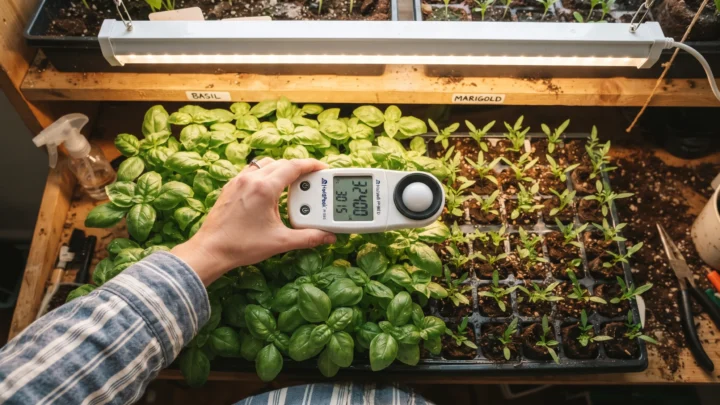
Unlike light or soil moisture, you cannot reliably gauge air moisture with your eyes or fingers. Using an indoor plant humidity checker—most commonly known as a hygrometer—takes the guesswork out of indoor plant care. By giving you an exact percentage of relative humidity, a simple humidity meter tells you whether your living room feels like a lush rainforest or a parched desert to your tropical foliage.
Understanding how to measure air moisture, where to place your sensor, and what those numbers actually mean for different plant species can transform struggling houseplants into lush, resilient focal points.
What Is an Indoor Plant Humidity Checker?
An indoor plant humidity checker is a compact device designed to measure relative humidity (RH)—the percentage of water vapor currently in the air compared to the maximum amount the air can hold at that specific temperature. Because warm air holds significantly more moisture than cool air, nearly all modern plant humidity checkers also include a built-in thermometer to display temperature alongside relative humidity.
For indoor gardeners, a humidity checker acts as an early warning system. Rather than waiting weeks for a tropical plant to drop leaves or develop brown edges, a quick glance at your meter alerts you the moment your home’s heating or air conditioning system drops the ambient moisture below healthy thresholds.
Relative Humidity vs. Vapor Pressure Deficit (VPD)
While relative humidity is the standard measurement displayed on almost every home indoor plant humidity checker, experienced growers also pay attention to how temperature interacts with that number. According to agricultural extension resources, plants lose water through tiny pores in their leaves called stomata in a process called transpiration.
When the air is warm and dry, the moisture gradient between the damp interior of the leaf and the dry surrounding air becomes steep. This pulls water out of the plant faster than its roots can absorb it from the pot. Monitoring both temperature and relative humidity on your checker helps you maintain a gentle balance so your plants can breathe and photosynthesize without dehydrating.
Why Indoor Air Moisture Matters for Houseplants
Most popular houseplants—including monsteras, philodendrons, peace lilies, marantas, and maidenhair ferns—are native to tropical and subtropical understories. In their natural habitats, relative humidity regularly hovers between 60% and 80%.
Inside an average home, however, indoor relative humidity typically sits between 30% and 50%. During winter months in colder climates, forced-air furnaces and radiators can push indoor humidity down to 15% or 20%—drier than the Sahara Desert. Conversely, running air conditioners heavily during hot, humid summers also strips moisture from indoor air.
Because local climate zones, home insulation, and seasonal weather patterns vary dramatically from region to region, indoor humidity levels are never static. A sunroom in coastal Florida experiences completely different baseline air moisture than an apartment in Denver or Chicago during January. Checking your specific indoor microclimates regularly ensures you respond to real conditions rather than seasonal assumptions.
Common Signs of Low Humidity in Plants
Before you even set up an indoor plant humidity checker, your plants may already be signaling dry air stress. Watch for these telltale symptoms:
- Brown, crispy leaf tips and edges: Often mistaken for underwatering or fertilizer burn, dry tips occur when leaf extremities lose moisture faster than roots can replenish it.
- Curling or rolling leaves: Prayer plants, calatheas, and stromanthes frequently curl their leaves inward to reduce surface area and slow down moisture loss.
- Stuck or torn new leaves: High-humidity lovers like Philodendron and Monstera species need moisture in the air to lubricate emerging leaves. Dry air causes new foliage to get stuck in its sheath, resulting in ripped or deformed leaves.
- Drooping despite moist soil: If the potting mix is damp and roots are healthy, yet the foliage looks limp, dry air may be causing excessive transpiration.
- Increased spider mite activity: Two-spotted spider mites thrive in warm, dry indoor environments. A sudden webbing outbreak on the undersides of leaves is frequently linked to low humidity.
Types of Indoor Plant Humidity Checkers Compared
When shopping for or setting up an indoor plant humidity checker, you will encounter several distinct options. Each comes with trade-offs in accuracy, convenience, and price.
| Checker Type | How It Works | Accuracy | Best For |
| Digital Hygrometer | Uses electronic capacitive or resistive sensors to measure air moisture and temperature. | High ($\pm 2\%$ to $\pm 3\%$) | Everyday houseplant shelves, plant cabinets, and quick visual checks. |
| Smart Wi-Fi / Bluetooth Sensor | Syncs digital sensor data to a smartphone app, tracking historical graphs and sending alerts. | High ($\pm 2\%$ to $\pm 3\%$) | Rare plant collections, greenhouse cabinets, and remote monitoring. |
| Analog Dial Hygrometer | Uses a mechanical coiled metal or synthetic fiber strip that expands and contracts with moisture. | Low to Moderate ($\pm 5\%$ to $\pm 10\%$) | Decorative setups where battery-free operation is preferred (requires frequent calibration). |
| Soil-and-Air Combo Meter | Multi-probe devices that attempt to read soil moisture, light, pH, and air humidity in one unit. | Variable | Quick rough estimates, though dedicated air sensors are generally far more reliable. |
1. Standalone Digital Hygrometers
For most indoor gardeners, a small, battery-powered digital hygrometer is the gold standard. They are inexpensive, react quickly to environmental changes, and display clear numbers you can read from across the room. Look for models that record 24-hour high and low readings—this feature reveals overnight humidity drops caused by heating cycles while you are asleep.
2. Smart App-Connected Sensors
If you keep humidity-sensitive species inside an enclosed glass cabinet (such as an IKEA greenhouse conversion) or maintain a dedicated plant room, a Bluetooth or Wi-Fi indoor plant humidity checker is worth the modest upgrade. These devices log hourly charts so you can see exactly how long your humidifier runs and whether your ventilation fans are pulling too much moisture out of the enclosure.
3. Analog Dial Hygrometers
Analog hygrometers look classic and never need batteries, but their mechanical springs drift out of calibration over time. If you use an analog dial, check its accuracy periodically using a simple salt calibration test (detailed below) so you aren’t misled by a stuck needle.
Can You Check Plant Humidity Without a Device?
If you don’t have a meter on hand yet, you can perform a rough ice cube test to gauge whether your air is excessively dry:
- Place three or four ice cubes into a glass of water and stir briefly.
- Set the glass on a table in the room where your plants live (away from direct sunlight or heating vents).
- Wait three to four minutes and inspect the outside of the glass.
If condensation droplets form on the outside of the glass, your room has a reasonable baseline of moisture. If the glass remains completely dry after four minutes, the air in that room is very dry, and tropical houseplants will likely benefit from supplemental humidity. While fun as a quick check, this method cannot give you exact percentages, making a dedicated digital meter much more practical for ongoing care.
Ideal Humidity Chart for Common Indoor Plants
Once your indoor plant humidity checker gives you a reading, you need context to know whether that number is ideal or problematic. Different plant families have adapted to vastly different native climates, meaning a single room cannot effortlessly satisfy every plant at once without strategic grouping.
| Plant Category | Ideal Relative Humidity | Common Examples | Care Notes |
| High-Humidity Tropicals & Ferns | 60% – 80%+ | Maidenhair fern, Boston fern, Calathea, Maranta, Fittonia (Nerve plant), Anthurium, Jewel orchids | Struggle below 50% RH; thrive near humidifiers, in bright bathrooms, or inside glass terrariums/cabinets. |
| Standard Foliage Houseplants | 45% – 60% | Monstera deliciosa, Philodendron, Pothos, Peace lily, Fiddle leaf fig, Rubber plant, Dracaena | Adapt well to average home humidity (40%–50%) but grow faster and produce larger leaves closer to 55%–60%. |
| Succulents & Arid Plants | 20% – 40% | Echeveria, Jade plant, Aloe vera, Snake plant (Dracaena trifasciata), ZZ plant, Cacti | Prefer drier air; prolonged humidity above 60% combined with cool temperatures increases fungal and rot risks. |
Why Grouping Plants Works So Well
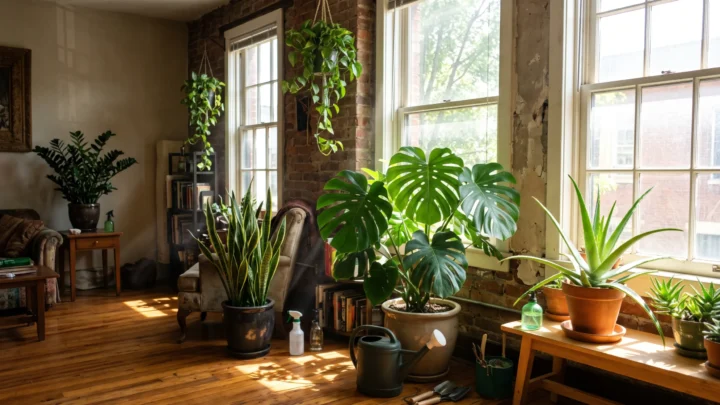
Notice how your houseplants naturally fall into tiers. By checking different spots in your home with your humidity meter, you can match plants to existing microclimates. A steamy, sunlit bathroom might naturally sit at 65% RH—perfect for ferns and calatheas—while a sunny, dry south-facing living room window at 35% RH is an ideal haven for succulents and snake plants.
How to Place and Calibrate Your Humidity Checker for Accurate Readings
Even the best indoor plant humidity checker will give misleading numbers if placed in the wrong spot. Air moisture is not uniform across a room; it varies depending on airflow, heat sources, and proximity to damp potting soil.
Best Placement Practices
- Place at canopy height: Set your checker right among your plants at leaf level rather than high up on a wall or down on the floor. Warm, moist air rises, while cool air sinks, creating noticeable differences within just a few feet.
- Keep it out of direct sunbeams: Direct sunlight hitting the plastic housing of a digital sensor heats the internal electronics, artificially inflating the temperature reading and causing the relative humidity calculation to drop inaccurately.
- Avoid direct mist or humidifier plumes: Never place your sensor directly in the path of a humidifier’s mist nozzle. Direct water droplets saturating the sensor membrane will cause it to read 99% RH and can permanently damage sensitive electronic components. Keep the meter at least 2 to 3 feet away from a humidifier outlet.
- Stay clear of HVAC vents and drafty windows: Registers blowing hot or cold air create localized spikes and drops that do not reflect the steady environment your plants actually experience.
How to Calibrate Your Hygrometer at Home
If you suspect your indoor plant humidity checker is reading high or low—or if you want to verify a brand-new unit—you can test its accuracy using standard table salt and water. In a sealed environment at room temperature, a saturated sodium chloride (table salt) slurry naturally stabilizes at 75% relative humidity.
- Pour about 1 tablespoon of regular table salt into a small bottle cap or shallow dish.
- Add just enough water (a few drops) to make the salt look like wet sand without dissolving it into a liquid pool.
- Place the salt cap and your humidity checker inside a sealed zip-top plastic bag or an airtight glass jar, trapping a small pocket of air inside.
- Leave the sealed container undisturbed at stable room temperature (away from sunlight) for 6 to 8 hours.
- Read the display through the clear bag or jar without opening it.
If your checker reads 75% (or within $\pm 2\%$), it is properly calibrated. If it reads, say, 71%, you know your device runs 4% low—simply add 4% to future readings, or adjust the calibration dial/app offset if your model supports manual calibration.
Practical Ways to Raise or Lower Indoor Plant Humidity Safely
Your indoor plant humidity checker is only as useful as the adjustments you make based on its readings. Depending on your season and home setup, you may need to either boost moisture or improve airflow.
When Your Checker Reads Too Low (Below 40% RH)
- Run a cool-mist or evaporative humidifier: This is by far the most effective and consistent way to raise ambient humidity for a collection of plants. Place it near your tropical plant grouping and monitor your humidity checker until the zone stabilizes around 50% to 60% RH. Clean the tank regularly according to manufacturer instructions to prevent mineral dust and microbial growth.
- Cluster plants together: As plants transpire water vapor through their leaves, grouping several pots together creates a localized microclimate where they share moisture, naturally bumping humidity up by 5% to 10% right around the foliage.
- Use pebble trays carefully: Setting pots on a shallow tray filled with pebbles and water (making sure the bottom of the pot sits above the waterline so soil doesn’t wick up excess water) provides a modest, localized humidity boost as water evaporates.
- Skip routine leaf misting: Despite being popular advice, spraying leaves with a handheld mist bottle raises air humidity for only 10 to 15 minutes before evaporating. Worse, sitting water droplets on leaves in stagnant indoor air can encourage fungal leaf spots and bacterial infections. Rely on humidifiers and grouping instead.
When Your Checker Reads Too High (Above 70% RH in Living Spaces)
While tropical plants enjoy high moisture, prolonged indoor humidity above 65% to 70% in standard living rooms can encourage mold growth on drywall, window frames, and potting soil surfaces.
- Increase gentle air circulation: Run a small oscillating fan on a low setting near your plant shelf. Moving air prevents stagnant moisture pockets on leaves, strengthens plant stems, and deters fungal spores like powdery mildew and botrytis.
- Space pots slightly apart: Give dense foliage breathing room so air can move freely between leaves.
- Run a dehumidifier or crack a window: If your home naturally experiences high seasonal humidity, use a dehumidifier set to 55% RH—a comfortable middle ground that protects your home’s interior while keeping almost all houseplants happy.
Frequently Asked Questions
1. What is the ideal humidity level for most indoor plants?
Most common houseplants thrive between 45% and 60% relative humidity. Tropical specialty plants like ferns, calatheas, and prayer plants prefer 60% to 70%, while succulents and cacti do best in drier air around 20% to 40%.
2. Where should I put my indoor plant humidity checker?
Place your checker at plant canopy height right next to the plants you want to monitor. Keep it out of direct sunlight, away from heating or air conditioning vents, and at least 2 to 3 feet away from direct humidifier mist so the sensor reads true ambient air moisture.
3. Can a soil moisture meter check air humidity too?
Standard two-prong or single-prong soil moisture meters only measure electrical conductivity or moisture inside the potting mix—they do not measure air humidity. While a few digital multi-meters include a separate ambient air sensor on the housing, a dedicated digital hygrometer is much more accurate and easier to read at a glance.
4. Why does my humidity checker reading drop every night?
When outdoor temperatures drop at night, your home’s heating system kicks on more frequently. Warmed furnace air has a much lower relative humidity, causing indoor air moisture to plunge overnight. Checking a hygrometer with a 24-hour min/max memory helps you spot these overnight dips so you can run a humidifier on a timer.
5. Is 80% humidity too high for indoor plants?
Inside an enclosed terrarium or ventilated glass plant cabinet, 75% to 85% humidity is great for moisture-loving tropicals, provided there is gentle airflow from a small internal fan. In an open bedroom or living room, however, keeping humidity at 80% is too high for household comfort and can cause condensation and mold on walls and furniture.
Conclusion
Taking care of houseplants becomes much less stressful once you stop guessing about their environment. An indoor plant humidity checker is one of the simplest, most affordable tools you can add to your plant care kit, turning an invisible variable into clear, actionable numbers.
Start by placing a calibrated digital hygrometer among your plants for a full 24-hour cycle to see how your home’s air fluctuates throughout the day and night. Once you know your baseline, you can group moisture-loving tropicals together, position arid succulents in drier sunny spots, and run a humidifier only when your plants truly need the boost. With steady air moisture and the right microclimates, your foliage will reward you with vibrant color, clean leaf edges, and healthy new growth year-round.

Similar Posts