Grow Light Hanging Height Calculator
Botanical Horticulturist & Food Preservation Specialist at Brittle Bloom · Certified Master Gardener & Master Food Preserver · 12+ Years in Plant Propagation & Food Preservation
Grow Light Height Calculator
Find the ideal distance between your grow light and plant canopy.
Setup Calculated!
Your recommended grow light height is ready.
Quick Answer: How High Should a Grow Light Be?
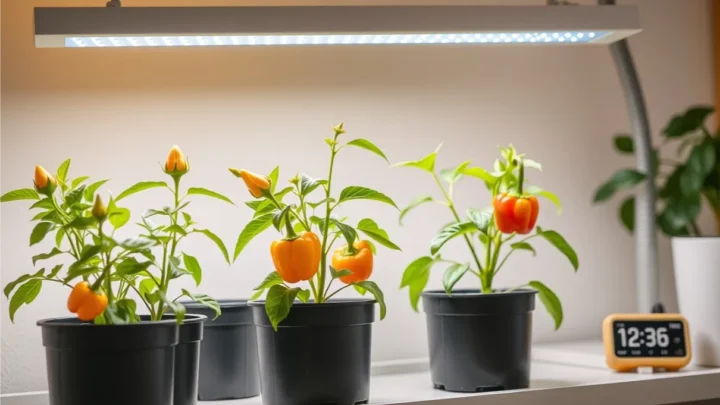
The ideal grow light hanging height depends on the fixture’s light output, plant type, and growth stage. As a general starting point, seedlings may need approximately 4–6 inches, hydroponic lettuce and herbs 6–12 inches, and foliage houseplants 12–24 inches. Always follow the manufacturer’s recommendations because LED grow lights vary significantly in intensity.
Growing plants indoors gives you more control over their environment, but getting the lighting right can be confusing. One of the most common questions new indoor gardeners ask is: How high should I hang my grow light above my plants?
Hang a light too close, and some plants may experience excessive light exposure or heat stress. Position it too far away, and seedlings may stretch toward the light or develop weak growth.
That’s where a grow light hanging height calculator can help. It gives you a starting point for estimating the distance between your grow light and the top of your plants, helping you create a more suitable lighting setup.
However, there isn’t one perfect hanging height for every grow light. The correct distance depends on the fixture’s design, light output, coverage area, plant type, and growth stage.
In this guide, you’ll learn how to estimate grow light hanging height, understand the factors that affect light distance, and adjust your setup as your indoor garden grows.
What Is a Grow Light Hanging Height Calculator?
A grow light hanging height calculator is a practical tool that helps indoor gardeners estimate how far a grow light should be positioned above the plant canopy.
The plant canopy refers to the uppermost layer of leaves. It is the area that receives most of the light from an overhead fixture.
Instead of guessing how high to hang your LED grow light, a calculator can use information about your lighting equipment and growing conditions to provide a starting recommendation.
Depending on the calculator, useful inputs may include:
- Grow light type: LED, fluorescent, or another lighting technology.
- Light wattage: The electrical power consumed by the fixture.
- Plant category: Seedlings, leafy greens, herbs, or flowering plants.
- Growth stage: Newly established seedlings, vegetative growth, or flowering.
- Light output: PPFD measurements or manufacturer-provided lighting data.
- Growing area: The width and length of the space you want to illuminate.
The result is an estimated hanging distance, usually measured in inches or centimeters.
Keep in mind that a calculator cannot accurately determine the ideal distance from wattage alone. Two LED fixtures with identical wattage can produce very different light intensities and coverage patterns.
For the most useful recommendation, combine calculator estimates with your manufacturer’s hanging-height guidance and, when possible, measured PPFD.
Why Does Grow Light Hanging Height Matter?
Light is one of the essential resources plants need for photosynthesis. When indoor plants don’t receive suitable lighting, their growth and appearance can suffer.
The distance between a grow light and the plant canopy affects how much light reaches the leaves.
1. Preventing Excessive Light Exposure
Placing a powerful grow light too close to plants can expose their leaves to excessive light intensity.
Depending on the fixture and growing conditions, symptoms may include:
- Bleached or unusually pale leaves
- Dry or scorched-looking leaf areas
- Leaf curling or other stress symptoms
- Uneven growth across the canopy
These symptoms aren’t always caused by lighting. Watering problems, nutrient imbalances, and temperature issues can produce similar signs.
If you notice unusual leaf changes, check the lighting distance along with other growing conditions.
2. Reducing Leggy Plant Growth
Have you noticed seedlings growing tall, thin, and weak?
Insufficient light can contribute to this problem. Seedlings may stretch toward a light source when the available light isn’t strong enough.
Moving the fixture closer, increasing its output, or adjusting the lighting setup may help provide more suitable light.
The goal is to encourage compact, sturdy growth without exposing young plants to excessive light.
3. Improving Light Coverage
Grow light height also affects how evenly light spreads across your growing area.
A fixture positioned higher generally illuminates a wider area, but the light intensity at individual points may decrease.
A fixture positioned lower may provide stronger light directly underneath it while leaving plants near the edges with less illumination.
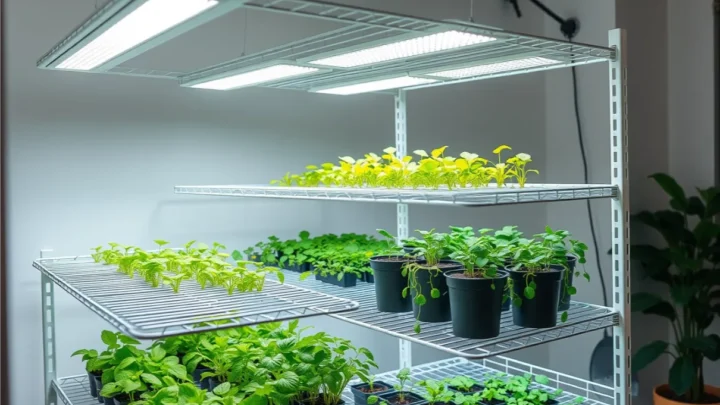
This is particularly important when growing multiple plants on shelves, tables, or in indoor grow tents.
Recommended Grow Light Hanging Heights by Plant Type
There is no universal hanging distance that works for every LED grow light. However, general reference ranges can help beginners understand where to start.
The following distances are practical starting points, not guaranteed recommendations for every fixture.
| Plant category | General starting distance |
|---|---|
| Seedlings | 4–6 inches |
| Hydroponic lettuce and herbs | 6–12 inches |
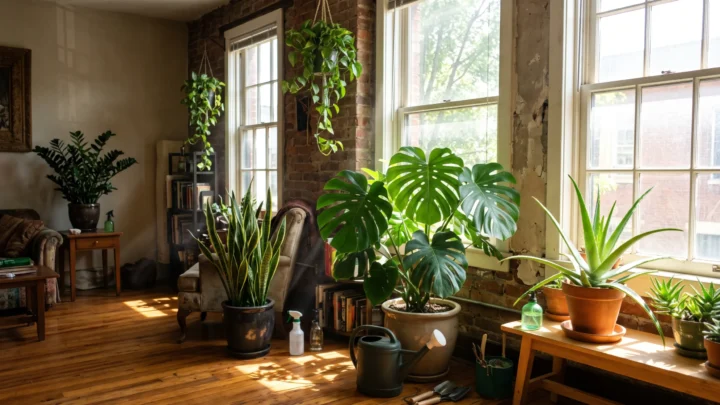
| Foliage houseplants | 12–24 inches |
| Flowering houseplants | 6–12 inches |
These reference ranges are based on guidance from the University of Minnesota Extension. Always compare them with your fixture manufacturer’s recommendations because some high-output lights require considerably more clearance.
Grow Light Height for Seedlings
Young seedlings need sufficient light to develop strong stems and healthy leaves.
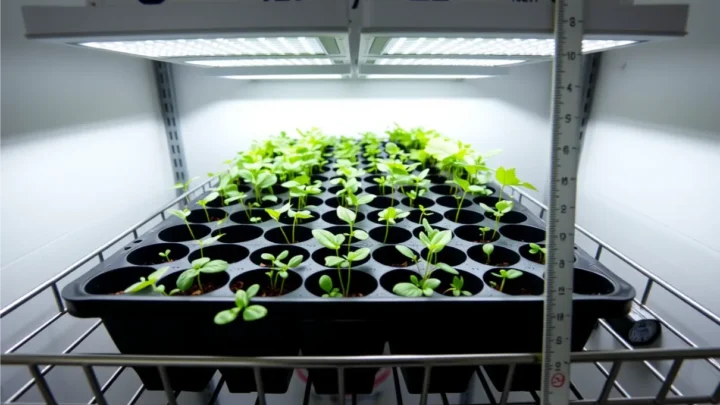
For many small seed-starting setups, a distance of approximately 4–6 inches can be a useful starting point when using suitable fixtures.
However, not every LED grow light produces the same intensity.
If you’re using a powerful grow light, follow the manufacturer’s recommendations rather than automatically positioning it four inches above your seedlings.
Check your plants regularly. If seedlings become unusually tall and stretched, investigate whether they are receiving enough light. If leaves become bleached or stressed, reassess the light intensity and distance.
As seedlings grow taller, adjust the fixture to maintain an appropriate distance from the canopy.
Grow Light Height for Leafy Greens
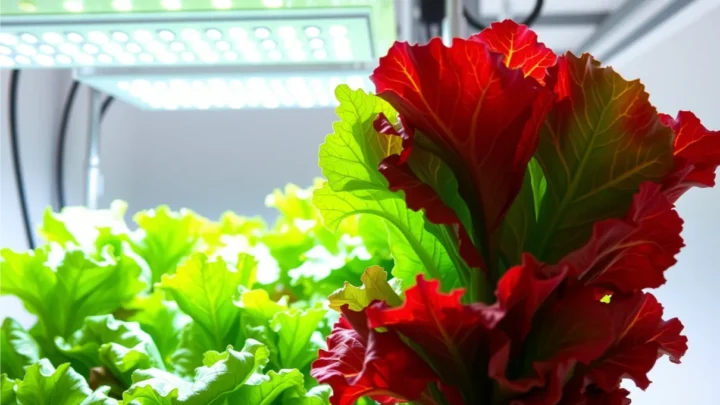
Lettuce, spinach, and other leafy greens are popular choices for indoor gardening.
These plants generally need consistent light to support healthy leaf development.
For hydroponic lettuce and herbs, the University of Minnesota Extension provides a general reference distance of 6–12 inches.
The ideal position still depends on the fixture’s output and coverage.
If you’re growing several containers together, check the light distribution across the entire growing area rather than focusing only on the plant directly beneath the fixture.
Grow Light Height for Herbs
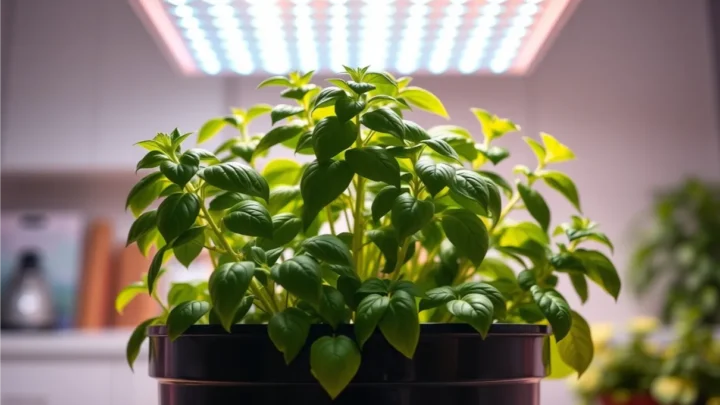
Indoor herbs such as basil, parsley, mint, and cilantro can grow well under suitable artificial lighting.
Different herbs have different light preferences, so avoid treating them as one identical category.
For example, basil generally benefits from bright growing conditions, while some other herbs can tolerate somewhat lower light.
Start with the grow light manufacturer’s recommendations and adjust the height according to plant response.
If your basil develops long, weak stems, check whether the light intensity is sufficient.
Grow Light Height for Flowering Plants
Flowering plants may need different light conditions from young seedlings or foliage houseplants.
Their lighting requirements depend on the species, growth stage, and whether the plant produces flowers under particular day-length conditions.
A light that works well for a foliage plant may not provide sufficient intensity for a flowering plant.
Use species-specific growing guidance and the manufacturer’s PPFD information when available.
How to Calculate Grow Light Hanging Height
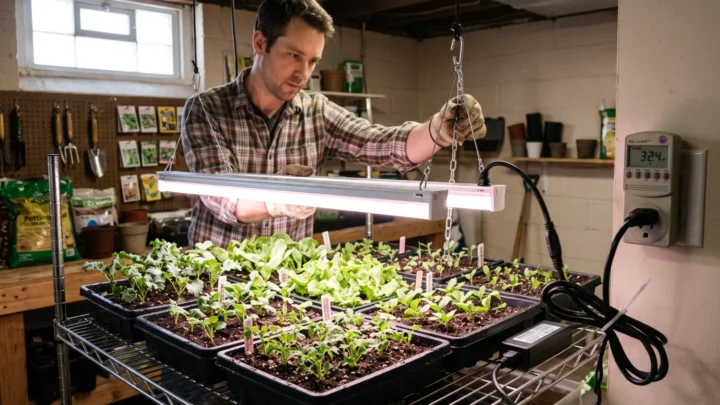
The easiest way to estimate grow light distance is to start with the fixture’s recommended hanging height and adjust according to the actual light intensity at the canopy.
Here are the main factors to consider.
Step 1: Identify Your Grow Light Type
Different grow lights have different designs and lighting characteristics.
Common options include:
LED grow lights: These are popular for indoor gardening because they are energy-efficient and available in different sizes and output levels.
Fluorescent grow lights: These are often used for seed starting and small indoor growing spaces.
High-intensity discharge lights: These include technologies such as high-pressure sodium and metal halide. They can produce substantial heat and require careful placement.
Never assume that the same hanging distance works for all three types.
Step 2: Check the Manufacturer’s Recommended Distance
Before calculating anything, check the product manual or manufacturer’s website.
Look for:
- Recommended hanging height
- Seedling-stage distance
- Vegetative-stage distance
- Flowering-stage distance
- PPFD maps
- Coverage area
Some manufacturers provide separate hanging-height recommendations for different growth stages.
These instructions are usually more useful than generic wattage-based recommendations.
Step 3: Understand Wattage and Light Intensity
One common mistake among beginners is assuming that higher wattage automatically means a stronger grow light.
Watts measure electrical power consumption, not the amount of usable plant light reaching the leaves.
For example, two 100-watt LED fixtures may have different light outputs because their efficiency, design, and optical characteristics differ.
Instead of relying only on wattage, look for PPF and PPFD specifications.
PPF (Photosynthetic Photon Flux):
PPF measures the amount of photosynthetically active light produced by a fixture each second. It is expressed in micromoles per second (µmol/s).
PPFD (Photosynthetic Photon Flux Density):
PPFD measures how much photosynthetically active light reaches a particular surface each second.
It is expressed in:
µmol/m²/s
PPFD is particularly useful when determining how much light reaches your plant canopy.
The University of Minnesota Extension explains that PPFD decreases as plants move farther away from a light source.
Step 4: Measure the Distance From the Plant Canopy
Always measure from the bottom of the grow light fixture to the highest part of the plant canopy.
Don’t measure from the floor, growing shelf, or top of the container.
For example:
- Bottom of the fixture: 60 inches above the floor.
- Plant canopy: 42 inches above the floor.
- Hanging distance: 18 inches.
This gives you the actual distance between the light and the plants.
As your plants grow, this measurement changes, so check it regularly.
Step 5: Adjust the Light According to Plant Response
Once your grow light is positioned, observe the plants.
Look for:
- Compact and balanced growth
- Healthy-looking leaves
- Strong stems
- Consistent growth across the growing area
- Signs of bleaching, stretching, or stress
Make small adjustments rather than changing the lighting setup dramatically without checking the results.
Understanding the Inverse Square Law and Grow Light Distance
You may come across the inverse square law when researching grow light distance.
This principle describes how light intensity from an ideal point source decreases as the distance increases.
In simplified terms:
Light intensity is proportional to 1 ÷ distance².
For example, if the distance from an ideal point light source doubles, the intensity can decrease to approximately one-quarter.
However, real grow lights are not always point sources.
Large LED panels and bar-style fixtures distribute light differently. Their reflectors, lenses, beam angles, and illuminated areas also influence the light received by plants.
Therefore, don’t use the inverse square law as a universal formula for calculating the exact hanging height of every LED fixture.
A manufacturer’s PPFD map or an actual measurement at canopy level is generally more useful.
What Is the Difference Between PAR, PPF, PPFD, and DLI?
If you’re researching grow light placement, you’ll probably encounter several technical lighting terms.
Understanding them makes it easier to use a grow light hanging height calculator correctly.
PAR
Photosynthetically Active Radiation (PAR) describes the range of light wavelengths, generally 400–700 nanometers, used in photosynthesis.
PAR describes the light spectrum, not the intensity of light reaching your plants.
PPF
PPF measures the total amount of photosynthetically active photons produced by a grow light each second.
A higher PPF generally means a fixture produces more plant-usable photons, but it doesn’t tell you exactly how much light reaches each plant.
PPFD
PPFD measures the number of photosynthetically active photons reaching one square meter every second.
This is one of the most useful measurements for evaluating light intensity at the plant canopy.
DLI
Daily Light Integral (DLI) measures the total amount of photosynthetically active light received by a surface over an entire day.
It is expressed in mol/m²/day.
DLI depends on both PPFD and the number of hours the light operates.
For example, the relationship can be calculated using:
DLI = PPFD × Lighting Hours × 0.0036
If your plants receive an average PPFD of 150 µmol/m²/s for 12 hours:
DLI = 150 × 12 × 0.0036
DLI = 6.48 mol/m²/day
This calculation helps you understand why hanging height and lighting duration should be considered together.
Common Mistakes When Hanging Grow Lights
Even a good lighting fixture won’t deliver the best results if it’s positioned incorrectly.
Avoid these common mistakes.
Using Wattage as the Only Measurement
Wattage alone cannot determine the correct hanging height.
Check the fixture’s PPF, PPFD map, and manufacturer recommendations whenever possible.
Ignoring the Plant Growth Stage
Seedlings, established plants, and flowering plants may have different lighting requirements.
Adjust your setup as the plants develop instead of keeping one distance throughout the entire growing cycle.
Measuring From the Pot Instead of the Canopy
Plants grow at different heights, even when they are planted at the same time.
Always measure from the light to the highest part of the canopy.
Ignoring Edge Plants
The center of a grow space may receive much more light than the corners.
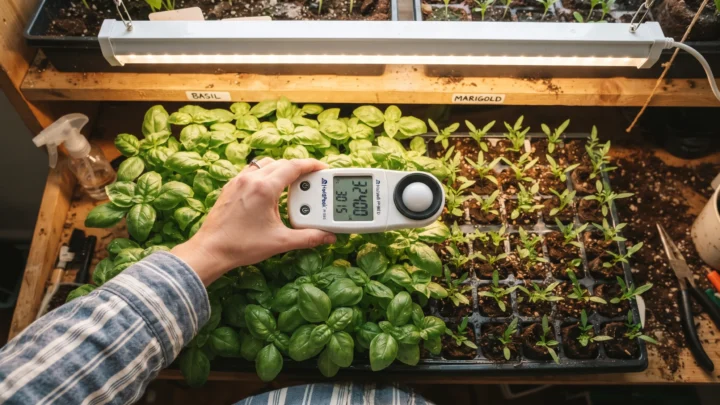
Check plants across the entire growing area and consider using a PPFD meter to identify uneven coverage.
Forgetting About Natural Sunlight
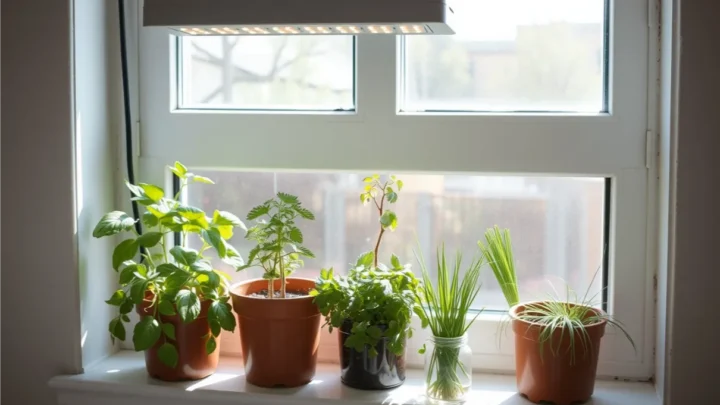
If your indoor plants receive sunlight through windows, artificial lighting adds to their total daily light exposure.
Consider both natural and artificial light when evaluating the lighting schedule.
Practical Tips for Getting the Best Results From Your Grow Lights
A few simple habits can make indoor lighting easier to manage.
Use adjustable hanging equipment. Chains, hooks, and adjustable hangers allow you to raise or lower the fixture as plants grow.
Keep a consistent lighting schedule. Use a timer to provide regular light and darkness. More hours are not always better.
Check the manufacturer’s specifications. Product-specific instructions should take priority over general hanging-height estimates.
Monitor temperature. Even LED fixtures can contribute to heat buildup in enclosed growing spaces.
Measure PPFD when possible. A suitable quantum sensor provides more useful information than guessing based on wattage.
Keep a simple growth record. Write down the hanging distance, lighting schedule, and any noticeable changes in plant growth.
Check local growing conditions. Indoor temperature, humidity, natural sunlight, and seasonal conditions vary by region. Adjust your growing environment accordingly.
Frequently Asked Questions
1. How high should I hang an LED grow light above my plants?
The correct height depends on the fixture’s output, design, coverage area, and plant requirements.
As a general reference, the University of Minnesota Extension suggests 4–6 inches for seedlings, 6–12 inches for hydroponic lettuce and herbs, and 12–24 inches for foliage houseplants.
Always check the manufacturer’s recommendations before using these distances.
2. Can I calculate grow light distance using wattage?
Not accurately.
Wattage measures electrical consumption rather than the amount of light reaching your plants.
For a more useful estimate, look for PPF, PPFD, and manufacturer-provided hanging-height recommendations.
3. Should grow lights be closer to seedlings?
Seedlings generally need sufficient light to develop compact growth.
A closer light can increase light intensity, but the appropriate distance depends on the fixture.
If seedlings become stretched, evaluate light intensity and duration. If leaves show signs of excessive exposure, adjust the distance or output.
4. How often should I adjust grow light height?
Check the distance regularly, especially during active growth.
You may need to raise the fixture as plants become taller to maintain a suitable distance from the canopy.
There is no fixed adjustment schedule that works for every indoor garden.
5. What happens if my grow light is too far away?
Insufficient light can contribute to weak, stretched growth, particularly in seedlings.
However, symptoms depend on the plant species and overall growing environment.
Check light intensity, lighting duration, and other growing conditions before making adjustments.
Conclusion
Finding the right distance between your grow light and your plants doesn’t have to involve endless guessing.
A grow light hanging height calculator can provide a useful starting estimate, especially when you combine it with information about your fixture, plant type, and growth stage.
Remember that wattage alone doesn’t determine the correct distance. PPFD measurements, manufacturer recommendations, light coverage, and plant response all matter.
Start with a suitable hanging height, monitor your plants, and make gradual adjustments as they grow.
With a little observation and a consistent lighting setup, you can create a healthier indoor growing environment for seedlings, herbs, leafy greens, and houseplants.

Similar Posts