Raised Garden Bed Layout: 12 Plans for Every Yard Size
Botanical Horticulturist & Food Preservation Specialist at Brittle Bloom · Certified Master Gardener & Master Food Preserver · 12+ Years in Plant Propagation & Food Preservation
A wheelbarrow stacked with 22 bags of soil mix rolls down a 30-inch aisle between two empty cedar frames, and the handles clip the corner post on the turn. That single jam is why this list exists. The ground looks generous until the barrow has to move through it.
Somewhere a tape measure is being pulled across a bare 20-by-20 first backyard, or snapped down a 5-ft side strip between house and fence, and the person holding it is convinced the hard part will be building the box. The box is the cheap, easy part.
The aisle decides whether the garden works: 18 in. for one person tending, 30 in. for a wheelbarrow, 36 in. where a wagon or wheelchair has to turn. Aisle width is the number that fixes how many beds your ground actually holds.
What follows is twelve dimensioned and costed bed-and-aisle layouts, filed by the yard situation that produces them rather than by ambition.
Pick the one that matches the ground you have, stake the four corners, string the aisles at full width, and walk the barrow route before any lumber is ordered.
Quick Tips Before You Start
Measure the aisle first
Decide who walks the gap — hands, tote, or wheelbarrow — and set the aisle width before you set bed width.
Check the sun path
Full sun is 6+ hours; a fence on the east side costs 2–3 summer hours, so put those beds to greens and roots.
Level the frame, not the yard
A 6-in. drop across an 8-ft run is fixed with a 2×6 cedar riser on the low side, about $18 per bed.
Calculate soil by volume
A 4×8×10 in. bed takes about 27 cu ft — roughly 22 bags of 1.25 cu ft, or $95 of bulk topsoil-compost mix.
Run drip, not cans
A hose bib or a 1/4-in. drip line to the bed costs about $70 for six beds and keeps the layout from being abandoned in July.
1. Two-Bed Starter Grid in a First Backyard
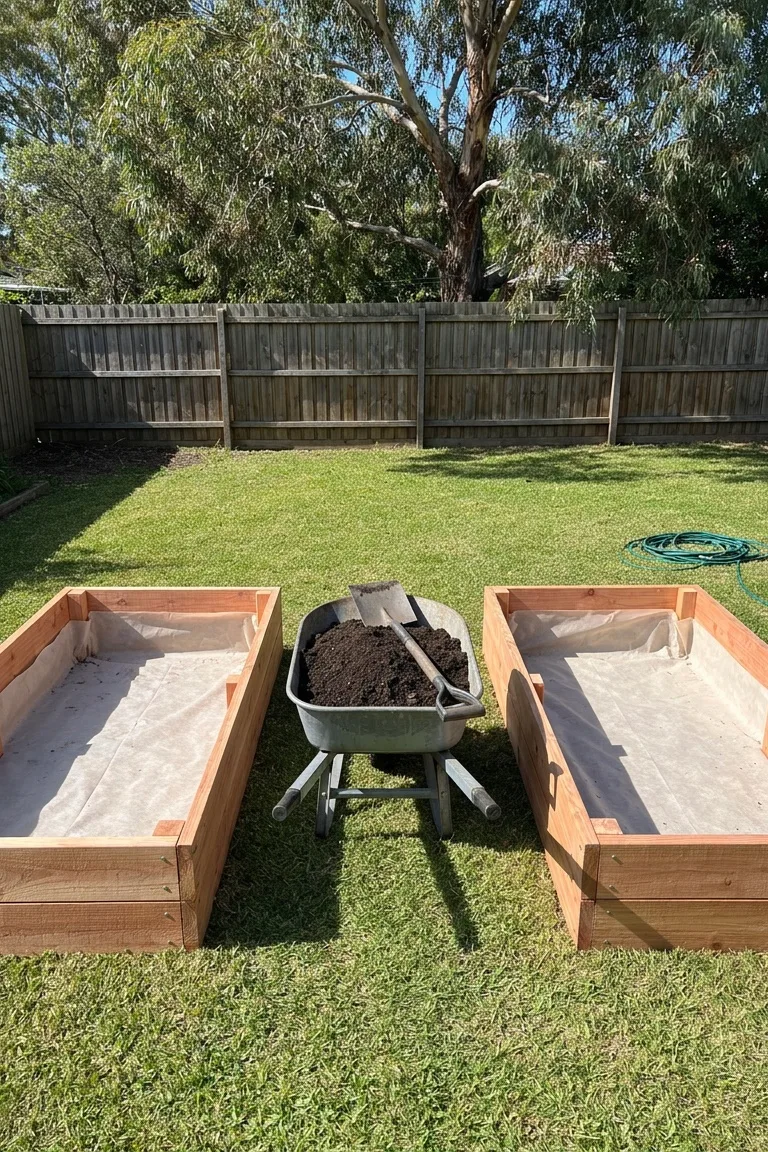
Start with the smallest version that still works. A flat 20×20 lawn holds two 4x8x10 in. cedar beds with a single 30-in. aisle between them, and that pair gives you 64 sq ft of growing space out of 64 sq ft of bed footprint – most of the lawn stays grass, and the mower still has somewhere to go.
Lay the boxes so the aisle runs east-west and the long south face of each bed sits in sun from morning until late afternoon. Face a bed the wrong way and one whole side spends the season in shade, which is the sort of mistake you notice in August when the tomatoes on that edge are still green.
Budget about $400 for both kits, since a cedar 4×8 runs $180 to $240 apiece, then $190 more in soil. Each bed swallows 27 cu ft – 22 bags at 1.25 cu ft, or $95 of bulk topsoil-compost mix per bed if a truck can reach the spot.
Behind the pair, a 12-ft strip of lawn stays open. That strip is the mower pass, and it matters more than it sounds: tuck the beds against the back fence and the last few feet become a strimming job every second weekend.
The gap is the whole plan. Thirty inches is exactly what a loaded wheelbarrow needs, and that one aisle is the only route soil comes in and tomatoes go out. Leave a coiled hose, a bag of fertilizer or a stack of spare lumber in it for a week and you will start carrying things by hand.
Stake the two rectangles and string that 30-in. gap at full width before you order a single board. Walk it with the barrow loaded and you will find out in ten minutes whether the plan fits your yard or only fits the drawing.
💡 Tip: Stake the four corners and run a string at 30 in. between them before you order anything. Walk the string with a loaded wheelbarrow.
| Plan | Yard it fits | Beds | Aisle width | Build cost |
|---|---|---|---|---|
| 1. Two-Bed Starter Grid | Flat first backyard | Two 4×8×10 in. cedar | 30 in. | $400 kits + $190 soil |
| 2. Patio Four-Square | Paved patio, no digging | Four 4×4×10 in. cedar | 18 in. | $260 kits + $200 soil |
| 3. Narrow Side-Yard Single File | 5-ft side strip | 2×8×10 in. cedar | 18 in. | $95 per bed + $47 soil |
| 4. Three-Tier Terrace | Sloped yard | Three 4×8×10 in. cedar | 30 in. | $620 kits + $285 soil |
| 5. Corner L | Yard that keeps its lawn | Two 4×8×10 in. cedar | 30 in. | $400 kits + $190 soil |
| 6. Six-Bed Grid | Big open backyard | Six 4×8×10 in. cedar | 36 in. main + 30 in. cross | $1,150 kits + $570 soil + $70 drip |
| 7. Fence-Line Salad Frame | Half-shade fence line | Three 3×6×10 in. cedar | 18 in. | $330 kits + $175 soil |
| 8. Wide-Aisle Plan | Wheelchair or wagon use | 4×8×10 in. cedar | 36 in. | $430 kits + $190 soil + $45 gravel |
| 9. One-Bed Kitchen-Door Plan | One bed near the door | 4×8×10 in. cedar | 30 in. | $200 kit + $95 soil |
| 10. Renter’s Tabletop Trio | Rented patio or deck | Three 2×4×12 in. cedar on legs | 18 in. | $70 per box + $25 soil |
| 11. Perimeter U | Edges with central lawn | 4×8 and 2×8×10 in. cedar | 36 in. | $760 kits + $330 soil |
| 12. Front-Yard Four-Square | Front yard with rules | Four 4×4×10 in. cedar | 24 in. gravel | $260 kits + $200 soil + $60 gravel |
2. Patio Four-Square That Needs No Digging
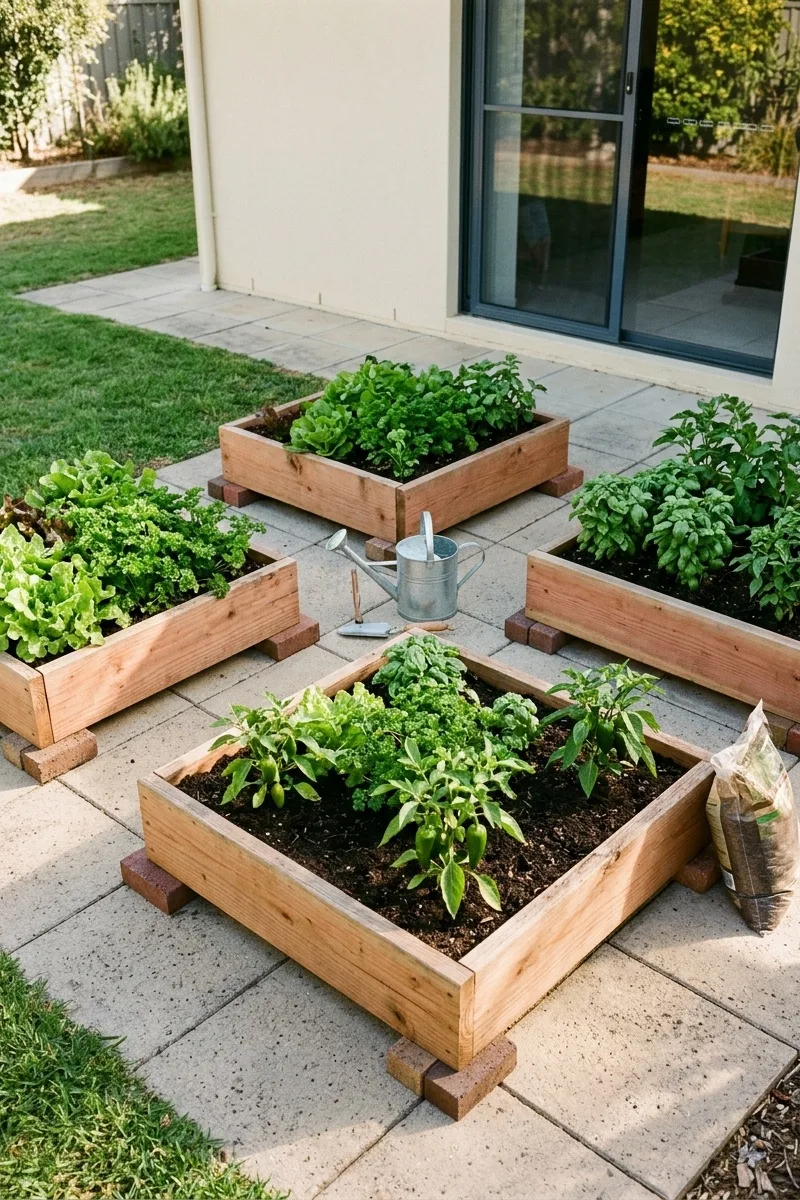
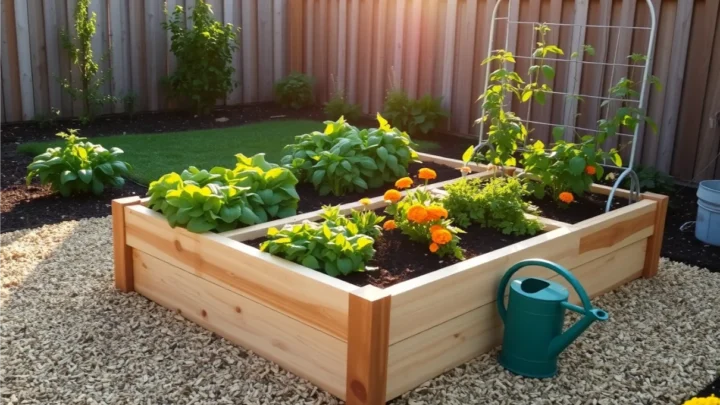
Paving does not disqualify the ground. Four 4x4x10 in. cedar kits arranged in a square on an existing 10×12 patio turn a slab into a kitchen garden, with 18-in. gaps between the boxes and not one square foot of concrete cut or lawn killed.
The footprint math is the same two-box thinking that fits a small lawn, just reshaped: no soil to dig into, so the frames do the work, and the gaps shrink because nothing on wheels ever enters. About $260 buys all four 4×4 cedar kits, and $200 covers the soil to fill them.
Set each frame on feet or pavers. Water then drains out from under the box instead of pooling on the slab, and the concrete underneath stays free of the dark stain that wet cedar and soil leave behind.
Eighteen inches is tending space, nothing more. No wheelbarrow fits, so the soil goes in by the bag and the spent plants come out in a bucket – one 1.25-cu-ft bag at a time, which is slower than a bulk delivery but keeps the patio usable.
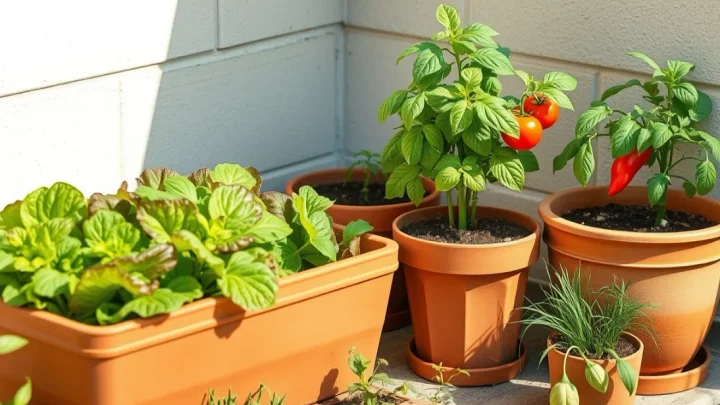
Go with salad, herbs and peppers. A 4-ft reach covers a 4×4 box from a single side, so a box pushed against the house wall gives up nothing – the back row is still an arm’s length from where you stand.
Check the gaps with your own stride before the kits arrive. If your foot plus a watering can will not pass between two boxes, the pattern is too tight no matter how good it looks from the kitchen window.
💡 Tip: Put the boxes on pressure-treated 2×4 feet, not directly on the slab, so air moves under the frame and the concrete stays clean.
⚠️ COMMON MISTAKE
Don't size the aisle for the wrong cart
Most people measure a path for a person and then discover a wheelbarrow needs 30 in., not 18. Before you fix any layout, decide what has to pass through the gap: a tote, a barrow, a wagon, or a chair. The bed size follows from that answer.
3. Narrow Side-Yard Beds in Single File
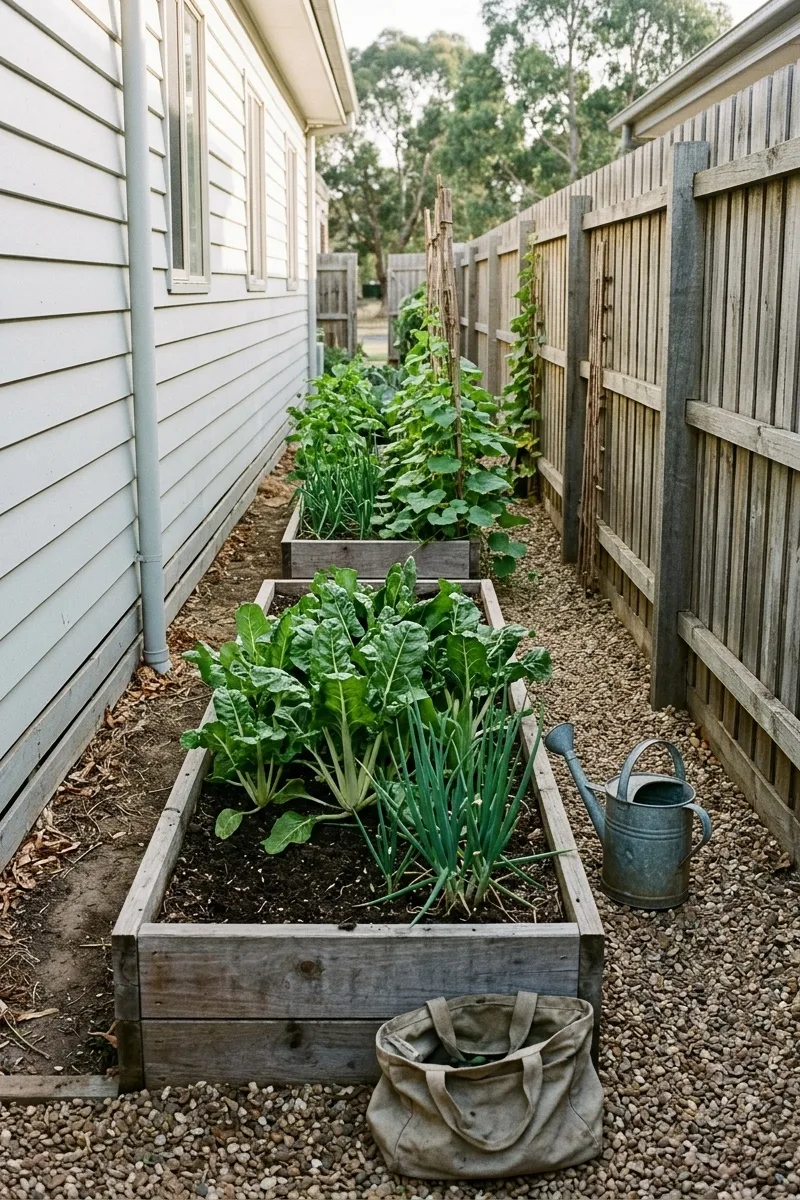
A strip narrower than a bed plus a barrow aisle does not need a grid. It needs one line of boxes. Squeeze more from tight ground these small raised garden bed ideas for making the most of a tiny yard. Take a 5-ft side yard: two 2x8x10 in. beds running lengthwise along the house wall, set 18 in. off that wall for the path, and the arithmetic closes – 2 ft of bed, 3 ft of path, nothing left over.
Cedar at that size runs about $95 a bed. Soil comes to $47 each at the 2×8 footprint, well under half a 4×8 fill, which is the quiet advantage of narrow boxes: cheap to start, cheap to top up.
Eighteen inches is a squeeze and should be treated as one. Watering is a watering can, not a hose dragged down the strip, and harvest comes out in a tote because a cart will not turn. Bulk soil stops at the gate and gets carried in bags.
The 2-ft width pays for itself vertically. Run pole beans and cucumbers up a trellis on the fence side and the crop climbs instead of spreading, so the narrow bed grows as much as its floor space suggests and then some.
Length is the one dimension you can play with. A 2×8 kit cuts down to the run of the strip without touching the 18-in. path, so a 14-ft side yard gets a 12-ft bed and the same squeeze at the end.
Walk the strip with the tape pulled to 18 in. before you commit. If your shoulders brush both the house and the fence, drop to a 2-ft-wide bed and keep the path at full width – the plants will not miss the extra inches.
Slope Fix — At a Glance
📐 Drop
6 in. over 8 ft
🪵 Fix
2×6 cedar riser on low side
💵 Cost
About $18 per bed
📏 Aisle
30 in. between tiers
🌱 Soil
27 cu ft per 4×8 bed
Rule
Terrace the beds, not the yard — a 10-in. box needs no retaining wall and no permit.
4. Three-Tier Terrace for a Sloped Yard
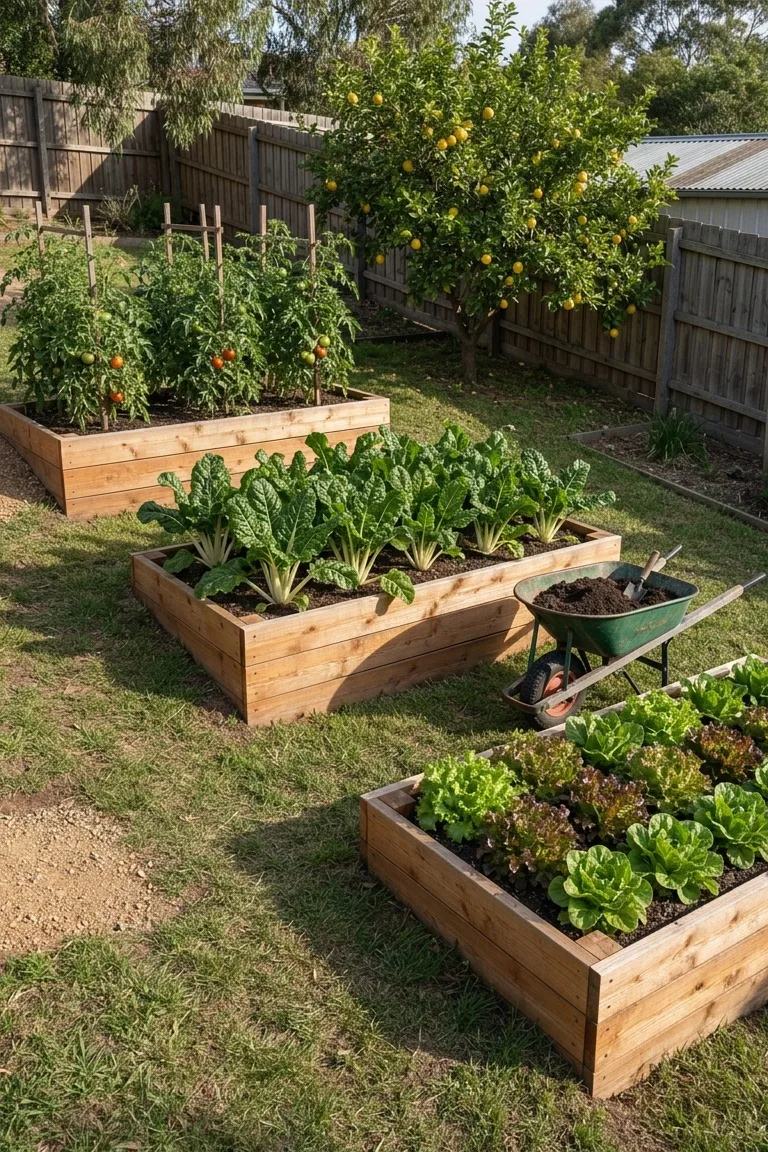
A side strip lies flat along its whole run, which is exactly the luxury a sloping yard does not have. Drop 6 in. across an 8-ft run and nothing about the box-and-aisle math works until each bed is leveled on its own footing.
the beds stay level and the ground under the aisles keeps its grade. Three 4x8x10 in. frames step down the hill in a staircase, and each one sits on ground that has been cut and filled until its four corners read the same number.
Those steps get 30 in. of aisle between tiers. You need that 30 in. for the wheelbarrow of soil that arrives at the top and has to reach the bottom bed, so treat the gap as the delivery lane on a slant.
Lock each frame level with a 2×6 cedar riser under the low edge, and budget about $18 per bed for it. That single board spans the 6-in. drop over an 8-ft run and, just as important, closes the low side so a hard rain cannot walk the soil mix over the lip and down the hill. You will find a mud fan at the bottom of the yard before you notice a problem in the top bed.
Cost for the three terraced beds lands near $620 in cedar kits, because risers are not included, and about $285 of soil mix. Buy it bulk if you can: 81 cu ft of topsoil-compost is a lot of 1.25-cu-ft bags to hump from the curb.
This plan lets the yard keep its slope. A 10-in. box does not need a retaining wall behind it and does not pull a permit, which a regraded, walled yard very often does; you are not moving the hillside, you are planting on it.
One last thing about that 30 in. between tiers: on a grade it doubles as the access ramp for the whole layout. Give each aisle a shallow step or ramp at its uphill end, so a loaded barrow can climb from one tier to the next instead of plowing a trench of loose fill every trip. Walk that descent with a full load before you build a single frame.
💡 Tip: Set the riser on the downhill side first, then level the frame to it — working uphill saves you fighting gravity with a shovel.
Three Layout Mistakes That Waste the Whole Build
5. Corner L That Keeps the Lawn
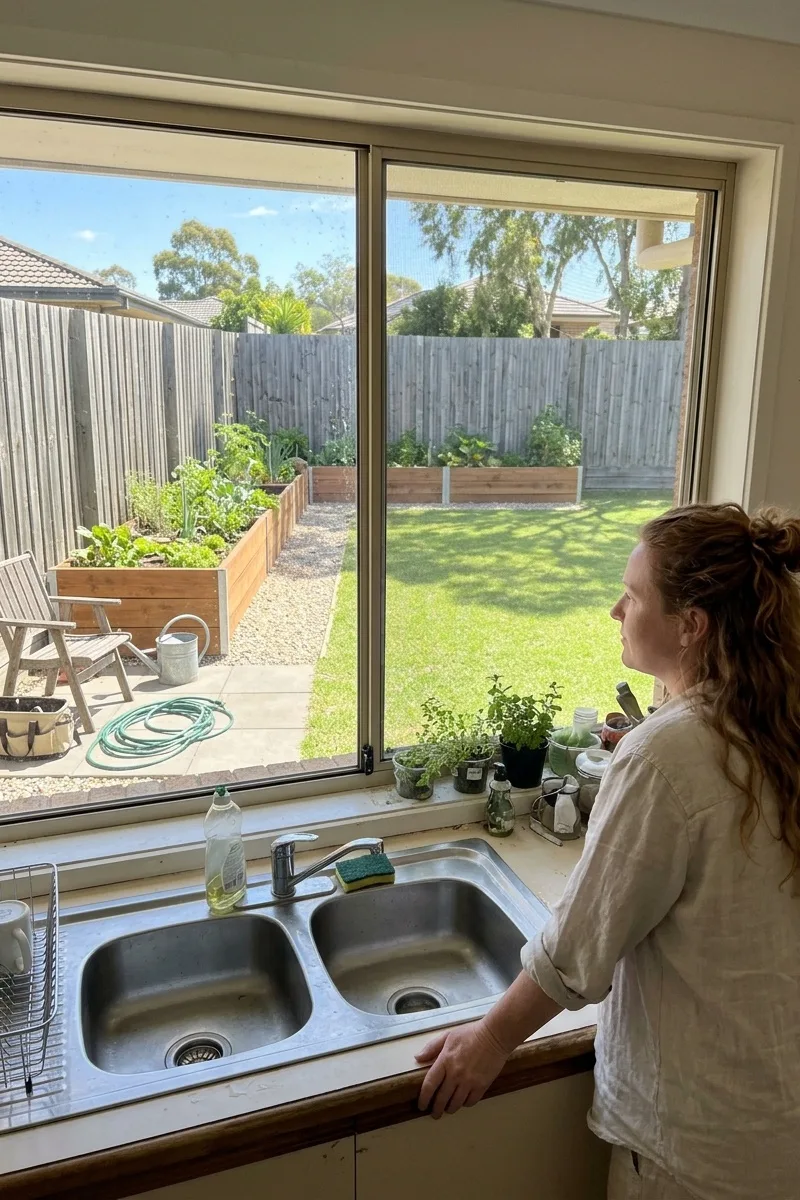
Level ground is the precondition; once the ground is flat, arrangements open up. The same two 4×8×10 in. boxes can be set to shape how the yard reads, not just to maximize what it grows.
Set them at a right angle along two fences, 30-in. aisle on the inside of the L. That corner where the two fences meet is the payoff: a 6×6 pad in the crook, under a chair and a watering can, using space no bed can reach. About $400 in kits and $190 of soil, same as the boxes alone.
The inside 30-in. aisle does double duty – barrow route and chair access. Which means nothing gets stored in it. Tools and bags live on the pad, never in the gap.
The lawn stays whole because both beds hug the fence lines. An unbroken rectangle in the middle, room for a badminton net, and the yard still looks like a yard from the kitchen window. That is the whole trade: two beds against the edges instead of four in the middle buys back the green.
Stake-and-Walk Layout Check
6. Six-Bed Grid for a Big Backyard
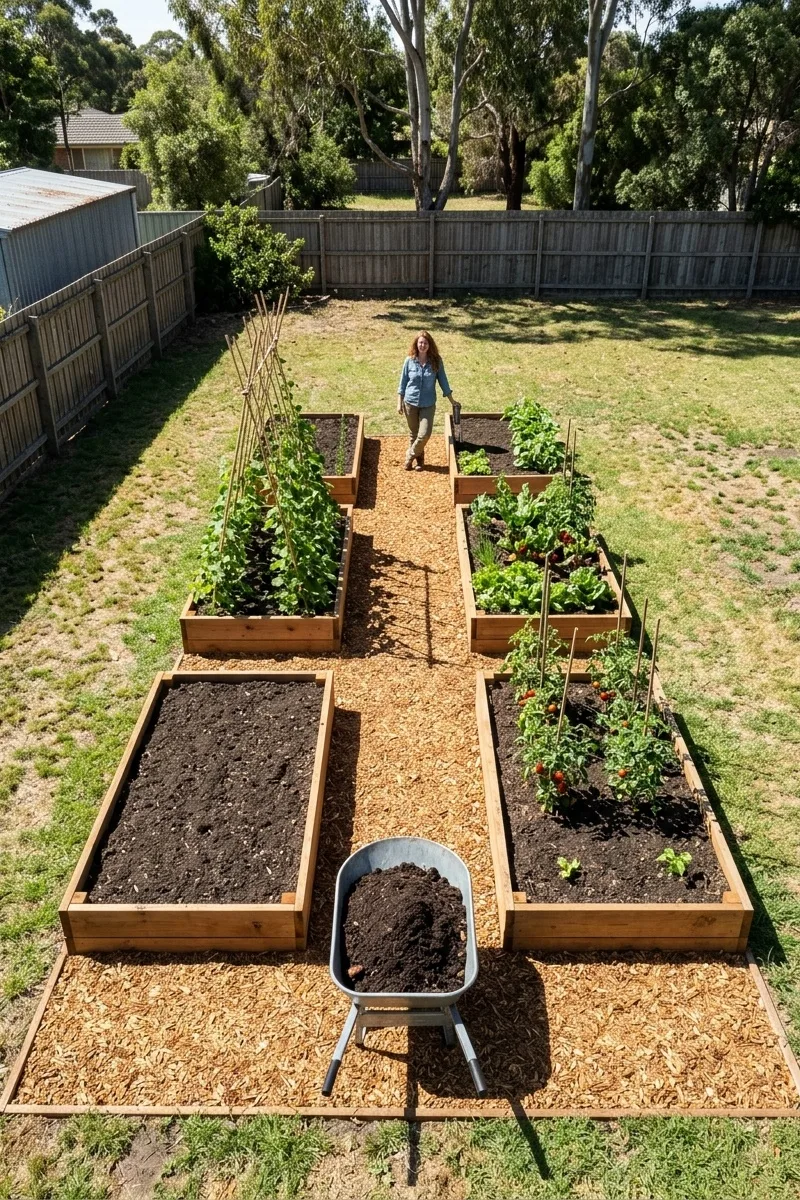
Leftover lawn stops being the point the moment the plot is big enough to feed a real household. Then the 4×8 box repeats, and the spacing you hang between the copies becomes the entire design.
Six of them on a 20×20 patch give you 192 sq ft under cultivation without the space ever feeling walled off. The geometry that keeps it open is an aisle hierarchy: 36 in. at each end where loads come in and turn around, 30 in. down the middle where you just walk in and pick.
The 36-in. ends aren’t the same job as the 30-in. middle. One is a turning circle for a wheelbarrow or wagon, the other is a passing lane for you and a tote. Get that backwards and you will be dragging a full barrow down a corridor too tight to steer.
Mulch those aisles 3 in. deep with arborist wood chips, because a grid that gets walked every day goes to mud without them. A cubic yard covers about 100 sq ft at that depth and costs $35 delivered, which is the cheapest part of the whole build.
Orient the beds north to south. A tall crop then casts its shadow up the aisle and not across its neighbor’s bed, and the 4-ft width plus a 30-in. cross aisle means you can reach every plant in either box without ever stepping on soil.
Total for the grid: about $1,150 in cedar kits, $570 of soil and $70 in drip parts to water all six. If the mower already lives in the garage, the aisles have quietly become your paths too, which is a bonus this layout gives you for nothing.
Sketch it on graph paper at a quarter inch to the foot and check one thing before you order: that an aisle at full width still hits the gate, the hose bib and the house door. A grid is just repeated geometry until a route has to pass through it.
💡 Tip: Run the drip line down the cross aisle and tee into each bed — one timer, six beds, no hose dragging.
7. Fence-Line Salad Frame for Half Shade
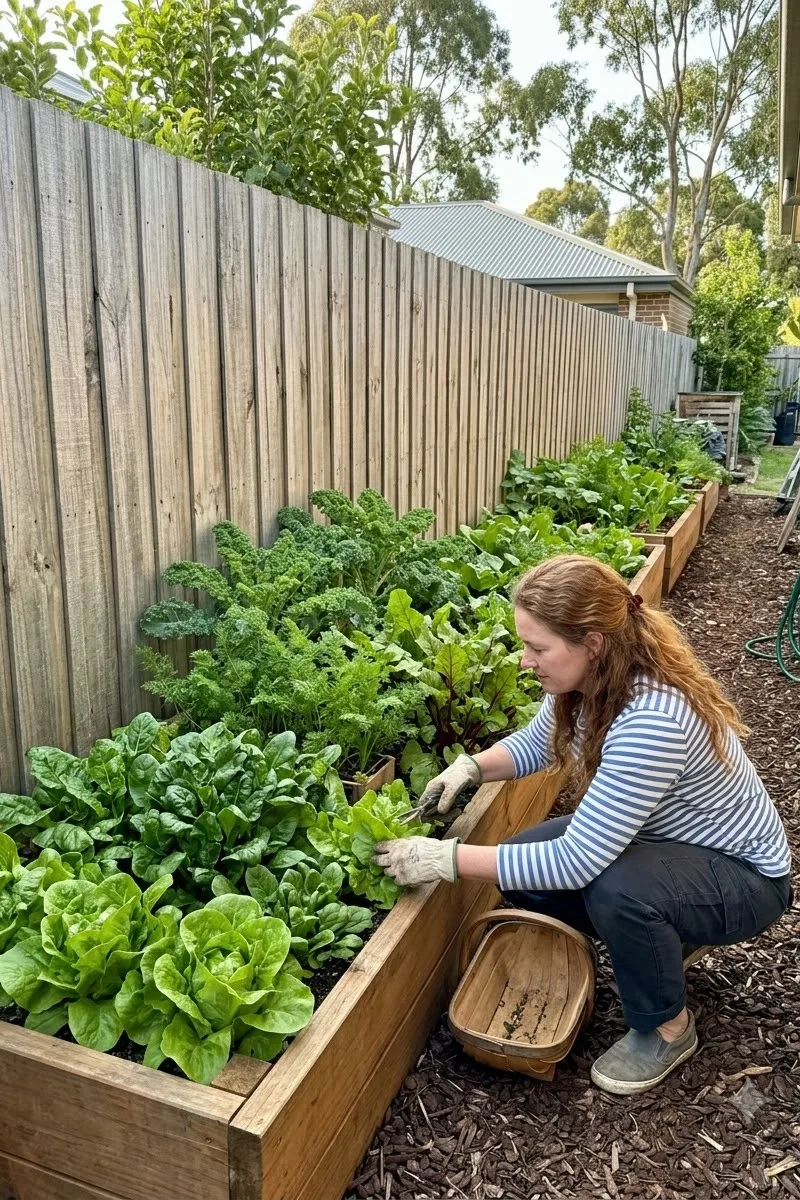
A full-sun plan assumes light falls evenly across the plot. It rarely does. A fence on the yard’s east side shaves 2 to 3 hours of summer sun off whatever sits against it, and those beds still grow food – just not the same food.
The fix is boring and it works: pull the beds tight to that east fence and run a narrow path down the front only. A bed that backs onto a fence never gets walked from behind, so there is no reason to pay for aisle space nobody uses.
Three beds, each 3 ft across and 6 ft long, 10 in. deep, butted up to the fence line with an 18-in. path running the front. Three feet instead of four because the reachable face is the front only, and 3 ft from a front path still puts every plant within easy arm’s length. The kits run about $330 for the three; the soil to fill them, around $175.
Now the part that trips people up: what to plant. Lettuce, spinach, kale, carrots, beets. Greens and roots shrug off the lost hours and some of them prefer the cooler, softer light that fence throws in the afternoon.
Tomatoes, peppers and squash stay out in the open beds, where they get their full 6-plus hours. Shade is not lost yard – it is a different crop list.
That 18-in. front path never needs to fit a barrow. Greens come out in a basket, one hand, one snip at a time, and nothing heavier than a trug ever enters the gap. If the bed backed onto an open lawn on both sides you would be paying for 30 in. of aisle twice. It is not, so you are not.
Aisle Widths: Match the Width to the Traffic
18-in. aisle
- One person tending with a hand tool
- Harvest carried out in a tote or basket
- Soil goes in by bucket or bag
- Fits a 5-ft side strip or a patio gap
30–36-in. aisle
- Wheelbarrow passes with a full load
- 36 in. is the minimum for a wagon or wheelchair to turn
- Bulk soil and compost delivered to the bed
- Wide enough to kneel and work from a pad
8. Wide-Aisle Plan for Wagons and Wheelchairs
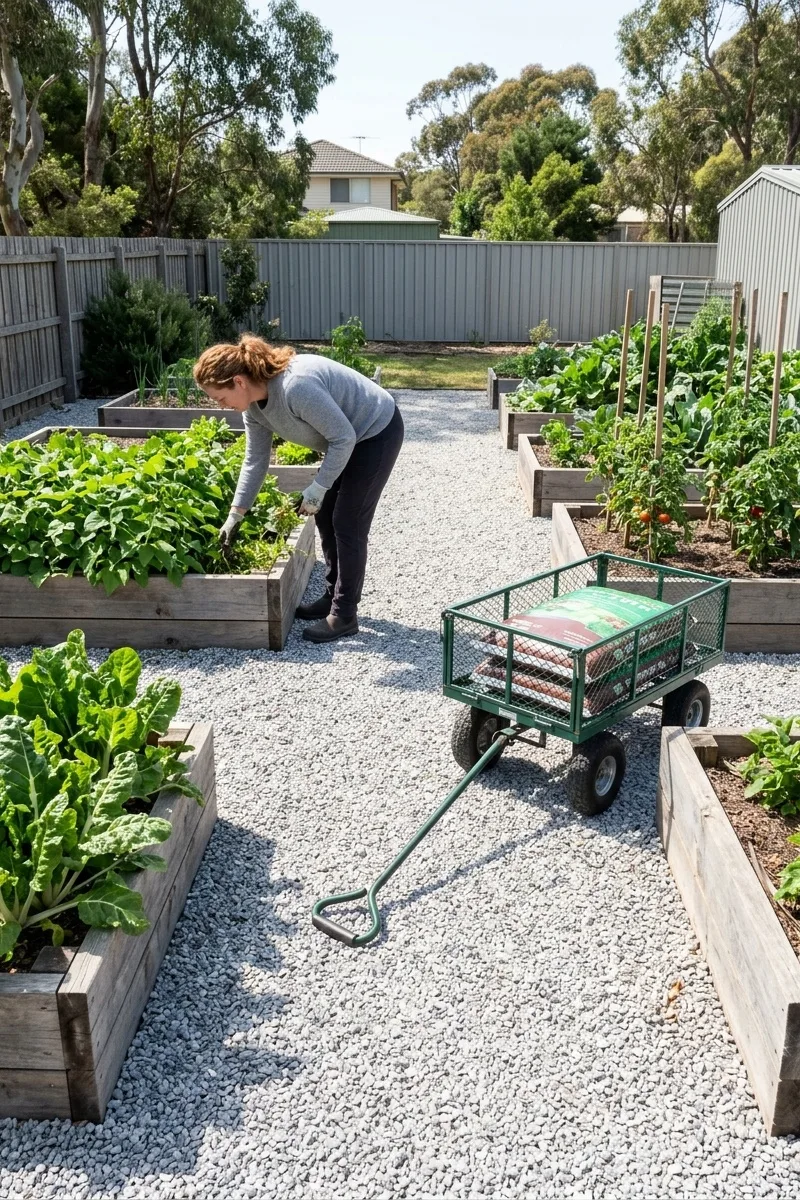
A narrow front path suits a person on foot with a basket. Put that same person in a wheelchair, or hand them a garden wagon loaded with soil, and the gap between beds stops being leftover space and starts dictating the whole plan.
Here the aisle is the design, and the beds get arranged around it.
Set 4×8 beds with their short ends facing the paths. Every box is bordered by a 36-in. aisle, and a 36-in. turning pad sits at the corner where two aisles meet. Turning a loaded wagon at the end of a run needs that square of open ground – without it you back out the way you came.
What the end-to-path arrangement buys you is reach. The 4-ft face turned toward the aisle means no point inside any bed is more than 2 ft from a hard surface. You lean in, you pick, you pull a weed, and your feet stay on gravel. The soil underneath never gets stepped on, so it never compacts, so roots and water move the way they should. Long side to the aisle, short end to the next aisle – that is the whole geometry.
Cost, all in: about $430 in kits, $190 of soil, and $45 for compacted gravel or pavers under the turning pad. The pad is the piece people skip and then regret.
Read the 36-in. number correctly. It is the minimum clear pass-through, not a comfortable turn. If the chair turns in place rather than rolling through an arc, widen the pad past 36 in. before the gravel truck arrives – a pad poured at the minimum is the one thing on this list you cannot cheaply undo.
💡 Tip: Set the gravel pad on a compacted base, not loose stone — a turning wheelchair will sink a loose pad within a season.
🌱 GROWING TIP
Put the bed where you'll actually pick from it
A bed more than 20 ft from the kitchen door gets harvested once a week instead of daily. That distance is part of the layout, not an afterthought — measure it before you site anything.
9. One-Bed Kitchen-Door Plan
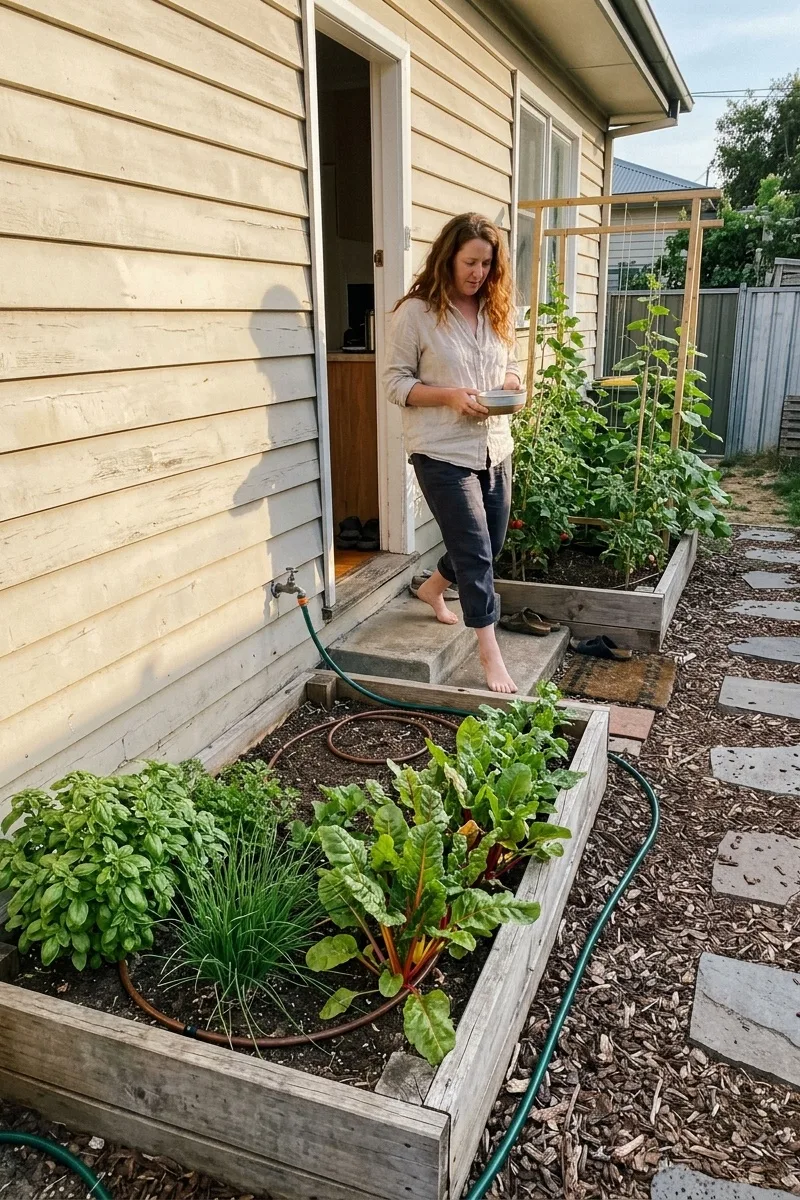
On a wide-aisle layout the deciding number is the gap; on a one-bed layout the deciding number is the distance from the bed to the kitchen door. That is the whole design, and it changes everything else.
One 4×8×10 in. bed on the sunniest wall within 20 ft of the kitchen door. Not the best soil spot, not the prettiest corner – the wall the sun hits first and the door opens closest to. A 30-in. path runs along the long side, wide enough for the barrow that brings the soil in and takes the prunings out. About $200 in cedar and $95 of soil, and the layout is done.
Plant it by walking distance. Herbs and cut-and-come-again greens at the near end, tomatoes and trellised cucumbers at the far end. The daily pick – a snipping of basil, a handful of chard, on the way back from the mailbox – takes the shortest walk, and the crops that survive on neglect sit closest to the door.
Run a hose bib or a quarter-inch drip line to that bed before the first plant goes in. A bed watered by carrying cans across a yard gets skipped in the first hot week of July, and skipped weeks are how a good bed becomes a weed patch.
One bed at the door gets picked every day. That is the only layout that stays harvested instead of ripening past use and dropping to the ground while nobody walks out to it.
10. Renter’s Tabletop Trio on Legs
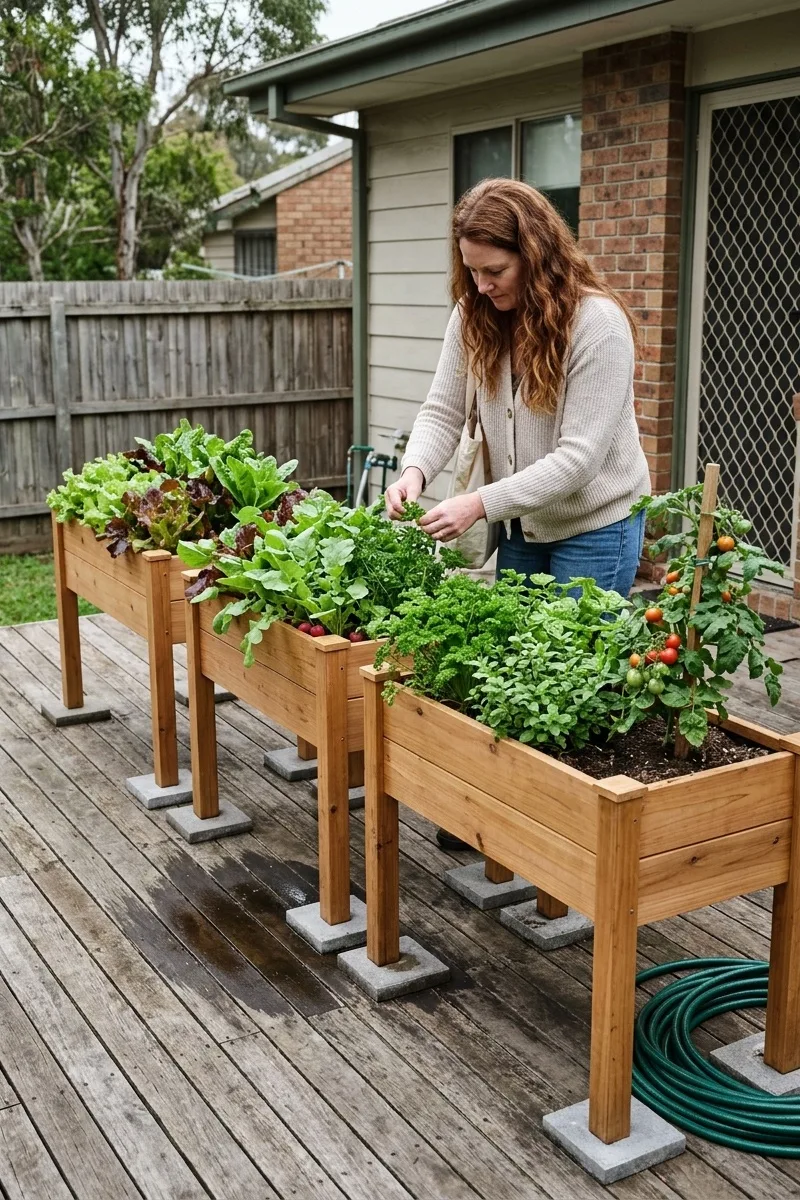
A bed twenty feet from the kitchen door still feeds nobody if the lease ends in March. Portability comes first when you rent, and everything else about the layout follows from it.
Three tabletop boxes solve that. Each one is 2×4 feet, 12 inches deep, and sits on 30-inch legs, which puts the soil surface at roughly waist height. No bending, no kneeling, no digging into a deck you do not own. Space the boxes 18 inches apart and you have a tending row you can reach from either side without stepping between them.
Cost runs about $70 in cedar per box and $25 of soil mix to fill it – roughly $285 for the set of three. Cheaper than one in-ground bed with a rented-truck soil delivery attached to it.
Two details decide whether the set survives a season. Drill drainage holes in the floor of every box, because a 12-inch-deep planter with no outlet is a bathtub. And set each leg on a paver, so the cedar never sits in standing water and the deck beneath it stays unstained.
Depth is the honest limit. Twelve inches of soil grows lettuce, herbs, radishes and determinate cherry tomatoes without complaint. It does not grow carrots worth pulling or corn worth planting – both want root run this box cannot give, and a stunted carrot is not a lesson, it is just a disappointment.
The 18-inch gaps are the whole aisle width, and that is enough. Soil arrives a bag at a time in one person’s arms; harvest leaves in a tote with a pair of snips. Nothing with wheels ever needs to enter. Your patio only has to be as wide as the boxes plus 18 inches.
Which means the set breaks down flat when the lease does. Unscrew, stack the frames, bag the soil for the next place or give it to a neighbor, and haul the legs out in a hatchback. The layout moves with you, and that is the only dimension that matters when the ground under it is temporary.
11. Perimeter U With a Central Path
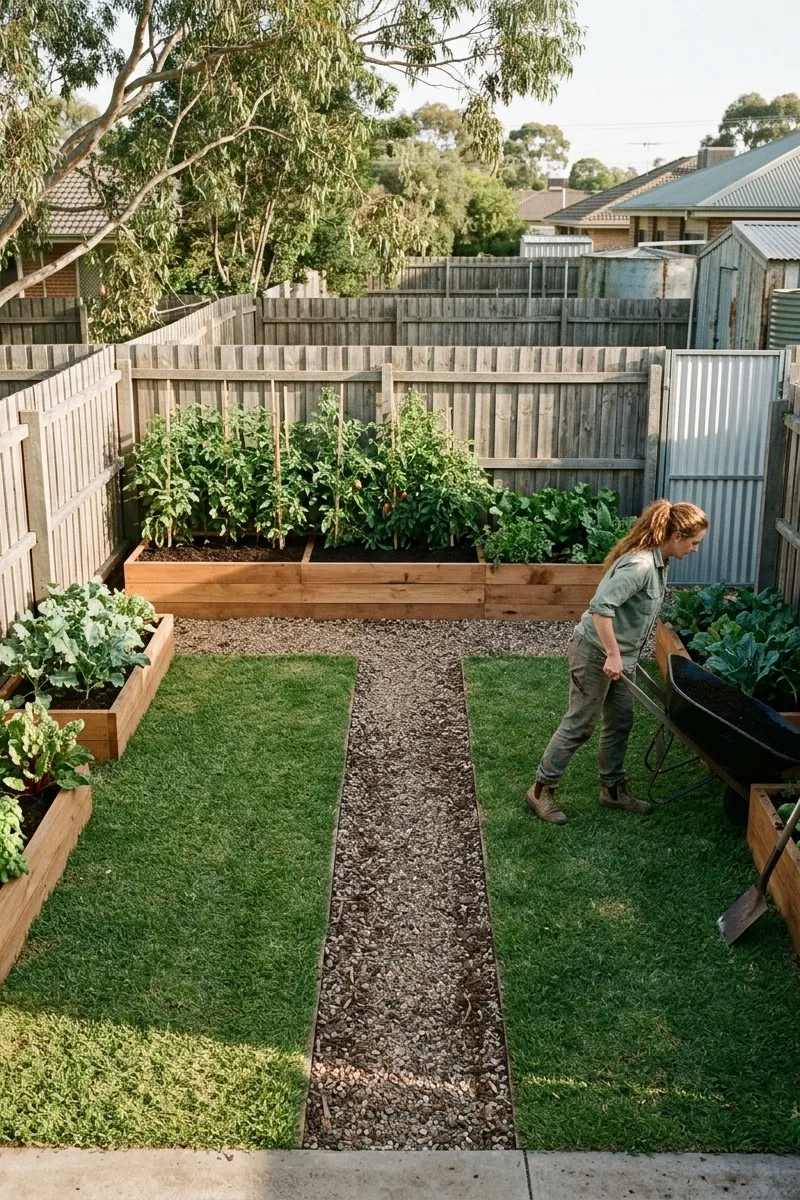
Keep the lawn and still grow food by pushing the boxes to the perimeter and giving the middle to one straight run of path.
The back fence takes a 4×8 bed laid long-side to the boards. Down each side fence, run a narrow 2×8. Between them, a single 36-in. central path connects the back to the gate. Four beds total, and every one of them gets worked from that one path.
About $760 in cedar kits and $330 of soil puts it in the ground. The side beds cost less because there are two fewer feet of box to buy on each run.
The 36-in. path is the whole trick. A mower rolls it without clipping a corner, and a wheelbarrow rolls the same line with a load of soil or a load of spent vines. It is mower route and haul route at once, which is why the side beds shrink to 2 ft: a 2×8 leaves the path its full width where a 4-ft box would pinch it to a hard squeeze.
That leaves a 12×12 square of open lawn in the middle that the mower reaches from the path without ever crossing a bed. The kids still have a patch. So does the dog.
Fence-line beds dry out faster than open-ground beds, and the reason is concrete: the fence reflects afternoon heat straight onto the back of the soil, and the boards block the morning dew from settling. Mulch 3 in. deep and run drip to the perimeter boxes, or the back row of tomatoes sulks through every dry week while the front row shrugs it off.
💡 Tip: Put a gate or gap at each end of the central path so the mower never has to back out with a full bag.
12. Front-Yard Four-Square That Reads as Landscaping
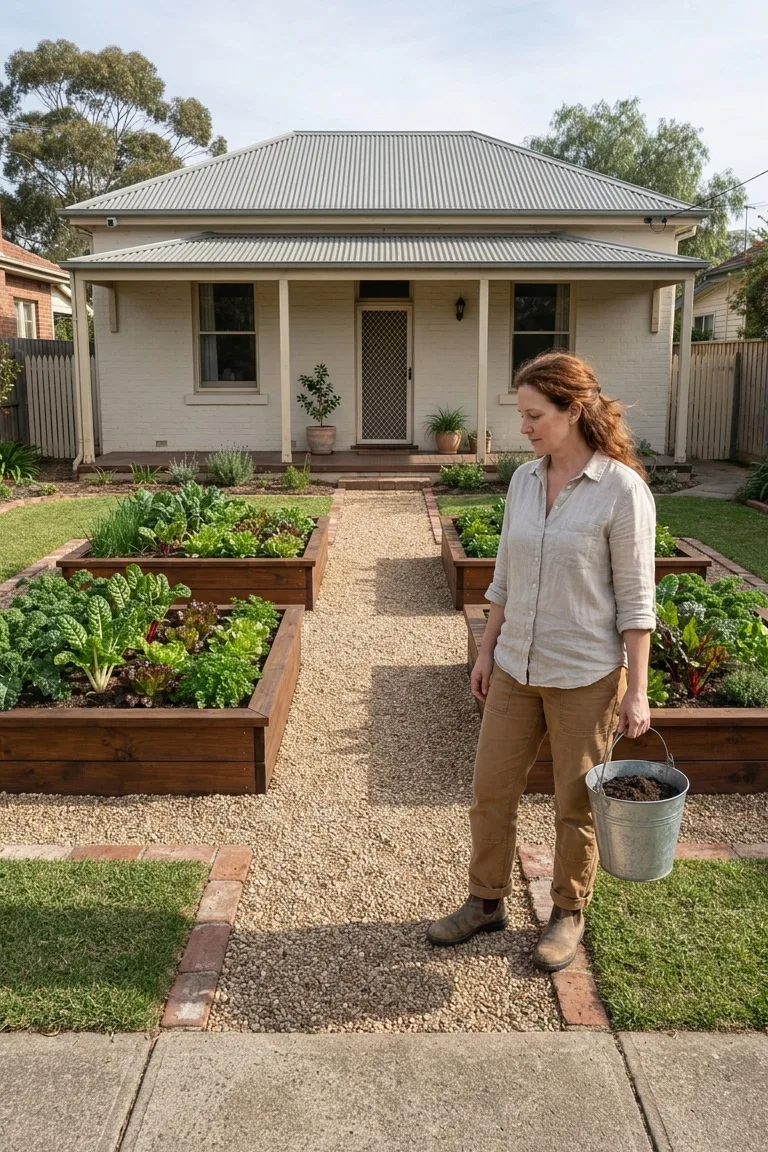
The only sun on the property falls in front, and the neighbors see it. So the same four-square geometry that worked out back moves to the front of the lot, where it has to satisfy a harder audience – the street, the setback rule and the HOA.
Four 4x4x10-inch cedar boxes set in a 12×12 square, with 24-inch gravel walks between them. This is a formal parterre, not a vegetable patch, and that distinction is the whole design. Tomatoes trellised in the middle of a front parterre look like a crop; lettuce, chard, kale and herbs in a clipped square look like a planting scheme.
Costs run about $260 for the four cedar kits, $200 of soil, and $60 of gravel for the walks. Stain every frame one color and match the edging to it, so from the sidewalk the set reads as a garden feature that belongs to the house.
The 24-inch walks take a person and a tote. They do not take a barrow turn, so soil goes in by bucket and spent plants leave the same way – a few bags at a time, carried around the side of the house. Plan for that before the gravel goes down, not after.
Before any digging, call the city or the HOA. Front-yard setbacks, height limits and even the number of planting structures allowed in a front yard vary by jurisdiction, and no layout fixes a rule. A five-minute phone call before you stake is worth more than a season of arguing about it afterward.
Get the clearance and the right crop list, and the front four-square becomes the best-lit bed on the property – one that happens to look like it was designed.
💡 Tip: Keep the four-square symmetrical from the sidewalk — the formality is what sells it to neighbors and code inspectors alike.
Frequently Asked Questions
How wide should the aisle between raised garden beds be?
18 in. if one person tends with a hand tool, 30 in. if a wheelbarrow has to pass, and 36 in. where a wagon or wheelchair turns. Set the aisle width before the bed width — the aisle decides what can move through the garden.
How much soil does a 4×8 raised bed need?
About 27 cu ft for a 10-in.-deep bed. That’s roughly 22 bags of 1.25 cu ft, or about $95 of bulk topsoil-compost mix delivered. Order it after the frame is built and leveled.
Can I put raised beds on a patio or concrete?
Yes. Set the frames on feet or pavers so water drains out from under them and the slab doesn’t stain. Use 4×4 kits with 18-in. gaps for tending, and plan on bagged soil carried in by bucket.
What do I do if my yard slopes?
Step the beds down the slope and keep the frames level with a 2×6 cedar riser on the low side — about $18 per bed. Terrace the beds, not the yard: a 10-in. box needs no retaining wall and no permit.
Which direction should raised beds run?
North–south where you can, so tall crops don’t shade their neighbors. A 4-ft width plus a 30-in. cross aisle keeps that shading from becoming a problem even with tomatoes on the north side.
How much does a raised bed layout cost to build?
A two-bed starter grid runs about $400 in cedar kits plus $190 of soil. A six-bed grid runs about $1,150 in kits, $570 of soil and $70 in drip parts. Cedar 4×8 kits are $180–$240 each; galvanized steel runs $130–$170.
Pick Your Plan, Then Walk It Before You Buy
Match the plan to the ground and the decision is quick. Choosing what goes in each bed is easier with vegetable garden layouts built around sunlight, space and your own goals. Flat first backyard: Plan 1, two 4×8 beds 30 in. apart, about $400 in kits and $190 of soil. Rented patio: Plan 2 if you are staying put, Plan 10 if the lease ends next year. Slope: Plan 4 with the $18 cedar risers on the low side. A 5-ft side strip: Plan 3. Big open plot: Plan 6 with 36-in. main aisles. Half shade: Plan 7, 3×6 beds along the east fence, greens and roots in them. Wheelchair or wagon traffic: Plan 8, 36-in. aisles and a turning pad.
Before a single board is bought, stake the bed corners, string the aisles at full width, then walk the route with a loaded wheelbarrow: into the plot, around every end, and out again.
Back at the tape measure on the bare lawn, the number that mattered was never the bed. It was the gap. A stake moves for free; a delivered yard of soil and a built frame do not.
Stake It Out This Afternoon
Grab four stakes, a ball of string and a wheelbarrow. Mark the corners at full size, string the aisle at full width, and walk the loaded route before you order kits or soil.

Similar Posts