Indoor Grow Light Calculator
Botanical Horticulturist & Food Preservation Specialist at Brittle Bloom · Certified Master Gardener & Master Food Preserver · 12+ Years in Plant Propagation & Food Preservation
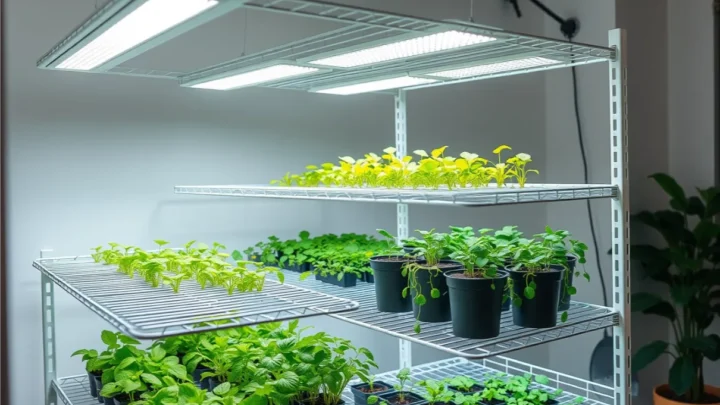
Growing plants indoors is a wonderful way to enjoy fresh herbs, leafy greens, seedlings, and beautiful houseplants throughout the year. But there is one challenge many indoor gardeners face: providing enough light.
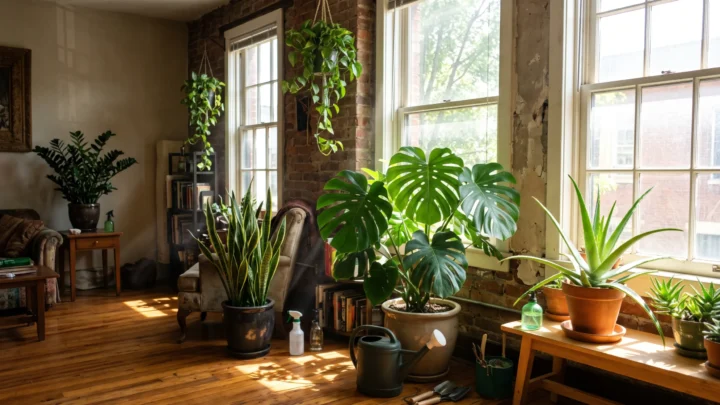
A sunny window might be sufficient for some houseplants, but vegetables, herbs, and young seedlings often need additional lighting to grow well. Choosing a grow light can also feel confusing when product descriptions mention watts, PPFD, PPF, and LED efficiency.
That’s where an Indoor Grow Light Calculator can help.
Our free calculator makes it easier to estimate the lighting requirements of your indoor garden. Enter your growing space dimensions, LED wattage, light efficiency, and plant type to estimate PPFD, Daily Light Integral (DLI), and the amount of lighting power your plants may need.
Whether you’re growing lettuce on a kitchen shelf or starting vegetable seedlings in a spare room, understanding your lighting requirements can help you create a healthier indoor growing environment.
What Is an Indoor Grow Light Calculator?
Indoor Grow Light Calculator
Find the right LED lighting power for healthier indoor plants.
🌱 Lighting Analysis
🎯 Your Recommended Setup
Estimates assume average light distribution across the growing area. Actual PPFD varies with fixture design, mounting height, reflective surfaces and canopy position. Use a manufacturer PPFD map or quantum sensor for precise measurements. Plant-specific requirements also vary by cultivar and growing conditions.
Use the calculator below to estimate your indoor lighting requirements.
Enter the length and width of your growing area, followed by your LED grow light specifications. Select your plant category and daily lighting duration to see your estimated results.
The calculator provides:
- Estimated average PPFD (Photosynthetic Photon Flux Density).
- Estimated DLI (Daily Light Integral).
- Growing area in square feet.
- Estimated LED wattage required for your selected plant category.
- Daily electricity consumption.
- A lighting performance score and recommendations.
Remember that these are planning estimates, not direct light measurements. Actual PPFD can vary across your growing space depending on fixture design, mounting height, and light distribution.
How to Use the Indoor Grow Light Calculator
You don’t need advanced gardening knowledge to use the calculator. Follow these simple steps to get your results.
1. Enter Your Growing Space Dimensions
Start by measuring the length and width of your indoor growing area.
For example, if you’re growing plants on a 4 × 4-foot shelf, enter:
- Length: 4 feet
- Width: 4 feet
The calculator uses these measurements to estimate your total growing area.
A larger space generally requires more total light output than a smaller one, assuming the same target light intensity.
2. Enter Your LED Power Consumption
Enter the actual electrical power consumption of your LED grow light in watts.
For example, if your grow light uses 100 watts, enter 100.
One important thing to remember: wattage alone doesn’t tell you how much useful light reaches your plants.
Two LED fixtures with the same electrical wattage can produce different amounts of photosynthetic light because their efficiency and design may differ.
Check the manufacturer’s specifications whenever possible.
3. Enter LED Light Efficiency
LED efficiency is measured in micromoles per joule (µmol/J).
It indicates how effectively a grow light converts electrical energy into photosynthetically active photons.
For example, a fixture with an efficiency of 2.5 µmol/J produces more photosynthetic photon output per watt than a fixture rated at 2.0 µmol/J.
Use the manufacturer’s stated efficiency rather than an estimated value whenever possible.
4. Set the Light Utilization Factor
The Light Utilization Factor estimates the percentage of a fixture’s total light output that reaches your growing area.
For example, entering 75% means the calculator assumes that 75% of the emitted photon output reaches the growing area.
This is an estimate rather than a measured property of your fixture. Actual light distribution depends on the fixture’s optics, mounting height, reflective surfaces, and growing-space layout.
If you don’t have measured information, use the default value as a starting assumption and interpret the results accordingly.
5. Select Your Plant Type
Different plants have different lighting requirements.
Our calculator includes six plant categories:
- Seedlings and Clones
- Leafy Greens and Lettuce
- Herbs and Microgreens
- Low-Light Houseplants
- Fruiting Plants and Vegetables
- Flowering Plants
Choose the category that most closely matches what you’re growing.
These categories use general PPFD target ranges to estimate your lighting requirements. Individual plant species and growth stages may need different conditions.
6. Choose Your Daily Lighting Duration
Enter how many hours your grow light operates each day.
For example, the calculator’s default setting is 16 hours.
You can change this value to match your planned lighting schedule.
Once you’ve entered all six settings, click Calculate My Grow Light Needs to view your results.
Understanding Your Grow Light Calculator Results
The calculator displays several useful measurements. Understanding what they mean will help you make better lighting decisions.
Estimated Average PPFD
PPFD stands for Photosynthetic Photon Flux Density.
It measures the amount of photosynthetically active light reaching a surface every second.
Its unit is:
µmol/m²/s
The calculator estimates average PPFD using LED wattage, light efficiency, light utilization, and growing area.
The simplified calculation is:
Estimated PPFD = (LED Watts × LED Efficiency × Utilization Factor) ÷ Growing Area in Square Meters
For example, consider a 4 × 4-foot growing space with:
- LED power: 100 watts
- LED efficiency: 2.5 µmol/J
- Light utilization: 75%
The growing area is approximately 1.49 square meters.
The estimated PPFD is:
(100 × 2.5 × 0.75) ÷ 1.49 = approximately 126 µmol/m²/s.
This is an estimated average across the growing area, not a guaranteed measurement at every point beneath the fixture.
Daily Light Integral (DLI)
DLI measures the total amount of photosynthetically active light received over an entire day.
It is expressed in mol/m²/day.
Unlike PPFD, which describes light intensity at a particular moment, DLI considers both light intensity and lighting duration.
The formula is:
DLI = PPFD × Lighting Hours × 0.0036
For example, if your estimated PPFD is 126 and your grow light operates for 16 hours:
126 × 16 × 0.0036 = approximately 7.26 mol/m²/day.
This gives you an estimate of the daily light exposure your plants receive from the calculated artificial lighting.
Growing Area
The calculator also displays your growing area in square feet.
This helps you understand how much space your fixture needs to illuminate.
Remember that a larger growing area generally requires more total photon output to achieve the same average PPFD.
Estimated Required Wattage
This result estimates the LED power needed to reach the midpoint of your selected plant category’s PPFD range.
The calculator uses:
Required Watts = (Growing Area × Target PPFD) ÷ (LED Efficiency × Utilization Factor)
For example, a larger growing area or a higher PPFD target will generally increase the required wattage.
A more efficient fixture can reduce the electrical power needed to achieve the same estimated photon output.
Daily Energy Consumption
The calculator estimates how much electricity your grow light uses each day.
The formula is:
Daily Energy Use = LED Watts × Lighting Hours ÷ 1,000
For example, a 100-watt grow light running for 16 hours consumes:
100 × 16 ÷ 1,000 = 1.6 kWh per day.
Your actual electricity cost will depend on your local electricity tariff.
How Much Light Do Different Indoor Plants Need?
Not every plant needs the same lighting intensity. Some foliage plants grow well under relatively low light, while fruiting vegetables generally need stronger illumination.
Our calculator uses the following general PPFD starting ranges:
| Plant Category | Estimated PPFD Range |
|---|---|
| Low-Light Houseplants | 50–150 |
| Seedlings and Clones | 100–200 |
| Leafy Greens and Lettuce | 150–250 |
| Herbs and Microgreens | 200–300 |
| Fruiting Plants and Vegetables | 400–600 |
| Flowering Plants | 300–600 |
All values are in µmol/m²/s.
These are broad planning ranges used by the calculator, not universal requirements for every species. Actual needs depend on plant variety, growth stage, environmental conditions, and daily lighting duration.
For example, lettuce generally requires less intense lighting than many fruiting vegetables grown entirely indoors.
If you’re growing several different plant types together, consider their individual lighting requirements rather than assuming one setting will suit every plant.
How Many Hours Should Grow Lights Be On?
Lighting duration affects how much total light your plants receive each day.
A plant receiving moderate light for several hours may receive a different DLI from one exposed to stronger light for a shorter period.
As general starting points:
- Seedlings often receive around 16–18 hours of supplemental lighting.
- Leafy greens commonly receive around 12–16 hours, depending on growing conditions.
- Many herbs grow well with approximately 12–16 hours.
- Foliage houseplants may benefit from supplemental lighting when natural daylight is limited.
These are general guidelines rather than fixed schedules. Some flowering plants have specific photoperiod requirements, and plants need an appropriate dark period.
Remember that the calculator estimates DLI using the lighting hours you enter. It does not independently determine whether that photoperiod is suitable for your particular plant.
If your plants also receive sunlight through a window, their total daily light exposure will include that natural light as well.
How Far Should a Grow Light Be From Your Plants?
Grow light distance can influence both light intensity and coverage.
Placing a fixture closer to the canopy generally increases the intensity directly beneath it, while raising it can spread light across a wider area but reduce intensity.
The ideal mounting height depends on the LED fixture, its optics, power, and manufacturer recommendations.
For better results:
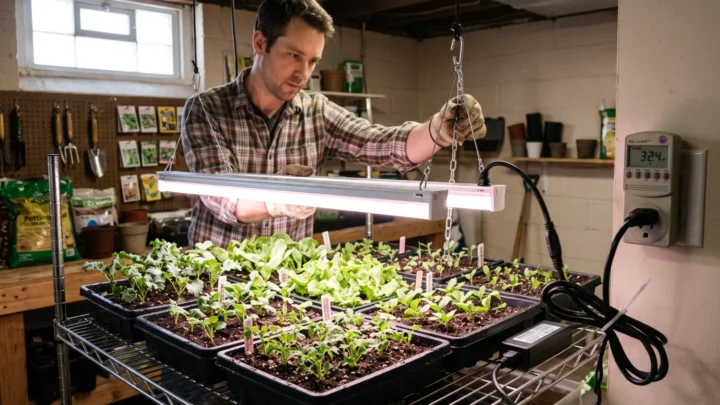
- Check the manufacturer’s recommended hanging height.
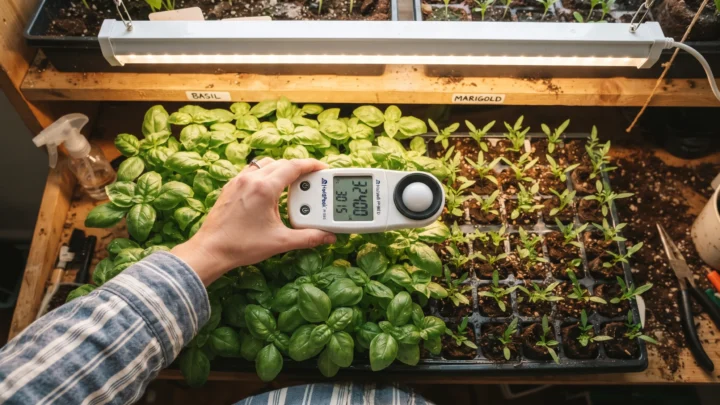
- Measure PPFD at plant canopy level when possible.
- Check several points across the growing area.
- Adjust the fixture gradually as plants grow.
- Watch for stretching, bleaching, curling, or signs of excessive light stress.
Our calculator does not ask for mounting height, so its PPFD result should be treated as an average planning estimate rather than a precise measurement at a particular distance.
Tips for Choosing the Right LED Grow Light
Before buying a new grow light, consider these practical factors.
Check LED efficiency: Compare µmol/J ratings to understand how efficiently different fixtures produce photosynthetic photons.
Look for PPFD maps: Manufacturer light maps can help you understand how evenly a fixture distributes light across your growing space.
Consider the coverage area: Make sure the fixture can illuminate the entire growing area rather than concentrating most of its output in the center.
Choose a suitable light spectrum: Full-spectrum white LED fixtures are a convenient option for many home-growing setups.
Consider electricity consumption: Calculate daily kWh usage before choosing a fixture so you can estimate ongoing operating costs.
Monitor plant health: Observe how your plants respond and adjust lighting intensity and duration when necessary.
Frequently Asked Questions
1. How do I calculate the wattage needed for an indoor grow light?
Multiply your growing area in square meters by your target PPFD, then divide by LED efficiency and light utilization.
This provides an estimated wattage requirement for your selected lighting target.
2. Is a 100-watt LED grow light enough for indoor plants?
It depends on the growing area, LED efficiency, utilization factor, and plant requirements.
A 100-watt fixture may work for a small growing space but may provide insufficient light for a larger area or plants requiring higher PPFD.
Use the calculator to estimate whether your current fixture is suitable.
3. What is the difference between PPFD and DLI?
PPFD measures the intensity of photosynthetically active light reaching a surface at a particular moment.
DLI measures the total amount of that light received throughout the day.
Both are useful for understanding indoor plant lighting.
4. Can I leave my grow lights on for 24 hours?
Continuous lighting should not be treated as a universal growing strategy.
Many plants benefit from a regular dark period, and some flowering plants respond to specific day-length conditions.
Follow the lighting recommendations for your particular plant.
5. Does higher LED wattage always mean better plant growth?
No. Higher wattage means greater electricity consumption, but it doesn’t automatically mean better light quality or distribution.
LED efficiency, PPFD, coverage, spectrum, and photoperiod all matter.
Final Thoughts
Providing the right amount of light is one of the most important parts of growing plants indoors.
By understanding growing area, LED wattage, light efficiency, utilization factor, PPFD, and DLI, you can make more informed decisions about your indoor gardening setup.
Our Indoor Grow Light Calculator gives you a convenient starting point for estimating your lighting requirements, comparing LED fixtures, and understanding daily electricity consumption.
Start by entering your growing space dimensions and light specifications. Select your plant type, choose your lighting duration, and explore the results.
Remember that calculator estimates work best alongside manufacturer PPFD maps, actual light measurements, and plant-specific growing recommendations.
With thoughtful planning and regular observation, you can create a better-lit indoor garden for healthier herbs, vegetables, seedlings, and houseplants.

Similar Posts