Indoor Pepper Growing Light Planner
Botanical Horticulturist & Food Preservation Specialist at Brittle Bloom · Certified Master Gardener & Master Food Preserver · 12+ Years in Plant Propagation & Food Preservation
Growing peppers indoors is one of the most rewarding projects a small-space gardener can take on—and one of the easiest to get slightly wrong. Unlike leafy greens or culinary herbs that happily coast along on moderate light, peppers are sun-hungry fruiting plants. When they do not get enough usable light, they tell you right away: seedlings stretch into thin, floppy stems, mature plants drop their flowers before pollination can happen, and harvests stall out at one or two undersized pods.
Even a bright south-facing windowsill rarely delivers the sustained light intensity peppers need once you account for window glass filtering out UV rays, shifting seasonal sun angles, and nearby buildings. That is why a reliable indoor pepper growing light planner makes the difference between an indoor plant that merely survives and one that produces crisp bell peppers, fiery jalapeños, or sweet lunchbox peppers right on a shelf or kitchen counter.
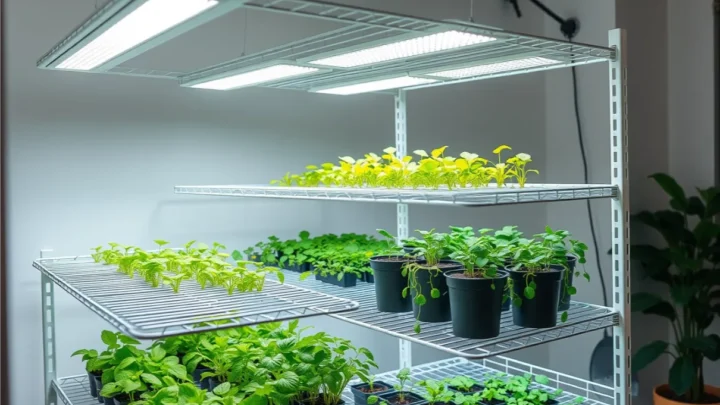
Whether you are tucking a single compact pepper pot into an apartment corner or organizing a multi-tier wire shelving unit, this planner breaks down exactly what your plants need at every growth stage—from seed germination through ripening fruit—along with practical hanging heights, daily schedules, and light measurements you can actually use at home.
Why Peppers Need a Dedicated Light Plan Indoors
Indoor Pepper Growing
Light Planner
Find the right lighting schedule for healthier pepper plants.
🗓️ Your Personalized Light Schedule
To understand how to schedule your lights, it helps to look at how pepper plants (Capsicum annuum, Capsicum chinense, and related species) use light energy. According to horticultural guidance from university extension programs such as the University of Minnesota Extension and Oklahoma State University Extension, fruiting vegetables require significantly higher daily light totals than foliage houseplants or salad greens.
In outdoor gardens, peppers bask in direct summer sun for 8 to 12 hours a day. Indoors, even strong LED grow lights emit a fraction of the intensity of midday sunlight. To compensate for lower intensity, indoor growers extend the duration of light exposure—giving plants more hours under the lamp so they accumulate enough total light energy each day.
Understanding PPFD and DLI Without the Jargon
When shopping for lights or mapping out a schedule, you will run into two measurements that matter far more than watts:
- PPFD (Photosynthetic Photon Flux Density): Measured in micromoles per square meter per second ($\mu\text{mol/m}^2/\text{s}$), this tells you how much usable plant light is actually hitting the top leaves of your pepper plant at a specific distance.
- DLI (Daily Light Integral): Measured in moles per square meter per day ($\text{mol/m}^2/\text{d}$), DLI is the total volume of light your plant collects over 24 hours. Think of PPFD as the speed of rain falling, and DLI as the total inches collected in a rain gauge by the end of the day.
Fruiting crops like peppers generally perform best indoors when they receive a DLI between 16 and 22 $\text{mol/m}^2/\text{d}$ during flowering and fruiting, while seedlings need closer to 10 to 14 $\text{mol/m}^2/\text{d}$. Because DLI combines both intensity and time, you can hit your target by pairing a moderately strong LED light with a 14- to 16-hour daily timer.
The Complete Indoor Pepper Growing Light Planner (Stage by Stage)
Pepper light needs shift dramatically from the moment a seed cracks open to the week your first pods turn red or orange. Keep a simple mechanical or smart outlet timer on hand—automating your light cycle eliminates guesswork and keeps your plants’ circadian rhythms steady.
| Growth Stage | Typical Timeline | Daily Light Hours | Dark Period | Target PPFD (μmol/m2/s) | Typical LED Hanging Distance | Primary Goal |
| 1. Germination | Days 1–14 | 0–12 hours | 12–24 hours | 100–150 | 12–18 inches (if lit) | Warmth & moisture; light optional until sprout emerges |
| 2. Seedling | Weeks 2–5 | 14–16 hours | 8–10 hours | 200–350 | 6–12 inches | Thick stems, compact nodes, true leaf development |
| 3. Vegetative | Weeks 6–10 | 14–16 hours | 8–10 hours | 350–500 | 8–14 inches | Branching canopy, strong root & stem structure |
| 4. Flowering & Fruit Set | Weeks 10–16+ | 12–14 hours | 10–12 hours | 500–700+ | 10–16 inches | Flower retention, pollen viability, pod initiation |
| 5. Ripening | Ongoing | 12–14 hours | 10–12 hours | 450–650 | 10–16 inches | Sugar development, color change, sustained harvests |
Note: Exact timelines vary depending on pepper variety—compact ornamental or dwarf varieties like ‘Lil’ Pumpkin’ or ‘Numex Twilight’ mature faster than large bell peppers or super-hot chinense varieties like habaneros. Indoor ambient temperatures and seasonal room conditions in your region also influence growth speed.
Stage 1: Seed Germination (Days 1 to 14)
Pepper seeds do not actually need light to germinate. What they need most is consistent warmth—ideally soil temperatures between 75°F and 85°F (24°C–29°C)—and steady moisture. Many indoor growers use a seedling heat mat rather than overhead lights during the first week.
How to Manage Light During Germination
- Before emergence: Keep your grow lights off to save electricity and prevent the surface of your seed-starting mix from drying out too quickly.
- The moment the first loop appears: Check your trays twice a day. As soon as you see the first pale green hook breaking through the soil, turn your grow lights on immediately. Waiting even 24 to 48 hours after emergence can trigger rapid stem stretching that is difficult to reverse later.
- Humidity dome tip: If you use a clear plastic humidity dome, remove it as soon as roughly half the seeds have sprouted. Plastic domes block up to 20–30% of light intensity and trap excess moisture that encourages damping-off disease.
Stage 2: Seedling Stage (Weeks 2 to 5)
Once your pepper seedlings unfurl their first pair of embryonic leaves (cotyledons) and begin producing their first set of true leaves, light becomes their primary fuel source. This is the make-or-break window for compact growth.
Seedling Light Schedule and Positioning
- Daily schedule: Run your lights for 14 to 16 hours on, followed by 8 to 10 hours of uninterrupted darkness. Plants process sugars and carry out cellular repair during the dark period, so leaving grow lights on 24 hours a day actually stresses peppers and can cause leaf yellowing (chlorosis).
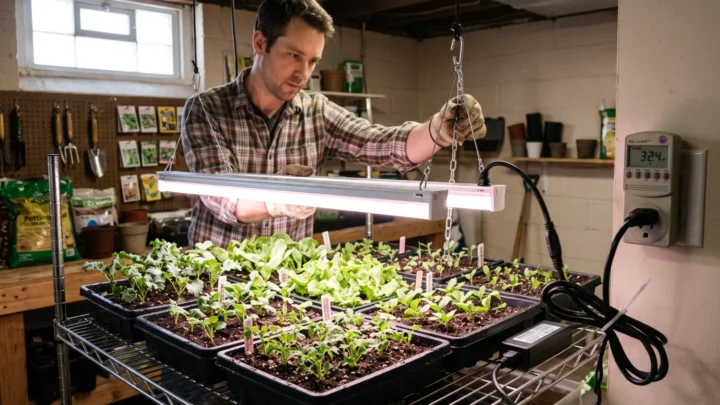
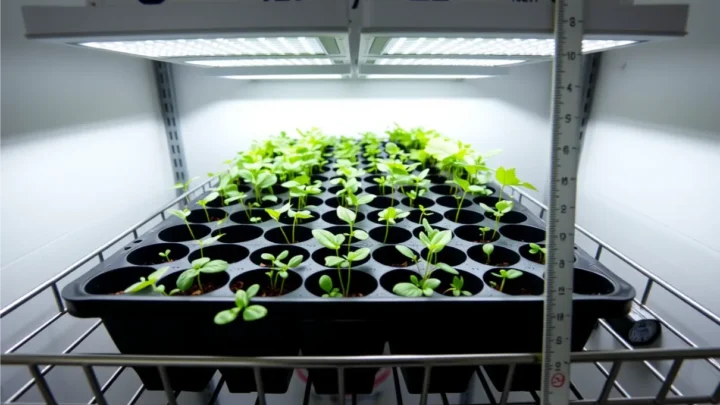
- Hanging height: For standard full-spectrum LED shop lights or bar-style grow lights (typically 20–40 watts per bar), position the fixture 6 to 12 inches above the tops of the seedlings. If you are using a higher-powered quantum board LED (100 watts or more), start at 14 to 18 inches or dim the fixture to 40–50% power so you do not scorch tender leaves.
- Adjust weekly: Because pepper seedlings grow upward quickly, attach your light to adjustable ratchet hangers or S-hooks on a wire rack so you can raise the fixture every 5 to 7 days as the canopy rises.
Visual Checkpoints for Seedlings
Your plants will tell you if your distance needs tweaking:
- Too little light: Stems grow pale and elongated with wide gaps between leaf sets, or seedlings lean sharply toward a nearby window. Lower the light by 2 inches or extend the timer from 14 to 16 hours.
- Too much light: Leaves curl upward like little tacos, turn pale yellow or bleached white at the center, or develop dry brown edges. Raise the light by 3 to 4 inches or dial down the dimmer.
Stage 3: Vegetative Growth (Weeks 6 to 10)
During the vegetative phase, your pepper plants transition from fragile seedlings into sturdy, branching bushes. They are building the structural framework needed to hold heavy fruit later on.
Expanding Light Coverage as Canopies Widen
As you pot your peppers up from small starter cells into their final containers (typically 2- to 5-gallon pots for indoor growing, depending on variety), each plant takes up significantly more horizontal footprint.
- Maintain 14–16 hours of light: Keep your timer steady at 14 to 16 hours daily. Consistent long days encourage lush foliage and thick main stems.
- Watch the outer edges: Light intensity drops off sharply toward the edges of a grow light’s coverage footprint. If you have three or four pepper pots under a single rectangular light, rotate the pots a quarter-turn every few days and swap outer pots with center pots once a week so all plants develop evenly.
- Prune lower foliage strategically: Once a plant reaches 8 to 10 inches tall and begins branching at the top (forming its natural “Y” split), leaves near the very bottom of the stem receive very little light. Removing lower leaves that touch the soil improves airflow and directs energy toward the brightly lit upper canopy.
Stage 4: Flowering and Fruit Set (Weeks 10 to 16+)
Peppers are technically day-neutral plants, meaning they do not rely on a strict change in day length to trigger flowering the way short-day crops do. Instead, peppers flower once they reach physiological maturity and have accumulated enough energy reserves. However, adjusting your light strategy during flowering helps prevent blossom drop and supports healthy fruit set.
Adjusting Your Light Planner for Blooms
- Shift to 12–14 hours of slightly higher intensity: Once flower buds appear, you can dial the timer back slightly from 16 hours to 12 to 14 hours while ensuring your light intensity sits near the upper end of your fixture’s capability (500–700 $\mu\text{mol/m}^2/\text{s}$ at the upper canopy).
- Pinch early flowers on tiny plants: If a young pepper plant produces flower buds while it is still only 5 or 6 inches tall, pinch those first buds off. Allowing a tiny plant to set fruit too early stunts vegetative growth and drastically reduces your total indoor harvest. Wait until the plant has a sturdy branched structure before letting flowers develop.
- Do not forget indoor pollination: Outdoors, wind and bees shake pollen loose inside pepper flowers. Indoors, stagnant air means flowers sometimes drop unpollinated even under ideal lighting. Gently tap the main stem of your plant every couple of days, run a small oscillating fan on low nearby, or lightly brush the inside of open flowers with a clean cotton swab or soft paintbrush.
Stage 5: Fruit Development and Ripening
Once tiny green peppers appear where blossoms used to be, your plant enters its heaviest energy-demand phase. Developing thick-walled fruits and converting starches into sugars requires steady, dependable light.
- Keep the schedule rock-solid: Maintain 12 to 14 hours of light daily. Avoid sudden changes to your timer or moving fruiting plants to darker corners of the room, as sudden drops in light can cause the plant to abort young pods.
- Manage upper-canopy shading: Tall pepper varieties can grow close to fixed shelf lights, causing top leaves to shade out developing fruit below. If you are growing in a tight space, choose compact bush varieties (such as ‘Mini Bell’, ‘Thai Hot’, ‘ Jalapeño Early’, or ‘Habanada’) or gently tie tall branches outward (low-stress training) to keep an even, flat canopy at a uniform distance from the light.
Choosing the Right Grow Light for Small Indoor Spaces
You do not need an industrial greenhouse setup to follow this planner, but choosing the right style of fixture makes hitting your DLI targets much easier—especially in apartments or shared living spaces.
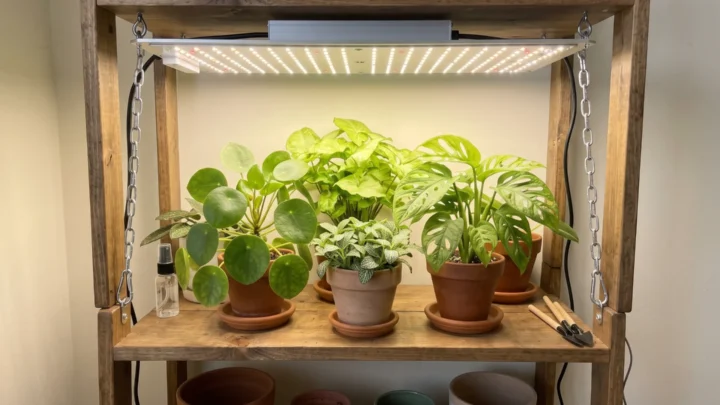
1. Full-Spectrum LED Bar Lights (Best for Shelving Units)
Slim LED light bars attach neatly under wire racks or bookshelves, making them ideal for vertical gardening. Look for full-spectrum white LEDs (usually rated around 3000K to 5000K, often supplemented with a few 660nm deep-red diodes). Full-spectrum white light renders plant colors naturally so you can spot nutrient deficiencies or pests easily, and it looks far more pleasant in a living room or kitchen than harsh purple (“blurple”) lights.
- Best use: Seedling trays, compact varieties under 18 inches tall, and multi-tier indoor plant stands.
- Tip: Use two parallel LED bars per shelf width (around 18 to 24 inches wide) to ensure mature fruiting peppers get enough intensity across the entire shelf.
2. Quantum Board / Panel LEDs (Best for High-Yield Fruiting Plants)
Compact aluminum panel lights pack dozens of high-efficiency diodes onto a flat board and usually include a built-in dimmer knob. A 100-watt to 150-watt true-draw LED panel can comfortably flower and fruit two to four mature pepper plants in a 2×2-foot or 2×3-foot footprint.
- Best use: Larger bell peppers, poblano plants, or hot peppers grown in 3- to 5-gallon fabric pots on the floor or inside a small grow tent.
3. Adjustable Gooseneck or Clamp Lamps (Best for Single Countertop Pots)
If you are growing just one dwarf pepper plant on a desk or kitchen counter, a high-output full-spectrum LED bulb (24W to 36W true wattage) screwed into a sturdy clamp fixture or pendant cord works well—provided you keep the bulb 6 to 10 inches above the plant canopy and avoid weak, low-wattage decorative plant rings.
How to Measure Your Light at Home (Without Buying Expensive Gear)
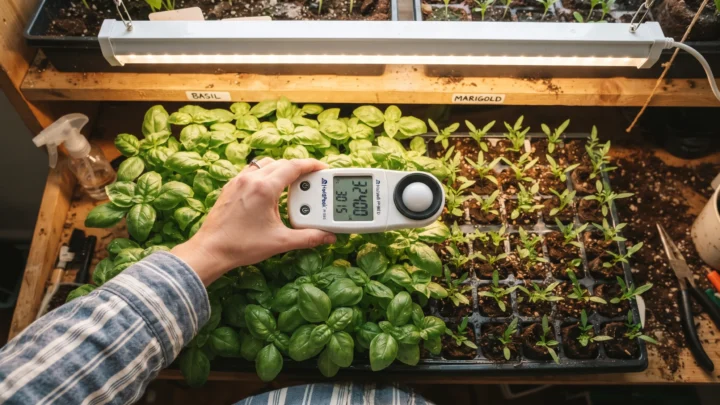
Commercial PAR meters cost hundreds of dollars, which is overkill for a home window or shelf garden. Fortunately, you can dial in your indoor pepper growing light planner accurately using two simple methods:
- Check the manufacturer’s PPFD chart: Reputable grow light brands publish a grid diagram showing exact PPFD readings at 6, 12, and 18 inches directly beneath the center and corners of the light. Use the center number for tall fruiting plants and the outer numbers to gauge where to place smaller seedlings.
- Use a smartphone light meter app with a paper diffuser: Apps like Photone (available on iOS and Android) use your phone’s front camera and a plain white piece of printer paper taped over the lens as a diffuser to estimate PPFD and DLI. While not laboratory-exact, it is far more accurate than guessing with your eyes—human eyes automatically adjust to brightness, making a dim corner look much brighter to us than it actually is to a pepper leaf.
Sample Daily Light Schedules for Real-Life Routines
Because grow lights can be quite bright in apartments or open-plan rooms, aligning your plant’s “daytime” with your household routine keeps your space comfortable.
Option A: The Early-Riser Kitchen Schedule (14 Hours On)
- 6:00 AM: Lights turn on automatically via smart plug.
- 8:00 PM: Lights turn off—no bright glare while you wind down in the evening.
- Best for: Vegetative and flowering stages in living rooms, dining areas, or home offices.
Option B: The Seedling Boost Schedule (16 Hours On)
- 6:00 AM: Lights turn on.
- 10:00 PM: Lights turn off.
- Best for: Newly sprouted seedlings and young vegetative plants that need maximum daily light volume.
Option C: The Off-Peak Utility Schedule (14 Hours On)
- 7:00 PM: Lights turn on.
- 9:00 AM: Lights turn off.
- Best for: Spare rooms, basements, or closets where you want to take advantage of cooler nighttime room temperatures (since LED drivers give off gentle warmth) or time-of-use electricity rates.
Regional and Seasonal Adjustments to Keep in Mind
Even though your peppers live indoors, outdoor seasons and regional climates still affect your indoor microclimate:
- Winter in northern climates: Cold drafts near windows can chill pepper roots below 60°F (15°C), slowing photosynthesis even when your grow lights are running at full strength. Keep indoor pepper pots at least a few inches away from cold window glass and use a small thermometer near the canopy to verify temperatures stay between 68°F and 80°F (20°C–27°C).
- Summer in warm regions: If your indoor plants sit near a sunny window while also running under LEDs, watch for heat buildup and leaf curl during peak afternoon sun. You can reduce your artificial light timer by 2 to 3 hours during bright summer months if natural sunlight supplements the canopy, or pull sheer curtains during midday heat spikes.
- Dry indoor air: Winter heating and summer air conditioning often drop indoor humidity below 30%, which can cause pepper blossoms to dry out and drop. Grouping pots together or placing a small tray of pebbles and water nearby helps maintain comfortable 40–60% relative humidity.
(If you ever plan to move your indoor-started peppers outdoors in spring, check your local USDA Hardiness Zone and average last spring frost date through your local university cooperative extension office, and harden plants off gradually over 7 to 10 days before exposing them to unfiltered outdoor sun.)
Troubleshooting Common Indoor Pepper Light Problems
| Symptom on Your Pepper Plant | Likely Light-Related Cause | Quick Fix |
| Tall, thin stems falling over | Light is too high above seedlings or too weak | Lower LED to 6–8 inches above seedlings; increase timer to 16 hours |
| Dark green leaves, zero flowers after 12+ weeks | Too much nitrogen or insufficient light intensity for fruiting | Increase PPFD to 500+ $\mu\text{mol/m}^2/\text{s}$; switch to a balanced or bloom-supporting fertilizer |
| Flowers form, turn yellow at the stem, and fall off | Low DLI, low humidity, temperatures above 85°F, or lack of pollination | Check light distance, gently shake stems daily for pollination, and verify room temperature |
| Upper leaves curling upward or turning pale/bleached | Light burn (PPFD too intense or fixture too close) | Raise light 4–6 inches or dim output by 20% |
| Lower leaves yellowing and dropping while top looks healthy | Normal shading of old leaves or crowded canopy | Prune shaded bottom leaves and rotate pots weekly |
Frequently Asked Questions (FAQs)
1. Can I grow peppers indoors on a sunny windowsill without a grow light?
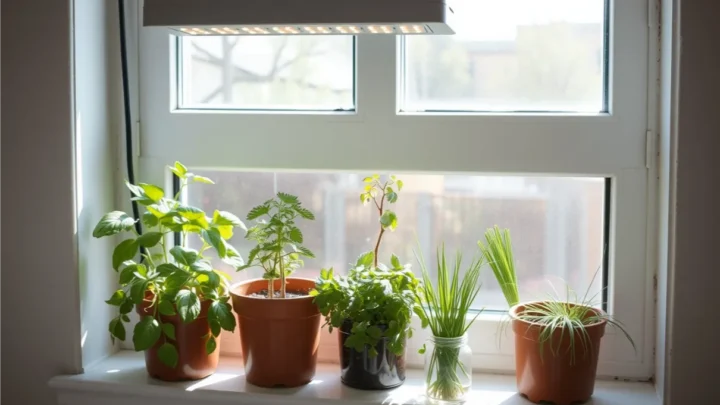
You can keep a pepper plant alive on a bright, unobstructed south-facing windowsill, especially in summer, but harvests are usually sparse. Modern double-pane window glass filters out a portion of solar radiation, and indoor window light only hits one side of the plant for a few hours a day. Adding even a modest supplemental LED grow light dramatically improves stem strength, flower retention, and pepper yields.
2. How many hours of grow light do indoor peppers need each day?
Plan on 14 to 16 hours of light per day during the seedling and vegetative stages, then shift to 12 to 14 hours per day once the plant begins flowering and setting fruit. Always provide at least 8 to 10 hours of uninterrupted darkness every 24 hours so the plant can complete essential respiration and metabolic processes.
3. Do indoor peppers need red and blue (“blurple”) lights, or are white LEDs better?
Full-spectrum white LED grow lights are generally the better choice for home growers. They emit all the blue and red wavelengths peppers need for compact foliage and fruiting, while also including green and yellow wavelengths that penetrate deeper into dense canopies—and they allow you to clearly inspect your leaves for pests like aphids or spider mites without distorted purple lighting.
4. How close should LED grow lights be to pepper plants?
It depends on your fixture’s power. Low-wattage LED bar lights or fluorescent T5 tubes usually work best 6 to 12 inches above the top leaves. Higher-output 100W+ LED panels should typically hang 12 to 18 inches above the canopy. Always check your specific light’s manufacturer recommendations and watch the upper leaves for signs of curling or bleaching.
5. Why are my indoor pepper flowers falling off even with a grow light?
Blossom drop indoors usually comes down to one of four triggers: insufficient daily light intensity (DLI), lack of pollination (since there are no bees or wind inside), indoor temperatures climbing above 85°F (29°C) or dropping below 60°F (15°C), or very dry air from home heating/AC. Confirm your light sits at the right height for flowering, gently tap your plant stems every other day to distribute pollen, and keep soil moisture even.
Bringing Your Indoor Pepper Light Plan Together
Success with indoor peppers rarely comes from buying the most expensive lamp on the market—it comes from consistency. By matching your light height and daily timer to each phase of your plant’s life, giving seedlings close, bright days to build sturdy stems, and maintaining steady, high-intensity light once blossoms open, you create the exact conditions peppers need to thrive in compact indoor spaces.
Start by setting up a simple outlet timer, choosing a compact pepper variety suited to your shelf or floor space, and adjusting your light height once a week as your plants grow. With a dependable light schedule in place, you will be harvesting fresh, homegrown peppers right from your living space long after outdoor gardens have gone quiet for the season.

Similar Posts