Grow Light Electricity Cost Calculator
Botanical Horticulturist & Food Preservation Specialist at Brittle Bloom · Certified Master Gardener & Master Food Preserver · 12+ Years in Plant Propagation & Food Preservation
Grow Light Calculator
Smart energy cost estimator
Your grow room is within budget. Great job!
Your grow light setup is ready to calculate. Adjust the settings to explore your electricity costs.
There is nothing quite like the magic of spotting your first emerald-green tomato cotyledons arching through damp potting mix in late winter, or snipping fresh Genovese basil from a kitchen shelf while frost coats the windowpanes outside.
Indoor grow lights give vegetable, herb, and flower growers the freedom to bypass short outdoor seasons, raise stocky transplants, and harvest leafy greens twelve months a year. Yet right after the excitement of setting up a seed rack comes a very practical question: what is this going to do to my electric bill?
Many home gardeners hesitate to plug in supplementary lighting because they associate indoor plant lights with sky-high utility statements.
Decades ago, when high-pressure sodium lamps and heavy magnetic ballasts dominated indoor horticulture, that worry was well-founded.
Today, modern full-spectrum light-emitting diodes (LEDs) have transformed home growing economics. In many households, running a single shelf of seedling lights for two months in spring costs less than buying two flat packs of nursery starts at the garden center.
Even so, guessing at your utility bill is never fun. Whether you are illuminating a single tray of zinnias and sweet peas or powering a three-tier wire rack packed with peppers, broccoli, and culinary herbs, using a grow light electricity cost calculator method takes the mystery out of indoor gardening. Below, we will walk through the exact step-by-step math to calculate your daily, monthly, and seasonal lighting expenses, compare real-world home gardening setups, and share science-backed ways to keep your plants thriving while trimming every unnecessary cent from your power bill.
The Simple Formula Behind Any Grow Light Electricity Cost Calculator
You do not need an engineering degree to figure out how much electricity grow lights use. Every utility company in North America and around the world bills residential customers by the kilowatt-hour (kWh). One kilowatt-hour equals 1,000 watts of power running continuously for one hour.
To build your own grow light electricity cost calculator on a notepad or phone calculator, you only need four numbers:
- Actual wattage: The real electrical power your fixture draws from the wall outlet, measured in watts (W).
- Daily hours: The number of hours your lights stay switched on each day (also called the photoperiod).
- Growing days: The total number of days you plan to run the fixture per month or growing cycle.
- Electricity rate: The price your local utility charges per kilowatt-hour, found on your monthly electric statement.
Once you have those four figures, run them through this two-step formula:
$$\text{Daily kWh} = \frac{\text{Actual Watts} \times \text{Hours per Day}}{1,000}$$
$$\text{Total Cost} = \text{Daily kWh} \times \text{Number of Days} \times \text{Electricity Rate per kWh}$$
Let us put that equation to work with a quick example. Suppose you use a 40-watt LED shop light over a tray of heirloom tomato and marigold seedlings. You run the fixture on a timer for 16 hours a day over a 30-day month, and your local utility charges $0.16 per kWh.
- Multiply watts by daily hours: $40\text{ watts} \times 16\text{ hours} = 640\text{ watt-hours per day}$.
- Convert to kilowatt-hours: Divide $640$ by $1,000$ to get $0.64\text{ kWh per day}$.
- Calculate monthly usage: Multiply $0.64\text{ kWh} \times 30\text{ days} = 19.2\text{ kWh per month}$.
- Multiply by your utility rate: $19.2\text{ kWh} \times \$0.16 = \$3.07\text{ per month}$.
For roughly three dollars a month, that single fixture can raise 36 to 72 sturdy vegetable and flower transplants ready for your backyard raised beds.
Why "Actual Wattage" Matters More Than "Equivalent Wattage"
The single biggest mistake gardeners make when using a grow light electricity cost calculator is entering the headline number printed on the front of the box. Many online lighting brands advertise fixtures as "600W Equivalent" or "1000W LED Grow Light" to suggest their lamp produces as much light as an old-fashioned 1,000-watt high-intensity bulb. In reality, a "1000W Equivalent" LED board usually pulls only 90 to 110 watts from the wall.
If you plug 1,000 watts into your calculation instead of 100 watts, your estimated electric bill will look ten times higher than what you will actually pay. Before calculating your costs, always look for the phrase actual power draw, input power, or rated wattage in the fine print of the product manual or on the silver sticker attached to the LED driver.
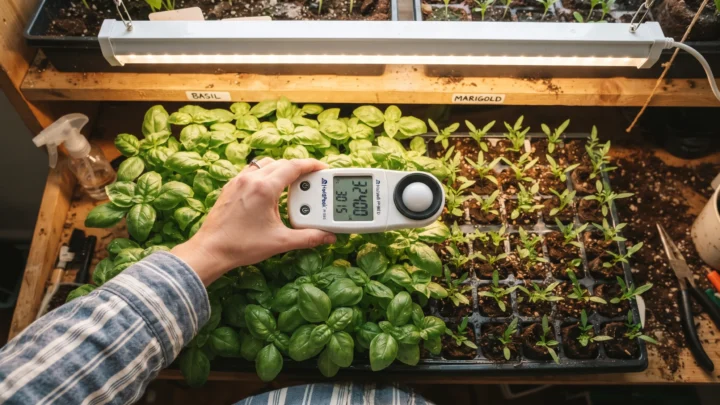
If you already own older fixtures with faded labels, or if you use dimmable LED panels at partial brightness, a plug-in electricity usage monitor (often sold at hardware stores or borrowed from local public libraries) gives you an instant, exact watt reading right at the wall socket.
How Regional Electricity Rates Change the Math
Just as USDA plant hardiness zones and last spring frost dates vary dramatically from region to region, electricity prices fluctuate depending on where you live and how your local utility generates power. According to U.S. Energy Information Administration (EIA) residential benchmarks, the national average hovers near $0.16 to $0.18 per kWh, but local realities span a wide spectrum.
- Low-rate regions: Gardeners in parts of the Pacific Northwest, Idaho, or the Mountain West often pay between $0.11 and $0.13 per kWh thanks to abundant hydroelectric power.
- Mid-rate regions: Growers across much of the Midwest, South, and Mid-Atlantic typically see rates between $0.14 and $0.18 per kWh.
- High-rate regions: Gardeners in New England, California, Alaska, and Hawaii frequently face residential rates ranging from $0.28 to greater than $0.40 per kWh.
Always check the "Supply" and "Delivery" lines on your most recent utility bill to find your true combined cost per kWh. Some utilities list a low base generation rate of $0.09 per kWh on the first page, but once transmission fees and local taxes are bundled in, the effective rate per kWh is closer to $0.17. Divide your total bill dollar amount by the total kWh used that month for the most accurate real-world rate.
Quick-Reference Grow Light Electricity Cost Table
If you want a fast benchmark before pulling out a calculator, the table below compares five common indoor gardening setups. Each row assumes a standard 16-hour daily photoperiod over a 30-day month at a baseline electricity rate of $0.16 per kWh.
| Grow Light Setup | Actual Watts | Daily kWh (16 Hrs) | Monthly kWh (30 Days) | Monthly Cost ($0.16/kWh) |
| Clip-On LED Desk Lamp | 20 W | 0.32 kWh | 9.6 kWh | $1.54 |
| Two-Bulb T5 Fluorescent (4 ft) | 54 W | 0.86 kWh | 25.9 kWh | $4.15 |
| Single LED Bar or Shop Light | 40 W | 0.64 kWh | 19.2 kWh | $3.07 |
| Mid-Size Full-Spectrum LED Panel | 100 W | 1.60 kWh | 48.0 kWh | $7.68 |
| Four-Shelf Seed Starting Rack | 160 W | 2.56 kWh | 76.8 kWh | $12.29 |
To adjust these numbers for your neighborhood, simply multiply the Monthly Cost column by a quick ratio. If your utility rate is $0.32 per kWh (double the $0.16 baseline), double the monthly cost shown in the chart. If you run your lights for only 12 hours a day instead of 16, reduce the monthly cost by one-quarter (25%).
Three Real-World Home Gardening Cost Scenarios
Numbers on a chart become much more useful when connected to actual plants, soil trays, and harvest goals. Different crops demand different light intensities and day lengths—a concept horticulturalists measure as Daily Light Integral (DLI). Here is how the electricity math plays out across three popular home growing projects, along with the plant care adjustments needed to make every watt count.
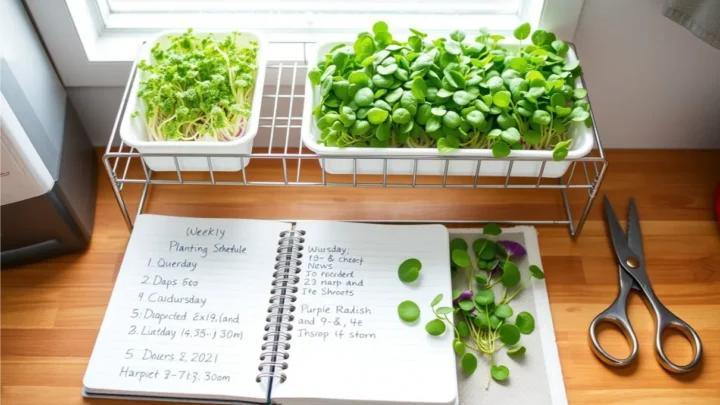
Scenario 1: The Countertop Culinary Herb and Microgreen Garden
Growing loose-leaf lettuce, arugula, cilantro, parsley, and basil indoors during fall and winter does not require blazing desert sunlight. Leafy greens and tender culinary herbs thrive under moderate light intensity when fixtures are positioned 6 to 10 inches above the foliage canopy.
- The setup: One 24-watt full-spectrum LED strip mounted under a kitchen cabinet or over a bamboo countertop stand.
- Photoperiod: 14 hours on, 10 hours off per day.
- Daily energy use: $(24\text{ W} \times 14\text{ hours}) \div 1,000 = 0.336\text{ kWh per day}$.
- Monthly cost at $0.16/kWh: $0.336\text{ kWh} \times 30\text{ days} \times \$0.16 = \$1.61\text{ per month}$.
- Annual cost (365 days): $\$19.62\text{ per year}$.
Practical growing tip: Because indoor kitchens have lower humidity than summer gardens, check container moisture every two days by pressing your finger an inch into the potting mix. Use a well-draining, peat-free or coco-coir indoor potting mix amended with perlite, and harvest outer lettuce leaves and basil tips regularly so compact plants stay within the sweet spot of your 24-watt light beam rather than bolting upward into the diodes.
Scenario 2: The Spring Vegetable and Flower Seed-Starting Station
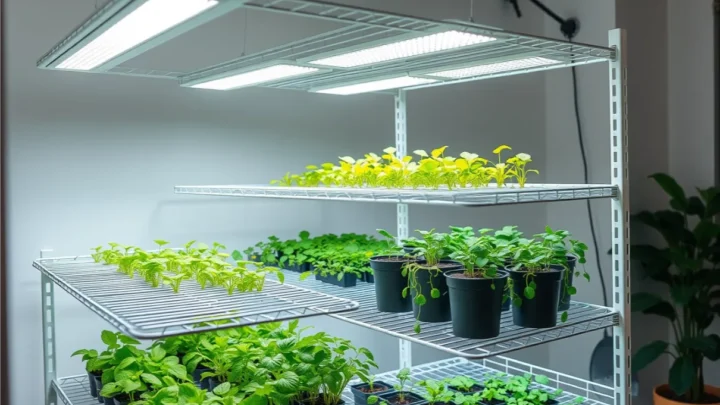
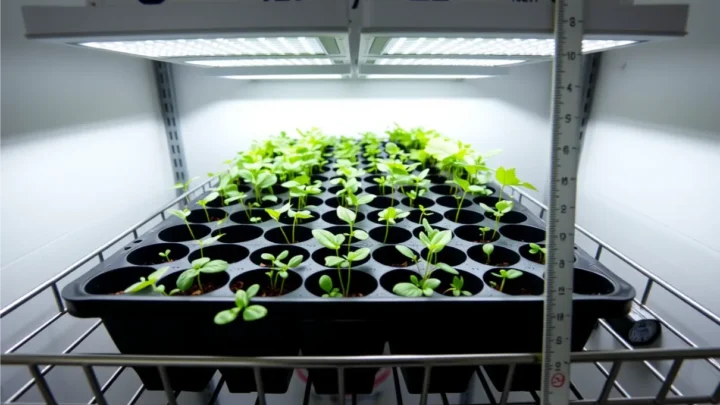
For backyard gardeners, a multi-shelf wire rack is the engine room of spring. Starting brassicas (broccoli, kale, cabbage), warm-season crops (tomatoes, peppers, eggplants), and annual cut flowers (cosmos, snapdragons, celosia) indoors requires bright, even light across standard 1020 propagation trays so stems grow thick and sturdy rather than pale and leggy.
- The setup: Three shelves, each equipped with two 36-watt linkable LED utility grow bars ($3 \times 72\text{ W} = 216\text{ watts total}$).
- Accessory power: Two 20-watt seedling heat mats ($40\text{ W total}$) used only during the first 7 days of germination, plus one small 15-watt clip fan running 16 hours a day for airflow.
- Photoperiod: 16 hours per day for an 8-week (56-day) spring propagation season.
- Lighting energy (56 days): $(216\text{ W} \times 16\text{ hours} \div 1,000) \times 56\text{ days} = 193.5\text{ kWh}$.
- Heat mat energy (7 days at 24 hrs): $(40\text{ W} \times 24\text{ hours} \div 1,000) \times 7\text{ days} = 6.7\text{ kWh}$.
- Fan energy (56 days at 16 hrs): $(15\text{ W} \times 16\text{ hours} \div 1,000) \times 56\text{ days} = 13.4\text{ kWh}$.
- Total 8-week season cost at $0.16/kWh: $(193.5 + 6.7 + 13.4)\text{ kWh} \times \$0.16 = 213.6\text{ kWh} \times \$0.16 = \$34.18\text{ total}$ (or about $\$17.09\text{ per month}$).
Practical growing tip: Notice how timing your seed starting to your local climate saves both money and plant stress. University extension educators—including specialists at the University of Minnesota Extension—remind home growers that starting tomato seeds 10 or 12 weeks before your local last spring frost date instead of the recommended 6 to 8 weeks results in rootbound, overgrown plants and an extra month of unnecessary electricity charges. Look up your county's average last frost date through your local cooperative extension office and count backward on the calendar before plugging in your rack.
Scenario 3: Fruiting Indoor Crops and Overwintering Patio Citrus
Producing flowers and ripe fruit indoors—such as dwarf determinate cherry tomatoes, bush strawberries, or overwintered Meyer lemon and calamondin trees—requires substantially higher light intensity than raising seedlings or leafy herbs. High-output quantum-board LEDs deliver the dense photosynthetic photon flux (PPF) required to set blossoms indoors.
- The setup: One 150-watt full-spectrum dimmable LED board suspended in a reflective corner grow area.
- Photoperiod: 14 hours per day over 120 days of winter shelter.
- Daily energy use: $(150\text{ W} \times 14\text{ hours}) \div 1,000 = 2.1\text{ kWh per day}$.
- Monthly cost at $0.16/kWh: $2.1\text{ kWh} \times 30\text{ days} \times \$0.16 = \$10.08\text{ per month}$.
- Full 4-month winter cost: $\$40.32\text{ total}$.
Practical growing tip: High-output LED boards warm the air slightly and accelerate plant transpiration. Container citrus and fruiting tomatoes under 150-watt panels absorb water and nutrients faster than dormant houseplants. Water thoroughly until moisture runs from the bottom drainage holes, empty the saucer after 15 minutes to prevent root rot, and space containers at least 6 to 8 inches apart so light reaches lower branches.
Comparing Grow Light Technologies: How Fixture Choice Drives Your Bill
When you run numbers through a grow light electricity cost calculator, you quickly notice that two fixtures producing the exact same plant growth can have wildly different power bills. That gap comes down to photosynthetic efficacy—how efficiently a lamp converts a watt of household electricity into usable light wavelengths (measured in micromoles per joule, or $\mu\text{mol/J}$) rather than wasted heat.
Full-Spectrum LED Grow Lights
Modern white full-spectrum LEDs are the gold standard for home vegetable, herb, and flower growers. Quality consumer LED grow bars and boards convert electricity into plant-usable light with roughly 40% to 60% less energy consumption than older fluorescent tubes of equal brightness.
- Hang height: Typically 6 to 18 inches above plants depending on wattage and lens angle.
- Heat output: Minimal radiant heat toward leaves, reducing leaf scorch and soil evaporation.
- Lifespan: Often rated for 30,000 to 50,000 hours, meaning no yearly bulb replacement expenses.
T5 and T8 Fluorescent Shop Lights
Many seasoned gardeners still have 4-foot T8 or high-output T5 fluorescent fixtures hanging in basements or potting sheds. While fluorescent lights grow healthy seedlings, they are less energy-efficient than LEDs and lose light output over time as the internal phosphors degrade.
- Hang height: Must hang very close—usually 2 to 4 inches above seedling tops—to prevent leggy stems.
- Hidden power draw: Older magnetic ballasts consume extra electricity and radiate noticeable warmth.
- Upgrade path: If your fixture uses a compatible ballast, swapping aging fluorescent tubes for direct-wire or plug-and-play LED tubes can cut electricity usage by nearly half.
High-Intensity Discharge (MH and HPS) Fixtures
Metal Halide (MH) and High-Pressure Sodium (HPS) lamps typically range from 250 watts to 1,000 watts. While once common in large greenhouses, they generate intense radiant heat that often requires noisy exhaust fans and extra air conditioning in a home environment. Unless you are heating a freezing outbuilding where the waste heat serves a dual purpose, replacing an old 400W HID lamp with a 150W to 200W modern LED board will pay for itself in electricity savings within one to two growing seasons.
Incandescent and Halogen "Plant Bulbs"
Standard incandescent bulbs and older glass "grow bulbs" sold at hardware stores convert roughly 90% of their electricity into heat rather than light. They are expensive to run, can scorch delicate foliage if placed too close, and lack the light intensity needed for vegetables and flowers. Swap these out for an LED grow bulb (such as a PAR38 full-spectrum LED bulb drawing 15 to 25 actual watts) for immediate energy savings.
How Photoperiod and Daily Light Integral (DLI) Impact Your Power Bill
One of the easiest ways to overspend on electricity is leaving grow lights switched on longer than your plants can biologically use the light. It is tempting to think that if 14 hours of light produces good growth, 24 hours of continuous light will make tomatoes grow twice as fast. Plant physiology tells a very different story.
According to horticultural research from Purdue Extension and other land-grant universities, plants rely on a daily dark cycle (respiration period) to metabolize the sugars created during photosynthesis, transport carbohydrates to developing roots, and regulate growth hormones. Leaving lights on 24 hours a day wastes 33% more electricity than a 16-hour schedule and can cause leaf chlorosis (yellowing), stunted growth, or prematurely stressed plants.
Matching Light Hours to Plant Growth Stages
Use these science-based daily photoperiod targets to keep your plants healthy and your grow light electricity cost calculator totals as low as possible:
- Germinating seeds (pre-sprouting): Most vegetable and flower seeds do not need light until the first loop of stem breaks the soil surface (exceptions include tiny surface-sown seeds like lettuce, snapdragons, and begonia, which need light to trigger germination). Save electricity by waiting until the first green shoots emerge before running full banks of lights.
- Vegetable and flower seedlings: Run lights for 14 to 16 hours per day, followed by 8 to 10 hours of complete darkness.
- Leafy greens and culinary herbs: Lettuce, spinach, swiss chard, mint, and parsley grow beautifully on 12 to 14 hours of light per day. Dropping from 16 hours to 12 hours cuts your monthly electricity bill by 25%.
- Low-light foliage houseplants: Ferns, pothos, philodendrons, and peace lilies supplemented during dark winters only need 8 to 12 hours per day at modest wattage.
How Hanging Height Multiplies Light Efficiency
Light obeys the inverse-square law: as you double the distance between your grow light and your plant leaves, the light intensity reaching a specific spot drops dramatically (though reflectors and walls capture some scatter). When a gardener hangs a 40-watt LED shop light 24 inches above a seedling tray instead of the recommended 6 to 8 inches, the seedlings stretch thin and weak—prompting the gardener to either run the light for 18 hours or buy a second fixture.
Instead of spending more on electricity, adjust your suspension chains or rope ratchets weekly so the fixture stays at the manufacturer's recommended distance above the tallest leaves. Always check leaf temperature with the back of your hand at canopy level; if it feels comfortably neutral after an hour of operation, the height is safe.
Hidden Factors That Influence Indoor Growing Energy Costs
When estimating your indoor garden budget, the light fixture itself is the main character, but several supporting factors around your growing space can nudge your costs up or down.
Heat Output, Room Temperature, and Soil Moisture
Every watt of electricity entering your home eventually turns into gentle heat. In a cool basement during February or March, the mild warmth from an LED driver helps keep seedling root zones near the ideal 65°F to 75°F range. However, if you run multiple fixtures in a small, closed spare bedroom during late spring or summer, your home air conditioner may have to work harder to remove that heat.
Higher temperatures under lights also speed up evaporation from seed cells and small pots. Check your trays daily: small plastic cells dry out much faster under bright lights and circulating air than outdoor garden beds. Water from the bottom by pouring lukewarm water into the solid base tray and letting the potting mix wick moisture upward for 20 to 30 minutes, then pour off any standing water. Bottom watering keeps foliage dry, prevents fungal issues, and encourages deep root growth.
Seed-Starting Heat Mats and Circulation Fans
If you want a complete picture from your grow light electricity cost calculator, remember to include your propagation accessories:
- Seedling heat mats: A standard 10-by-20-inch heat mat draws about 17 to 20 watts. Warm-season seeds like peppers, eggplants, and tomatoes germinate much faster at 75°F to 85°F soil temperature. However, once 70% of the tray has sprouted, unplug the heat mat immediately. Leaving heat mats running under sprouted seedlings produces soft, floppy stems and adds unnecessary watt-hours to your bill.
- Oscillating fans: A small clip-on or tabletop fan draws only 10 to 20 watts. Running a gentle breeze across seedlings for several hours a day strengthens cell walls in the stems (a process called thigomorphogenesis) and circulates dry air across the soil surface to prevent damping-off fungal disease. The tiny cost—often less than $1.50 a month—is worth every penny in saved plants.
Time-of-Use (TOU) Utility Billing
More electric utilities now use Time-of-Use (TOU) pricing, where electricity costs substantially more during late-afternoon and early-evening peak hours (often 4:00 PM to 9:00 PM) and drops to a discounted rate overnight and on weekends.
Your seedlings and indoor herbs do not care whether their "daytime" happens while you are awake or asleep, provided their growing area stays dark during their rest period. If your utility charges $0.32 per kWh during peak evening hours and $0.12 per kWh off-peak, set your grow light timer to turn off at 3:30 PM and turn back on at 9:30 PM. Shifting your 16-hour light cycle to overlap with off-peak overnight hours can slash your monthly grow light bill by 30% to 50% without changing a single piece of equipment.
7 Practical Ways to Lower Your Grow Light Electricity Bill Without Sacrificing Plant Health
You do not have to choose between stocky, vibrant transplants and an affordable utility bill. Apply these seven practical habits to stretch every kilowatt-hour in your indoor garden:
- Automate with a grounded timer: Plugging your lights into a simple mechanical or smart digital timer ensures fixtures never stay on for 3 or 4 extra hours when life gets busy.
- Use a dimmer for early growth: If your LED fixture has a dimming knob, run it at 50% power during the first week after germination and lower the light closer to the tray, ramping up to 100% as true leaves develop.
- Surround trays with reflective surfaces: Hanging inexpensive matte-white poster board or reflective Mylar curtains along the sides of your grow shelf bounces escaping light back onto outer plant rows.
- Group plants by light requirement: Place light-hungry tomatoes, peppers, and zinnias directly under the center of the fixture where intensity is highest, and tuck shade-tolerant impatiens, coleus, or lettuce around the perimeter.
- Wipe down diodes and tubes monthly: Household dust, potting soil particles, and hard-water misting spots can block 10% to 15% of a fixture's light output. Unplug the cool fixture and wipe it gently with a dry microfiber cloth before each season.
- Harden off on sunny days: Once outdoor daytime temperatures consistently reach 55°F to 60°F in spring, carry seedling trays outside into dappled shade and gradually increase morning sun exposure while turning your indoor grow lights off for those hours.
- Match sowing dates to your local zone: Consult your local university cooperative extension planting calendar so you start seeds right on schedule—keeping transplants under indoor lights for 6 weeks instead of 10 weeks cuts your seasonal energy cost by nearly 40%.
Frequently Asked Questions About Grow Light Electricity Costs
1. How much does it cost to run one LED grow light for a month?
A typical single-shelf LED grow light drawing 40 actual watts and running 16 hours a day uses 19.2 kWh per month. At the U.S. average electricity rate of $0.16 per kWh, that costs $3.07 per month. A smaller 20-watt clip-on light for houseplants or countertop herbs costs about $1.54 per month, while a high-output 100-watt LED board costs around $7.68 per month.
2. Do full-spectrum grow lights use more electricity than regular LED shop lights?
No—electricity consumption depends strictly on the fixture's actual wattage draw from the wall, not the color spectrum of the diodes. A 40-watt full-spectrum plant light and a 40-watt standard daylight LED shop light consume the exact same amount of electricity per hour. However, dedicated horticultural LEDs often use higher-efficiency diodes that deliver more plant-usable photons per watt, allowing you to use lower wattage or fewer fixtures for the same crop growth.
3. Does dimming an LED grow light actually reduce electricity usage?
Yes. Modern LED drivers reduce power draw proportionally when dimmed. If you turn a 100-watt dimmable LED panel down to 50% brightness for young seedlings or low-light herbs, it draws roughly 50 watts from the outlet, cutting your hourly electricity cost in half.
4. Is it cheaper to start vegetable seeds under grow lights or buy nursery transplants?
For anyone growing more than a dozen plants, starting seeds under LED grow lights is significantly more economical after the initial fixture purchase. Running a two-shelf, 80-watt LED setup for 8 weeks in spring costs roughly $14 to $16 in total electricity. In that space, you can easily raise 72 to 144 vegetable and flower transplants—plants that would cost $150 to $350 if purchased individually in four-inch pots at a retail garden center.
5. Are there safety rules I should follow when setting up multiple grow lights indoors?
Always keep electrical safety top of mind around water and damp potting soil. Plug grow lights into outlets protected by a Ground Fault Circuit Interrupter (GFCI), use heavy-duty grounded timers rated for your total wattage, and form a "drip loop" in power cords so water cannot trickle down a wire into a socket. Never daisy-chain more linkable lights together than the manufacturer specifies on the warning label, and keep fixtures clear of curtains or paper.
Conclusion: Grow Healthy Plants With Confidence and Predictable Costs
Starting your own seeds and tending an indoor herb garden should feel grounding and joyful—not like a gamble with your monthly household budget. Once you know how to look past exaggerated marketing wattage, locate your fixture's actual power draw, and run the numbers through a simple grow light electricity cost calculator formula, you stay in complete control of your indoor growing expenses.
For just a few dollars a month, modern LED fixtures let you raise stocky heirloom tomatoes, vibrant cut-flower starts, and crisp winter salad greens right on your schedule. Grab your most recent electric bill to check your local kWh rate, inspect the wattage label on your lights, set your timer for a steady 14-to-16-hour rhythm, and enjoy a thriving indoor garden all season long.

Similar Posts