Indoor Tomato Lighting Calculator
Botanical Horticulturist & Food Preservation Specialist at Brittle Bloom · Certified Master Gardener & Master Food Preserver · 12+ Years in Plant Propagation & Food Preservation
There is something deeply satisfying about walking over to a sunny corner of your home in the dead of winter and picking a sun-ripened, juicy tomato fresh off the vine. For indoor gardeners, apartment dwellers, and anyone with a green thumb who refuses to let seasonal changes halt their harvest, growing tomatoes indoors is the ultimate rewarding challenge.
However, if you have ever tried growing tomatoes inside a typical home, you have likely run into a frustrating wall: your plants grow tall, pale, and spindly (what gardeners call “leggy”), lean desperately toward the nearest window, drop their blossoms, and fail to produce fruit.
The number one culprit behind indoor tomato failure isn’t lack of fertilizer or small pots—it is light. Tomatoes are absolute sun worshippers. Outdoors, they thrive in full sun, soaking up the equivalent of intense, direct summer rays for 8 to 12 hours a day. Recreating that environment indoors requires more than just screwing a bright LED bulb into your kitchen ceiling fixture. It requires understanding light intensity, daily light integrals, and calculating the exact setup your plants need.
In this comprehensive guide, we will break down everything you need to know about lighting indoor tomatoes, introduce a practical calculation framework, and walk you through building a productive indoor setup that actually yields fruit.
Tomato Light Requirements: Why Standard Bulbs Fall Short
Indoor Tomato Lighting Calculator
Is your grow light powerful enough for healthy tomato plants? Calculate your daily light and discover what your tomatoes need.
🍅 1. Select Your Tomato Growth Stage
Different stages of tomato growth need different amounts of daily light.
💡 2. Enter Your Grow Light Details
Use your grow light specifications or a PPFD measurement taken at the top of your tomato canopy.
Example: Enter 400 if your light delivers 400 PPFD at leaf level.
A suggested target is automatically selected based on your growth stage. You can customize it.
💡 Lighting Analysis
🎯 Your Next Growing Move
Before diving into calculations, it helps to understand why tomatoes are so demanding when it comes to light. In botanical terms, tomatoes are high-light fruiting crops. Unlike leafy greens like lettuce or shade-tolerant houseplants, tomatoes need a massive amount of solar energy to power photosynthesis, develop flowers, and ripen juicy fruit.
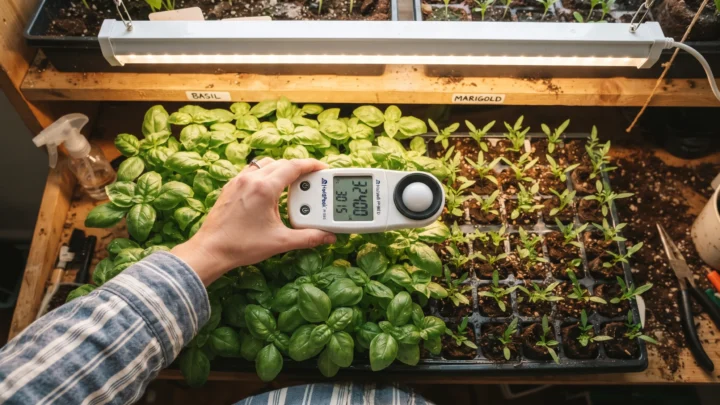
When measuring light for indoor growing, standard household measurements like lumens (which measure human eye perception of brightness) are practically useless. Instead, indoor growers rely on professional metrics:
- PPFD (Photosynthetic Photon Flux Density): Measures the actual number of photosynthetically active photons hitting a specific square meter every second ($\mu\text{mol/m}^2/\text{s}$).
- DLI (Daily Light Integral): Measures the total amount of light delivered to a plant over a 24-hour period, expressed in moles per square meter per day ($\text{mol/m}^2/\text{d}$).
The Magic Numbers for Indoor Tomatoes
To set flowers and grow healthy fruit, indoor tomatoes generally require:
- PPFD at canopy level: $400$ to $600\; \mu\text{mol/m}^2/\text{s}$ during the vegetative stage, and up to $600$ to $800\; \mu\text{mol/m}^2/\text{s}$ during the flowering and fruiting stage (supplemented with CO2 or high ambient air circulation if pushing the upper limits).
- DLI (Daily Light Integral): At least $20$ to $25$ $\text{mol/m}^2/\text{d}$, and ideally up to $30\; \text{mol/m}^2/\text{d}$.
- Photoperiod (Duration): $14$ to $18$ hours of light per day. Tomatoes are day-neutral plants, meaning they don’t rely on specific day lengths to trigger flowering, but they do need a long daily light duration to accumulate enough energy.
The Indoor Tomato Lighting Calculation Framework
Because every indoor growing space is different—ranging from a small kitchen countertop rack to a dedicated grow tent—calculating your lighting needs requires looking at three core variables: Growing Space Area (Square Footage), Target DLI, and Fixture Efficacy.
Here is how you can calculate your indoor tomato lighting requirements step-by-step.
Step 1: Calculate Your Growing Area
Measure the length and width of the footprint your tomato plants will occupy.
$$\text{Area (sq. ft.)} = \text{Length} \times \text{Width}$$
Example: If your indoor grow rack shelf is $2\text{ ft} \times 4\text{ ft}$, your growing area is $8$ square feet.
Step 2: Determine Total Photons Needed (PPF)
Tomatoes need a high PPFD target (let’s aim for an average canopy target of $500\; \mu\text{mol/m}^2/\text{s}$ for a balanced indoor setup). To calculate the total Photosynthetic Photon Flux (PPF, measured in micromoles per second) required for your space:
$$\text{Total PPF} = \text{Area (sq. ft.)} \times \text{Target PPFD} \times 0.0929$$
(Note: $0.0929$ converts square feet to square meters).
Using our $8$ sq. ft. example:
$$\text{Total PPF} = 8 \times 500 \times 0.0929 \approx 371.6\; \mu\text{mol/s}$$
This tells you that your total light fixture(s) should output a combined PPF of roughly $370$ to $400\; \mu\text{mol/s}$ dedicated to that $8$ sq. ft. footprint.
Step 3: Check Wattage and Efficacy
Modern LED grow lights list their “photon efficacy” in $\mu\text{mol/J}$ (micromoles per joule). High-efficiency LED bars and boards usually range from $2.0$ to $2.8\; \mu\text{mol/J}$. To find out how many actual watts of LED power you need:
$$\text{Total Watts} = \frac{\text{Total PPF}}{\text{Fixture Efficacy}}$$
Using our $370\; \mu\text{mol/s}$ requirement with a $2.5\; \mu\text{mol/J}$ light:
$$\text{Total Watts} = \frac{370}{2.5} \approx 148 \text{ Watts of actual powerdraw}$$
Important Note on Marketing Claims: Always look at the actual wattage pulled from the wall, not misleading labels like “1000W LED equivalent” which often refer to old incandescent outputs. For fruiting tomatoes, budget roughly $30$ to $40$ actual LED watts per square foot of canopy space.
Choosing the Right Type of Grow Light for Indoor Tomatoes
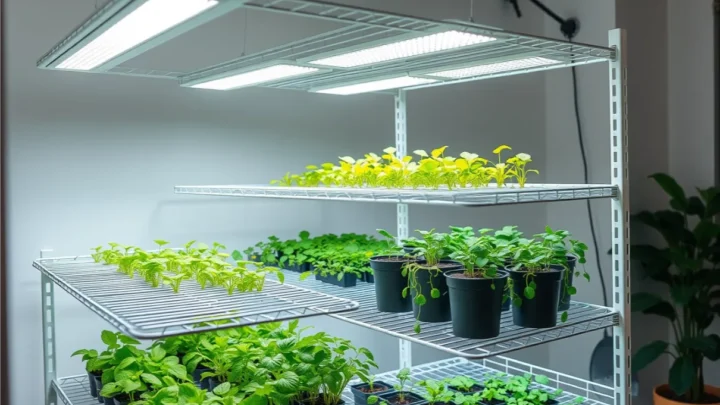
Not all indoor grow lights are created equal. When shopping for your indoor tomato setup, you will generally encounter three main options:
1. Full-Spectrum LED Grow Lights (The Gold Standard)
LEDs have revolutionized indoor gardening. They run cool, last for tens of thousands of hours, consume far less electricity, and can be engineered to emit a precise full spectrum that mimics natural sunlight—including deep reds and blues that drive photosynthesis and fruit set.
- Pros: Highly energy efficient, low heat emission, adjustable dimmers, excellent longevity.
- Cons: Higher upfront cost for high-PPFD commercial-grade fixtures.
2. T5 High-Output Fluorescent Fixtures
Traditional fluorescent tube lights (specifically T5 HO bulbs) were once the staple of indoor seed starting and herb growing.
- Pros: Affordable upfront, wide light spread.
- Cons: Low light penetration depth. While great for starting seedlings or growing microgreens, T5 tubes rarely pack enough punch for mature, fruiting tomato plants unless clustered densely and kept mere inches from the leaves.
3. High-Intensity Discharge (HID) Lights (MH / HPS)
Metal Halide (MH) and High-Pressure Sodium (HPS) lights are industrial-strength options traditionally used in large indoor horticulture.
- Pros: Intense light output.
- Cons: Generate immense amounts of heat, require ventilation fans, consume high amounts of electricity, and are generally impractical for home kitchens or small indoor living spaces.
Step-by-Step Guide to Setting Up Your Indoor Tomato Light System
Once you have calculated your lighting requirements and selected your LED fixture, proper installation and management are critical for a successful harvest.
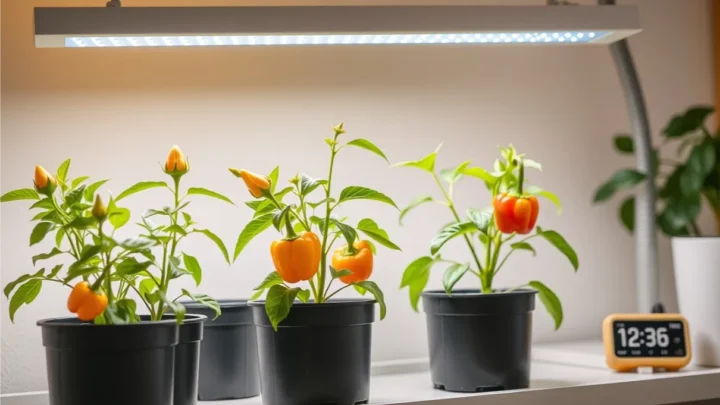
1. Select Dwarf or Micro-Dwarf Tomato Varieties
Trying to grow an indeterminate heirloom beefsteak tomato indoors is a recipe for overcrowding. Indeterminate vines can grow $10$ to $15$ feet tall and demand massive root space. Instead, choose micro-dwarf or dwarf determinate container varieties bred specifically for pots and indoor spaces. Excellent varieties include:
- Micro Tom (grows only 6–8 inches tall)
- Red Robin
- Tiny Tim
- Jochalos
- Spoon Tomato
2. Hang and Adjust Light Height
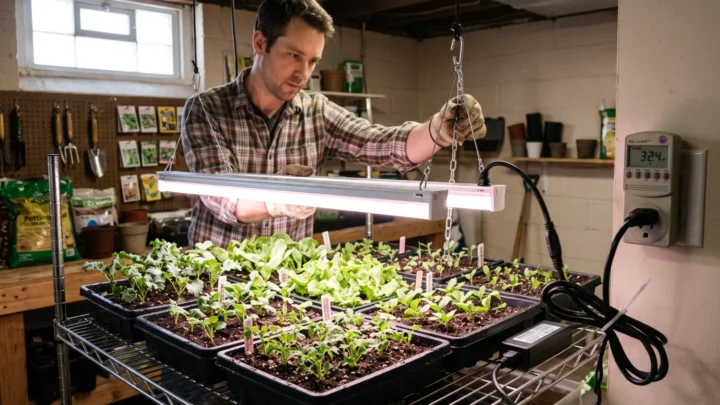
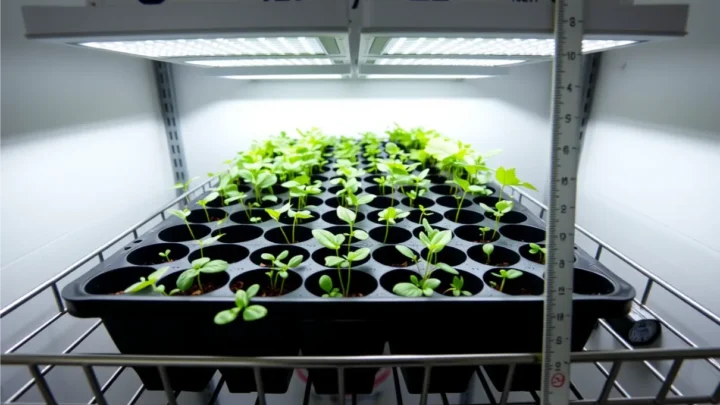
Your lights should be adjustable. As your seedlings grow into sturdy plants, maintain the manufacturer’s recommended hanging height (usually $12$ to $24$ inches above the canopy for LED panels).
- If lights are too close: Leaves may bleach, curl upward, or show signs of light stress.
- If lights are too far: Plants stretch upward, become thin and weak, and drop their flower buds.
3. Set a Timer
Tomatoes need a period of darkness to complete their metabolic cycles. Set your LED grow light on an automatic timer for 14 to 16 hours of light per day, followed by 8 to 10 hours of complete darkness.
4. Assist with Pollination
Outdoor tomatoes rely on wind and buzzing pollinators (like bumblebees) to shake pollen loose within their flowers. Indoors, you are the bee! Once your tomato plants begin producing yellow blossoms, gently flick or vibrate the main stem or individual flower clusters with your finger or an electric toothbrush every morning to ensure self-pollination and fruit set.
Frequently Asked Questions
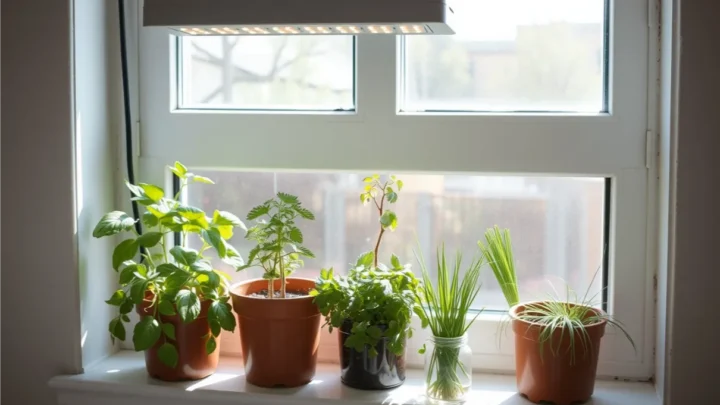
- Can I grow tomatoes indoors on a windowsill without a grow light? In most cases, no. Even a south-facing window during winter months receives far too little light intensity and duration for tomatoes to fruit successfully. Without supplemental LED lighting, windowsill tomatoes typically become weak, leggy vines that fail to flower.
- How many hours a day should my indoor tomato grow lights stay on? Tomatoes thrive with 14 to 16 hours of daily light. Use a reliable plug-in timer to keep your lighting schedule consistent. Avoid leaving lights on 24/7, as plants require a dark period for optimal metabolic health.
- Why are my indoor tomato leaves turning purple? Purple coloration on the underside of leaves or stems is often a sign of phosphorus deficiency, which can be triggered when indoor temperatures drop too low at night (below 60°F / 15°C) or when light intensity is too low for the plant’s metabolic pace. Check your ambient room temperature and light height.
- Do indoor tomatoes need a fan? Yes! Indoor air can become stagnant, leading to fungal issues like powdery mildew and weak stems. Running a small oscillating fan near your tomato plants on a low setting strengthens the stems through mechanical stimulation (thigmomorphogenesis) and improves air circulation.
- What size pot do I need for indoor container tomatoes? For micro-dwarf varieties, a 1-to-2-gallon container filled with a rich, well-draining potting mix is usually sufficient. For larger dwarf varieties, aim for a 3-to-5-gallon pot to give the root system enough room to support fruit production.
Conclusion
Growing tomatoes indoors bridges the gap between seasons, allowing you to enjoy homegrown, vine-ripened flavor all year round. By moving away from guesswork and utilizing a proper indoor tomato lighting calculation—focusing on adequate PPFD, proper DLI, and energy-efficient full-spectrum LEDs—you can successfully transform any indoor corner, shelf, or spare room into a thriving mini-orchard. Remember to choose compact micro-dwarf varieties, keep your lights at the correct height, and assist with hand pollination when those bright yellow blossoms appear.
Note: Always factor in your local climate and indoor ambient temperatures when setting up your indoor garden, as heating and humidity levels vary significantly by region.

Similar Posts