Convert Lux to PPFD for Herbs, Veggies & Flowers
Botanical Horticulturist & Food Preservation Specialist at Brittle Bloom · Certified Master Gardener & Master Food Preserver · 12+ Years in Plant Propagation & Food Preservation
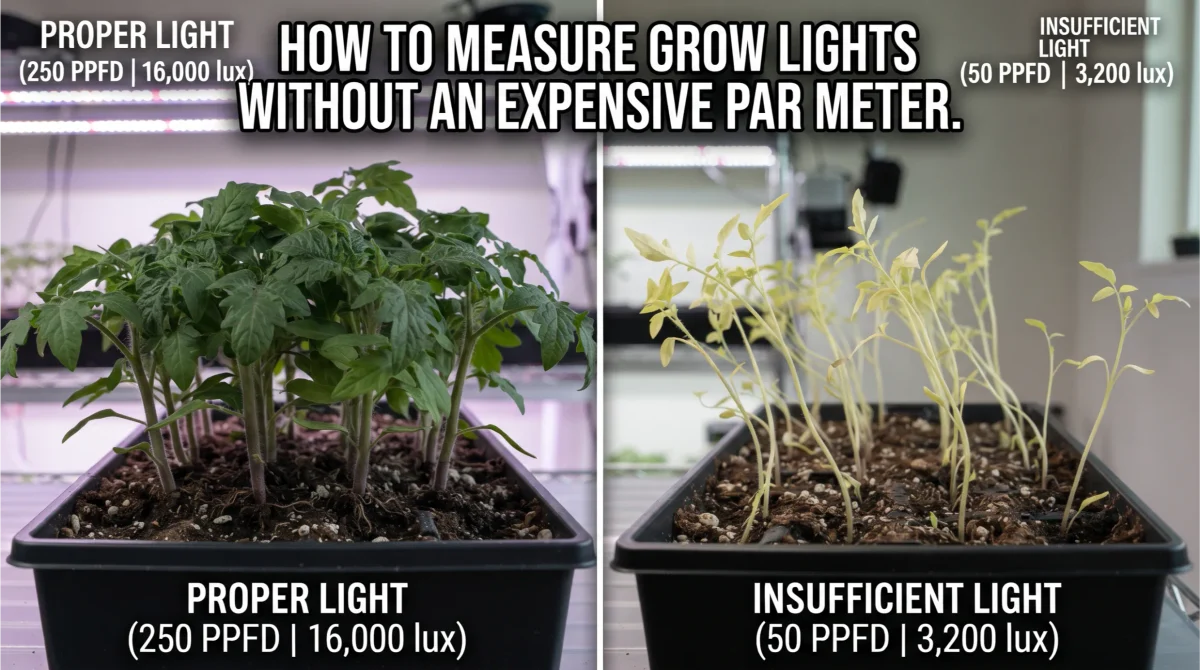
Every spring, countless home gardeners experience the same heartbreak. You fill your seed trays with rich potting mix, sow your favorite heirloom tomatoes, sweet peppers, and zinnias, and place them beneath a bright shop light or beside your sunniest south-facing window. Within a week, the seeds sprout—and within two weeks, they stretch into pale, spindly stems that flop over the moment you brush past them.
To your eyes, that room looks plenty bright. To your seedlings, however, it is as dim as twilight.
Human eyes and plant leaves perceive light in completely different ways. While professional greenhouse managers use specialized quantum sensors to measure plant-usable light in a unit called PPFD (Photosynthetic Photon Flux Density), those commercial meters often cost more than an entire home seed-starting setup. Fortunately, you do not need a laboratory budget to give your plants the exact light they crave. By pairing an affordable handheld lux meter (or a calibrated smartphone sensor) with a reliable Lux to PPFD Estimator, you can translate standard brightness readings into accurate plant-light measurements in seconds.
In this complete guide, you will learn why human vision tricks gardeners, how to use spectrum-specific conversion multipliers developed by agricultural researchers, and how much light your vegetables, culinary herbs, and flower seedlings actually need to grow thick stems and vibrant foliage.
Lux to PPFD Estimator
Convert light intensity into plant-usable light and discover your daily light exposure.
DLI = PPFD × Lighting Hours × 0.0036
PPFD measures instantaneous photosynthetic photon flux.
DLI measures total daily photosynthetic light.
Lux vs. PPFD: Why Your Plants See Light Differently Than You Do
Before converting any numbers, it helps to understand why plant scientists and lighting manufacturers use two different measurement systems in the first place. When you look at a bulb box at the hardware store, the packaging lists lumens or lux. When you read a university extension guide on growing indoor lettuce or starting vegetable transplants, the recommendations are written in PPFD.
What Lux Measures (Human Vision)
Lux measures illuminance—specifically, how bright light appears to the average human eye over one square meter (one lux equals one lumen per square meter). Human vision evolved to be most sensitive to green and yellow wavelengths, peaking right around 555 nanometers on the electromagnetic spectrum. Because our eyes are hyper-sensitive to green-yellow light and much less sensitive to deep blue and deep red wavelengths, a standard lux meter applies a weighting filter (called the photopic luminosity function) that heavily favors green light and largely ignores the edges of the visible spectrum.
What PAR and PPFD Measure (Plant Photosynthesis)
Plants do not care how bright a room looks to you; they care about harvesting photons to drive photosynthesis. According to controlled environment agriculture researchers at Utah State University and Cornell University, plants primarily use wavelengths between 400 and 700 nanometers, a band known as PAR (Photosynthetically Active Radiation).
Within that 400 to 700 nanometer window:
- Blue light (400 to 500 nm) regulates stomatal opening, encourages compact stem growth, and builds thick, sturdy leaves.
- Green light (500 to 600 nm) penetrates deeper into dense leaf canopies to support lower foliage, even though upper leaves reflect some of it.
- Red light (600 to 700 nm) drives peak photosynthetic efficiency, leaf expansion, and flowering responses.
PPFD stands for Photosynthetic Photon Flux Density. Expressed in micromoles of photons per square meter per second ($\mu\text{mol/m}^2\text{/s}$), PPFD counts the exact number of PAR photons landing on a one-square-meter surface every single second. Whether a photon is blue, green, or red, a quantum PAR meter counts it equally.
Why Spectrum Determines the Conversion Formula
Because a lux meter weighs green photons heavily and undercounts red and blue photons, there is no single universal number that converts lux to PPFD for every lamp on earth. Instead, the conversion factor changes depending on the spectral power distribution (color recipe) of your light source.
For example, a cool fluorescent bulb emits a tall spike of green-yellow light, which inflates the lux reading relative to the actual photosynthetic photons available. Full midday sunlight, by contrast, has a broad, balanced spectrum rich in blue, green, and red wavelengths, giving you far more plant-usable photons per lux. By matching your specific light source to its tested spectral multiplier, a Lux to PPFD Estimator bridges the gap between a twenty-dollar light meter and a five-hundred-dollar quantum sensor.
The Complete Lux to PPFD Estimator Chart and Formulas by Light Source
Agricultural physicists, most notably Dr. Bruce Bugbee and the Crop Physiology Laboratory at Utah State University, have tested common natural and artificial light sources to establish reliable conversion constants between lux and PPFD.
To convert your lux reading into an estimated PPFD value, use either the multiplication formula or the division formula below:
$$\text{Estimated PPFD } (\mu\text{mol/m}^2\text{/s}) = \text{Lux} \times \text{Conversion Multiplier}$$
$$\text{Estimated PPFD } (\mu\text{mol/m}^2\text{/s}) = \frac{\text{Lux}}{\text{Calibration Divisor}}$$
Use the reference table below to find the exact multiplier and divisor for your growing setup, along with quick benchmark estimates at two common brightness levels.
| Light Source | Multiplier | Divisor | PPFD at 10,000 Lux | PPFD at 25,000 Lux |
| Direct Sunlight | 0.0185 | 54 | 185 | 463 |
| White + Red Grow LED | 0.0180 | 55.5 | 180 | 450 |
| Standard White LED | 0.0155 | 64.5 | 155 | 388 |
| Cool White Fluorescent | 0.0135 | 74 | 135 | 338 |
| Ceramic Metal Halide | 0.0141 | 71 | 141 | 353 |
| High Pressure Sodium | 0.0122 | 82 | 122 | 305 |
The values in the table above represent PPFD in $\mu\text{mol/m}^2\text{/s}$ at the plant canopy. Always identify which category matches your lamp before calculating your light levels.
Direct Sunlight and Greenhouse Daylight
Natural sunlight is the gold standard for plant growth. On a clear summer day at solar noon, outdoor sunlight reaches roughly 100,000 to 110,000 lux, which translates to approximately 1,850 to 2,000 $\mu\text{mol/m}^2\text{/s}$ of PPFD.
Even when filtered through a clean double-pane south-facing window or a polycarbonate greenhouse panel, sunlight retains its balanced spectral ratio, so you should still use the 0.0185 multiplier (or divide lux by 54) when measuring sunny windowsills, cold frames, or sunrooms.
Standard White LEDs vs. Full-Spectrum Horticultural LEDs
Modern home growers rely heavily on LEDs because they run cool, last for years, and consume minimal electricity. However, LEDs fall into two distinct groups for conversion purposes:
- Standard White LEDs (3000K to 6500K shop lights and household bulbs): These fixtures use blue diodes coated in yellow phosphor to produce white light without extra deep-red diodes. Multiply your lux reading by 0.0155 (or divide by 64.5).
- Full-Spectrum Horticultural White + Deep Red LEDs: Dedicated quantum-style grow boards combine warm and cool white diodes with dedicated 660 nm deep-red diodes. Because lux meters barely register those 660 nm red photons, these boards deliver more photosynthetic punch per lux. Multiply your lux reading by 0.0180 (or divide by 55.5).
Fluorescent Grow Lights (T5, T8, and CFLs)
High-output T5 fluorescent tubes and compact fluorescent lamps remain popular for seed-starting racks and microgreen shelves. Because fluorescent phosphors emit a concentrated spike in the green-yellow waveband where human eyes are most sensitive, a fluorescent tube produces fewer photosynthetic photons per lux than an LED or the sun. Multiply your fluorescent lux reading by 0.0135 (or divide by 74).
High-Intensity Discharge Lamps (MH, CMH, and HPS)
If you use traditional high-intensity discharge fixtures in a basement grow tent or overwintering conservatory:
- Metal Halide (MH) and Ceramic Metal Halide (CMH / LEC): Multiply lux by 0.0141 (divide by 71).
- High Pressure Sodium (HPS): HPS lamps dump most of their energy into yellow-orange wavelengths, inflating the lux reading significantly. Multiply lux by 0.0122 (divide by 82).
Why You Cannot Use a Lux to PPFD Estimator for Red/Blue "Blurple" LEDs
If you own an older purple-tinted LED grow light made strictly of narrow-band royal blue (450 nm) and deep red (660 nm) diodes, do not rely on a lux meter. Remember that a lux meter's sensor filter drops toward zero sensitivity below 460 nm and above 650 nm. Attempting to measure a purple LED with a lux meter produces wild errors exceeding 50 percent, because tiny variations in diode wavelength completely skew the sensor. For narrow-band red/blue fixtures, rely on the manufacturer's published PPFD map or upgrade to a broad-spectrum white LED fixture.
Step-by-Step Guide: How to Measure Lux and Estimate PPFD at Home
Getting accurate readings across your indoor garden or seed bench takes less than ten minutes when you follow a repeatable testing routine.
Choosing Between a Handheld Lux Meter and a Smartphone App
You have two accessible options for capturing raw lux numbers at home:
- Dedicated Handheld Digital Lux Meter: Available at hardware stores or online for fifteen to thirty dollars, a dedicated meter features a domed white cosine corrector over the photodiode sensor. That white dome is critical because it captures light arriving at angled trajectories just like a flat leaf does.
- Smartphone Light Meter Apps: Modern smartphones include an ambient light sensor near the front-facing camera. While apps can read lux, bare phone glass reflects angled light away from the sensor unless you attach a paper or plastic cosine diffuser over the camera lens. According to university lighting evaluations, smartphone sensors vary widely across phone models, so a dedicated handheld lux meter is always the safer investment for serious seed starters.
Mapping Your Canopy Grid and Spacing Measurements
Light intensity is never uniform across a grow shelf. A fixture is always brightest directly underneath its center and weaker around the corners and edges. To get a true picture of what your plants experience:
- Warm up your lights: Turn your grow lights on for at least 15 minutes before measuring, as LEDs and fluorescent tubes shift output slightly as they reach operating temperature.
- Eliminate ambient interference: If you are testing artificial grow lights, close the blinds or measure after sunset so stray window glare does not skew your baseline numbers.
- Position the sensor at canopy height: Hold the white sensor dome completely flat, facing straight up toward the light source, right at the height of your plants' topmost leaves (or at soil level for ungerminated seed trays).
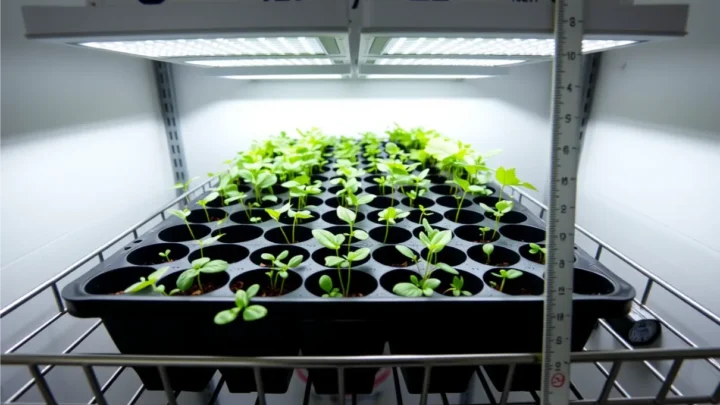
- Take a five-point grid reading: Record the lux right in the center of your 1020 seed tray or planter bed, then record readings at all four corners. Calculating both the center peak and the corner average tells you when to rotate your trays so outer seedlings grow just as stocky as center ones.
Calculating Your Numbers with Practical Examples
Let's walk through two real-world home gardening scenarios using our Lux to PPFD Estimator math.
Example 1: Starting Tomato Seedlings Under White LED Shop Lights Imagine you hang two 4000K white LED shop lights four inches above a tray of newly sprouted Roma tomato seedlings. Your handheld lux meter reads 14,500 lux in the center of the tray and 10,200 lux along the outer edges.
- Center PPFD calculation: $14,500 \text{ lux} \times 0.0155 = 224.75 \text{ }\mu\text{mol/m}^2\text{/s}$
- Edge PPFD calculation: $10,200 \text{ lux} \times 0.0155 = 158.1 \text{ }\mu\text{mol/m}^2\text{/s}$
- Takeaway: Vegetable transplants thrive between 200 and 350 $\mu\text{mol/m}^2\text{/s}$. The center of your tray is right in the sweet spot, while the edges are slightly low. By rotating your seed trays 180 degrees every two days—or adding a reflective white board along the sides of the shelf—every seedling will develop thick, purple-tinted stems ready for the garden.
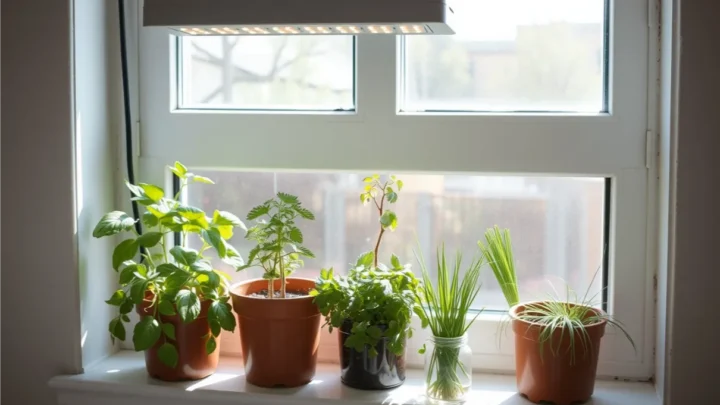
Example 2: Growing Culinary Herbs on a Sunny Windowsill Suppose you want to grow potted basil, rosemary, and parsley on a south-facing kitchen windowsill in April. At 1:00 PM on a clear day, your lux meter held at leaf level inside the glass reads 22,000 lux.
- Window Sunlight PPFD calculation: $22,000 \text{ lux} \times 0.0185 = 407 \text{ }\mu\text{mol/m}^2\text{/s}$
- Takeaway: While 407 $\mu\text{mol/m}^2\text{/s}$ is fantastic intensity at midday, windowsills only receive direct sun beams for four to five hours before the sun angle shifts. Knowing your midday peak and morning/afternoon drop-off helps you decide whether your sun-loving rosemary needs supplemental evening light to stay bushy.
Target PPFD and Lux Ranges for Vegetables, Herbs, and Flowers
Once you know how to convert lux to PPFD, the next step is matching your numbers to what you are actually growing. Different crops—and different growth stages—have very different photosynthetic appetites. Providing too little light causes weak, elongated stems and poor root development, while blasting delicate shade plants with excessive PPFD causes photo-inhibition, leaf bleaching, and curled edges.
Use the chart below, adapted from controlled environment horticulture data from Purdue University Extension and Cornell University, to dial in your target numbers.
| Crop Stage or Group | Target PPFD Range | Photoperiod (Hours) | White LED Lux | Full-Spectrum LED Lux |
| Cuttings & Clones | 75 to 150 | 14 to 16 | 4,800 to 9,700 | 4,200 to 8,300 |
| Seedlings & Microgreens | 150 to 250 | 14 to 16 | 9,700 to 16,100 | 8,300 to 13,900 |
| Leafy Greens & Soft Herbs | 200 to 350 | 12 to 16 | 12,900 to 22,600 | 11,100 to 19,400 |
| Sturdy Garden Transplants | 250 to 400 | 14 to 16 | 16,100 to 25,800 | 13,900 to 22,200 |
| Indoor Fruiting & Flowers | 450 to 700 | 12 to 16 | 29,000 to 45,200 | 25,000 to 38,900 |
Target PPFD values are listed in $\mu\text{mol/m}^2\text{/s}$. Use the White LED Lux column if your multiplier is 0.0155, or the Full-Spectrum LED Lux column if your fixture includes 660 nm deep-red diodes (multiplier 0.0180).
Seed Starting and Young Transplants (Tomatoes, Peppers, Brassicas, Annual Flowers)
When starting seeds indoors for your outdoor vegetable garden or cut-flower beds, timing and light intensity work hand in hand. Most warm-season crops like tomatoes, peppers, and eggplants should be sown 6 to 8 weeks before your region's average last spring frost date, while cool-season brassicas (broccoli, kale, cabbage) and hardy annual flowers (snapdragons, sweet peas) are started 8 to 10 weeks before planting out, and fast-growing tender annuals (zinnias, cosmos, marigolds) need only 4 to 5 weeks indoors. Because spring frost dates and climate zones vary dramatically by region, always check your local cooperative extension frost chart before sowing.
As soon as the first cotyledons (seed leaves) break through the soil surface:
- Initial week: Aim for 150 to 200 $\mu\text{mol/m}^2\text{/s}$ (roughly 10,000 to 13,000 lux under white LEDs) for 14 to 16 hours per day. Keep the potting mix evenly moist like a wrung-out sponge, never waterlogged.
- True-leaf stage: Once the first set of true leaves unfolds, increase light intensity to 250 to 400 $\mu\text{mol/m}^2\text{/s}$ (16,000 to 25,800 lux under white LEDs) by lowering the fixture or raising the dimmer. Thin seedlings to one strong plant per cell and space pots slightly apart as leaves touch so neighboring seedlings do not shade one another and trigger competitive stem stretching.
Leafy Greens and Culinary Herbs (Basil, Cilantro, Lettuce, Parsley)
Leafy greens and kitchen herbs are among the most rewarding crops to grow indoors year-round because you harvest their leaves rather than waiting on fruit.
- Cool-weather greens and tender herbs (lettuce, spinach, cilantro, parsley, chives): Thrive at 200 to 250 $\mu\text{mol/m}^2\text{/s}$ for 12 to 14 hours daily. Keep air temperatures moderate (60°F to 70°F) and use a well-draining potting mix amended with perlite so roots receive plenty of oxygen. Notice Tipburn—crispy brown edges on inner lettuce leaves? According to Cornell CEA researchers, tipburn happens when high light intensity pushes leaves to grow faster than the roots can pump calcium to the leaf margins. Gently blowing a small oscillating fan across the canopy increases transpiration and prevents tipburn.
- Sun-loving Mediterranean and heat-loving herbs (sweet basil, rosemary, thyme, oregano, sage): Perform best at 300 to 400 $\mu\text{mol/m}^2\text{/s}$ for 14 to 16 hours per day. Space individual basil plants at least 6 to 8 inches apart in containers and pinch back the central growing tip above a leaf node once the plant reaches six inches tall to encourage lush lateral branching.
Fruiting Crops and Indoor Dwarf Varieties (Chili Peppers, Bush Tomatoes, Strawberries)
Producing flowers and ripe fruit indoors requires serious photon energy. If you are growing compact container cultivars like 'Micro Tom' tomatoes, chili peppers, or everbearing alpine strawberries under lights all winter:
- Target intensity: Aim for 450 to 700 $\mu\text{mol/m}^2\text{/s}$ (25,000 to 45,000 lux depending on LED type) at the upper flowering canopy for 12 to 16 hours daily.
- Pollination and care: Because there are no bees or breezes indoors, gently tap tomato and pepper flower clusters daily or use an electric toothbrush against the flower stems to release pollen and set fruit. Use high-porosity container soil rich in organic compost, and feed regularly with a balanced, calcium-and-magnesium-supported vegetable fertilizer according to package directions.
Turning PPFD into Daily Light Integral (DLI) for Regional and Seasonal Success
While PPFD tells you how intense your light is at a single moment—like checking the speedometer in a car—plants ultimately care about the total cumulative light they collect over an entire day, which is like the odometer measuring total miles traveled. Horticulturists call this 24-hour total the Daily Light Integral (DLI), measured in moles of light per square meter per day ($\text{mol/m}^2\text{/day}$).
Once you know your estimated PPFD from your lux meter, you can calculate DLI with one simple formula:
$$\text{DLI } (\text{mol/m}^2\text{/day}) = \text{PPFD} \times \text{Hours of Light per Day} \times 0.0036$$
Why does the $0.0036$ factor work? There are 3,600 seconds in an hour, and one mole equals one million micromoles ($3,600 \div 1,000,000 = 0.0036$).
For example, if your herb garden receives 250 $\mu\text{mol/m}^2\text{/s}$ for 16 hours a day on an automatic timer:
$$\text{DLI} = 250 \times 16 \times 0.0036 = 14.4 \text{ mol/m}^2\text{/day}$$
According to Purdue University Extension guidelines:
- Seedlings and leafy greens need a DLI of 10 to 16 $\text{mol/m}^2\text{/day}$.
- Sturdy vegetable and flower transplants thrive at a DLI of 14 to 18 $\text{mol/m}^2\text{/day}$.
- Fruiting tomatoes, peppers, and full-sun flowers require a DLI of 20 to 30+ $\text{mol/m}^2\text{/day}$.
This math gives home growers tremendous flexibility. If your LED shop light can only reach 180 $\mu\text{mol/m}^2\text{/s}$ even when hung three inches above your seedlings, you do not have to buy a new light—simply run the fixture on a timer for 16 hours a day ($180 \times 16 \times 0.0036 = 10.4 \text{ DLI}$) rather than 10 hours a day ($180 \times 10 \times 0.0036 = 6.5 \text{ DLI}$). Keep in mind that most vegetables, herbs, and flowers still need at least 6 to 8 hours of uninterrupted darkness each night to regulate respiration and hormone cycles, so running lights 14 to 16 hours per day is the sweet spot.
Adjusting for Regional Climate Zones, Day Length, and Window Orientation
Your local geography and season play a massive role in how much natural light enters your home or greenhouse. According to solar radiation maps published by the National Renewable Energy Laboratory and university extensions, outdoor winter DLI in northern regions (such as USDA Hardiness Zones 3 through 5 in the Pacific Northwest, Midwest, or New England, or northern Europe) frequently drops below 5 to 8 $\text{mol/m}^2\text{/day}$ due to short days, low sun angles, and heavy cloud cover. Inside a window, where glass blocks roughly 25 to 40 percent of incoming PAR light, winter windowsill DLI in northern climates often falls to 2 or 3 $\text{mol/m}^2\text{/day}$—far too low to prevent leggy seedlings without supplemental grow lights.
Meanwhile, a gardener in a sunny southern climate (such as USDA Zones 8 through 10 in the American Southwest or Florida) may receive 15 to 25 $\text{mol/m}^2\text{/day}$ outdoors even in late winter. Always account for your regional climate, local cloud cover, and window direction (south-facing windows in the Northern Hemisphere deliver the highest daily total, followed by west- and east-facing windows) by measuring your windowsill lux at 9:00 AM, 12:00 PM, and 3:00 PM to find your true daily average.
Balancing Light Intensity with Watering, Soil Health, and Temperature
Whenever you use a Lux to PPFD Estimator to increase light levels over your plants, remember that light is the throttle pedal for every other biological process in the pot:
- Watering frequency: Higher PPFD opens leaf stomata wider and accelerates transpiration. Seedlings growing at 300 $\mu\text{mol/m}^2\text{/s}$ will drink water nearly twice as fast as seedlings sitting at 120 $\mu\text{mol/m}^2\text{/s}$. Check containers daily by lifting the pot or feeling the soil an inch below the surface.
- Soil structure and nutrition: Rapid photosynthetic growth demands healthy root respiration and steady nutrients. Use a sterile, peat- or coco-coir-based seed-starting mix for germination, and step up to a nutrient-rich potting soil with worm castings or slow-release organic fertilizer once seedlings have two sets of true leaves.
- Safe pest management under grow lights: Indoor environments can occasionally attract fungus gnats, aphids, or spider mites. Cultural prevention—avoiding overwatering, using yellow sticky traps, andquarantining new plants—should always come first. If you ever need to apply a horticultural oil, insecticidal soap, or neem spray indoors, always turn off your grow lights and wait until leaves dry completely before turning lamps back on. High-intensity light combined with oil or soap droplets on foliage can cause severe phototoxic leaf burn. Always read product labels thoroughly, confirm the spray is safe for edible crops, and follow local extension guidelines.
Common Light Measurement Mistakes and How to Fix Them
Even experienced home gardeners occasionally misread their light meters. Avoid these three common pitfalls when testing your setup:
- Measuring at pot level instead of canopy height: Light intensity drops off rapidly with distance—a physical principle known as the inverse-square law. Moving a grow light from 6 inches away to 12 inches away does not cut the light in half; it reduces intensity by up to 50 to 75 percent depending on reflector geometry. Always hold your lux meter sensor right at the level of the top leaves, and re-measure every week as plants grow taller.
- Tilting the sensor toward the bulb: Plant leaves generally orient horizontally, and PPFD standards measure photons hitting a flat horizontal plane. Keep your lux meter completely flat and level rather than angling it toward a corner lamp.
- Forgetting to acclimate plants before hardening off: Even if your indoor grow shelf provides a strong 350 $\mu\text{mol/m}^2\text{/s}$ (around 22,500 lux), full outdoor spring sunlight is still four to five times brighter (up to 100,000 lux or 1,850 $\mu\text{mol/m}^2\text{/s}$), and contains ultraviolet (UV) radiation that indoor LEDs lack. When transplanting indoor seedlings to your backyard garden beds, always harden them off over 7 to 10 days—starting with an hour or two of dappled outdoor shade and gradually increasing direct morning sun—so their leaves build protective cuticles without sunscalding.
Frequently Asked Questions About Estimating PPFD from Lux
1. How many lux do vegetable seedlings need under white LED grow lights?
Most vegetable and flower seedlings thrive at a PPFD of 200 to 350 $\mu\text{mol/m}^2\text{/s}$ once their true leaves emerge. If you are using standard white LED shop lights or grow bulbs (multiplier 0.0155), aim for 13,000 to 22,500 lux at the top of the plant canopy for 14 to 16 hours per day. If you use full-spectrum horticultural white LEDs with added 660 nm deep-red diodes (multiplier 0.0180), aim for 11,000 to 19,500 lux.
2. Can I use a free phone app as a Lux to PPFD Estimator?
A smartphone light meter app can give you a helpful ballpark estimate for comparing bright spots and dim corners on a grow shelf, provided you know the conversion multiplier for your light source. However, bare smartphone front cameras lack a domed cosine diffuser and can underread or overread by 20 to 40 percent depending on the phone model. For reliable seed starting and indoor vegetable growing, a fifteen-dollar handheld digital lux meter with a white dome sensor is much more consistent.
3. Why are my seedlings still leggy even when my lux reading looks high?
If your lux reading is above 15,000 lux and your seedlings are still stretching, check three culprits. First, confirm you used the right multiplier—fluorescent tubes and warm yellow bulbs produce fewer plant photons per lux than full-spectrum LEDs. Second, check your photoperiod; running lights for only 6 or 8 hours per day creates a low Daily Light Integral (DLI) even if midday brightness is high. Third, check your room temperature: overly warm nighttime temperatures (above 72°F to 75°F) combined with crowded seedling trays trigger rapid stem elongation in tomatoes and brassicas.
4. What is the difference between lumens, lux, and PPFD?
Lumens measure the total visible light output emitted by a bulb in all directions, weighted for human vision. Lux measures how many of those lumens actually land on a one-square-meter surface at a specific distance (one lux equals one lumen per square meter). PPFD measures the actual number of photosynthetically active photons (between 400 and 700 nm) landing on a one-square-meter surface each second. Because lux and PPFD both measure light arriving on a flat one-square-meter area, you can convert lux to PPFD using a spectral multiplier, whereas you cannot directly convert total bulb lumens to PPFD without knowing the hanging height and beam angle.
5. Can plants get too much PPFD indoors?
Yes. While outdoor full-sun crops like tomatoes and peppers can handle intense midday sun once hardened off, indoor plants grown in small containers have limited root volume and lower airflow. Pushing indoor PPFD above 450 $\mu\text{mol/m}^2\text{/s}$ on young seedlings or above 350 $\mu\text{mol/m}^2\text{/s}$ on tender leafy greens like lettuce often causes upward leaf curling ("taco leaves"), bleached yellow upper foliage, and crispy leaf margins. Always raise your fixture or dim your light if upper leaves look stressed while lower leaves remain healthy green.
Conclusion: Growing Stronger Plants with Simple Light Math
You do not need a commercial research greenhouse to raise stocky, dark-green vegetable transplants, fragrant windowsill herbs, and abundant indoor greens. By understanding that human eyes favor green light while plants feast on the entire 400 to 700 nanometer PAR spectrum, you can turn any inexpensive lux meter into a practical Lux to PPFD Estimator.
Start by identifying your light source, taking a quick five-point lux reading right at leaf level, and multiplying by your fixture's spectral conversion factor. Pair that target PPFD with a consistent 14-to-16-hour daily timer, keep your potting mix evenly moist, and give your seedlings a gradual hardening-off period before moving them into your outdoor beds. With just a few minutes of simple light math, leg-stretching seedlings will become a distant memory—and your garden will start the season stronger than ever.

Similar Posts