Indoor Seedling Light Calculator
Botanical Horticulturist & Food Preservation Specialist at Brittle Bloom · Certified Master Gardener & Master Food Preserver · 12+ Years in Plant Propagation & Food Preservation
Starting seeds indoors is one of the most rewarding ways to kick off a growing season, right up until the moment your once-promising tomato or zinnia sprouts stretch three inches tall in forty-eight hours, flop over the edge of the cell tray, and refuse to stand back up.
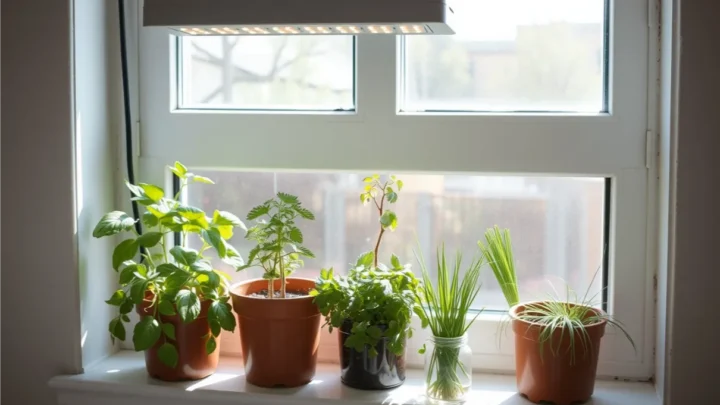
That stretched, pale, top-heavy look—commonly called “legginess”—is almost always a light problem, not a watering or soil issue. Even a bright south-facing window loses a massive portion of its usable light intensity through modern double-pane glass, and short late-winter days simply do not give young plants enough energy to build thick, sturdy stems.
If you have ever stood in a hardware store or scrolled online wondering whether a 20-watt LED bar is enough for a standard 1020 seed tray, or how high to hang a shop light without cooking tender cotyledons, you do not need to guess. By using a simple indoor seedling light calculator approach—combining your shelf area, light output, hanging distance, and daily timer—you can give your seedlings the exact light diet they need to grow compact, dark green, and ready for the garden.
Why Seedlings Need a Different Light Calculation Than Houseplants
Before running the numbers for your seed-starting rack, it helps to understand why seedlings behave differently than mature indoor foliage plants. Most common houseplants (like pothos, snake plants, or philodendrons) evolved on shady forest floors. They are perfectly happy surviving in low to moderate indoor light.
Garden vegetables, culinary herbs, and annual flowers are a completely different story. Crops like tomatoes, peppers, basil, broccoli, and marigolds are full-sun plants from the moment their first seed leaves emerge. According to university extension horticulture guidelines—such as those published by the University of Minnesota Extension and University of Maryland Extension—seedlings grown indoors require high light intensity placed very close to the foliage to mimic outdoor spring sunlight.
When light levels fall short, a seedling triggers a survival response known as etiolation. Sensing shade, the plant pours all its stored energy into rapid vertical stem elongation to “reach” above whatever is blocking the sun. Because its energy goes into stem length rather than stem thickness or root development, the plant becomes fragile and susceptible to damping-off disease and transplant shock.
The Four Variables in an Indoor Seedling Light Calculator
To calculate the right lighting setup for your home, you only need to account for four straightforward measurements:
- Grow Area (Square Feet): The footprint of your seed trays.
- Light Intensity (PPFD or Watts/Lumens): How much usable plant light reaches the leaves.
- Photoperiod (Hours per Day): How long your timer keeps the lights on.
- Daily Light Integral (DLI): The total “bucket” of light your seedlings collect over a 24-hour period.
Think of PPFD (Photosynthetic Photon Flux Density) as the rate at which rain is falling, and DLI (Daily Light Integral) as the total inches of rain collected in a bucket by the end of the day. If your light is slightly weaker (a gentle drizzle), you can leave it on a little longer to fill the bucket. If your light is very strong (a heavy downpour), you need fewer hours—or a higher hanging distance—to avoid overflowing the bucket.
Step-by-Step: How to Calculate Light for Your Seed Trays
Follow these four steps to calculate the exact light requirements for your seed-starting shelf.
Step 1: Measure Your Growing Footprint in Square Feet
Start by measuring the length and width (in inches) of the space your trays occupy—not the entire room, just the illuminated shelf area. Multiply length by width, then divide by 144 to get square feet.
$$\text{Square Feet} = \frac{\text{Length (in)} \times \text{Width (in)}}{144}$$
Common Seed-Starting Setups:
- One standard 1020 seed tray (10″ × 20″): $200 \div 144 = \mathbf{1.39\text{ sq ft}}$
- Two 1020 trays side by side (20″ × 20″): $400 \div 144 = \mathbf{2.78\text{ sq ft}}$
- Standard 4-foot wire shelving unit (48″ × 18″): $864 \div 144 = \mathbf{6.0\text{ sq ft}}$ (fits four 1020 trays oriented sideways)
Step 2: Set Your Target DLI and PPFD
Horticultural researchers at universities including Purdue University and Michigan State University measure plant light needs using Daily Light Integral (DLI), expressed in moles of light per square meter per day ($\text{mol/m}^2\text{/day}$).
For healthy, compact indoor seedlings, aim for these targets:
- Target DLI for Seedlings:12 to 16 $\text{mol/m}^2\text{/day}$ (Cool-season greens and herbs do well near 12; fruiting crops like tomatoes and peppers thrive closer to 14–16).
- Target PPFD at Canopy Level:200 to 300 $\mu\text{mol/m}^2\text{/s}$ (micromoles per square meter per second).
Step 3: Calculate Your Daily Light Integral (DLI)
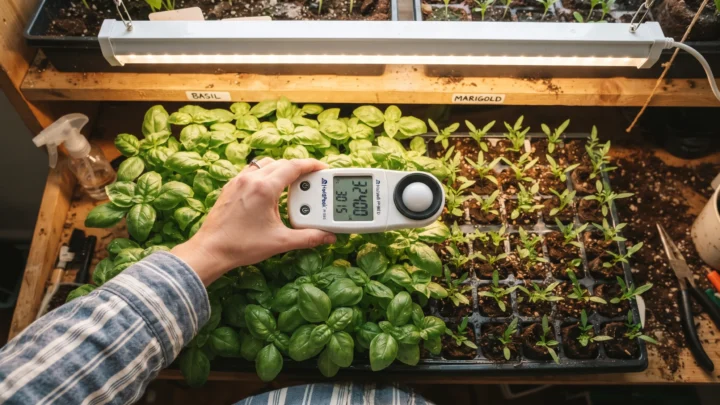
Once you know your light’s PPFD at canopy height (found on the manufacturer’s PPFD chart or measured with a light meter app/sensor) and how many hours you run your timer, use this standard horticultural formula:
$$\text{DLI} = \text{PPFD} \times \text{Hours of Light} \times 0.0036$$
(Why $0.0036$? There are $3,600$ seconds in an hour, and $1,000,000$ micromoles in a mole: $3,600 \div 1,000,000 = 0.0036$.)
Example Calculation 1: LED Grow Light Bar Suppose your LED strip delivers 220 $\mu\text{mol/m}^2\text{/s}$ at 4 inches above the soil, and you set your timer for 16 hours a day:
$$\text{DLI} = 220 \times 16 \times 0.0036 = \mathbf{12.67\text{ mol/m}^2\text{/day}}$$
This lands squarely inside the ideal 12–16 range for sturdy seedlings.
Example Calculation 2: Higher-Output Full-Spectrum Panel Suppose you use a stronger LED panel delivering 350 $\mu\text{mol/m}^2\text{/s}$ at 12 inches above the trays, running for 14 hours a day:
$$\text{DLI} = 350 \times 14 \times 0.0036 = \mathbf{17.64\text{ mol/m}^2\text{/day}}$$
That is slightly above the 12–16 target. You can easily dial it back into the sweet spot by raising the light 2–3 inches or trimming the timer to 12 hours ($350 \times 12 \times 0.0036 = 15.12$).
Step 4: Estimate Wattage and Lumens If PPFD Isn’t Listed
Many affordable LED shop lights sold at hardware stores list watts and lumens on the box rather than PPFD. While lumens measure brightness as seen by the human eye rather than plants, you can still calculate a reliable baseline for standard white LED fixtures (5000K–6500K):
- Actual LED Wattage Rule of Thumb: Aim for 20 to 30 actual watts of LED power per square foot of growing area (ignore “watt-equivalent” numbers on packaging—look strictly at actual power draw).
- Lumens Rule of Thumb: Aim for 2,000 to 3,000 lumens per square foot at the tray surface.
Quick Shelf Formula for Shop Lights:
- For one 1020 tray (1.4 sq ft): Look for roughly 30–40 actual watts or 3,000–4,200 lumens total across two parallel tube bars.
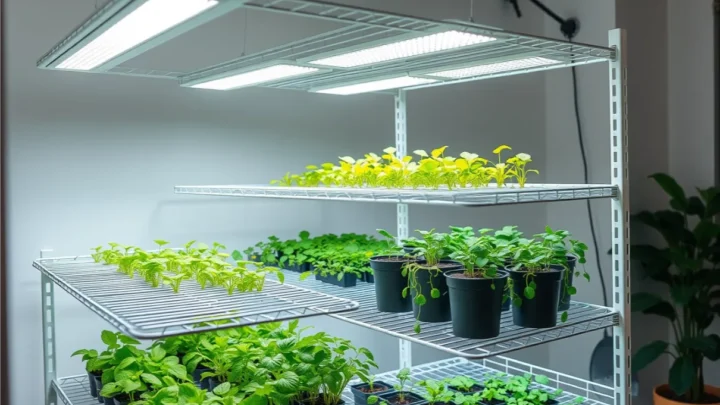
- For a 4-foot × 18-inch shelf (6 sq ft): Look for 120–180 actual watts or 12,000–18,000 lumens distributed evenly across 3 to 4 LED shop light tubes per shelf.
Indoor Seedling Light Reference Chart by Setup Size
Use this quick-reference table to match your seed-starting space with the right light output, tube count, and timer schedule.
| Growing Footprint | Dimensions | Target Actual LED Watts | Target Total Lumens | Typical 4-ft LED Shop Light Tubes | Recommended Photoperiod |
| 1 Standard 1020 Tray | 10″ × 20″ (1.4 sq ft) | 30–42 W | 3,000–4,200 lm | 2 tubes (2-ft length) | 14–16 hours/day |
| 2 Standard 1020 Trays | 20″ × 20″ (2.8 sq ft) | 55–85 W | 5,600–8,400 lm | 3–4 tubes (2-ft length) | 14–16 hours/day |
| Half Shelf (3-ft rack) | 36″ × 18″ (4.5 sq ft) | 90–135 W | 9,000–13,500 lm | 3 tubes (3-ft length) | 14–16 hours/day |
| Full Wire Shelf (4-ft rack) | 48″ × 18″ (6.0 sq ft) | 120–180 W | 12,000–18,000 lm | 3–4 tubes (4-ft length) | 14–16 hours/day |
Note: Seedlings along the outer edges of a shelf always receive less light than those directly under the center of the fixture. Rotating your trays 180 degrees every two to three days keeps growth uniform across every cell.
How Hanging Height Changes Your Light Math (The Inverse Square Law)
One of the easiest mistakes in indoor seed starting is hanging a light 18 inches above the soil “so the plants have room to grow.” Light intensity drops dramatically as distance increases—a physical principle known as the Inverse Square Law.
When you double the distance between your grow light and your seedlings, the light intensity reaching the leaves does not drop by half; it drops to one-quarter of its original strength. A shop light delivering a healthy 250 PPFD at 3 inches away may deliver barely 60 PPFD at 12 inches away—turning a great setup into a leggy-seedling factory overnight.
Recommended Hanging Heights by Light Type
Because different fixtures produce different levels of intensity and heat, adjust your hanging height based on the style of light you own:
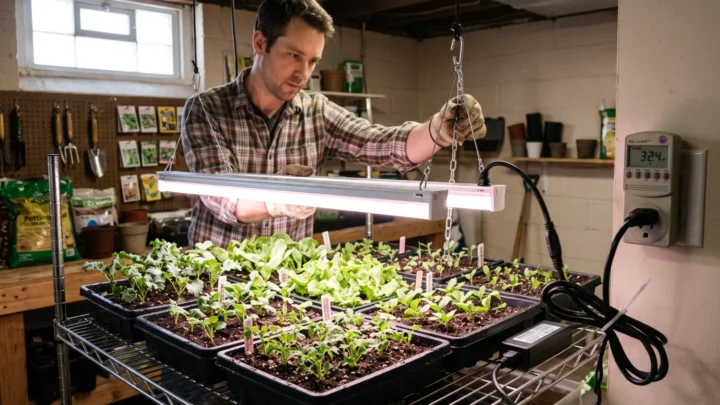
- Standard LED Shop Lights (20–40W per 4-ft tube): Hang 2 to 4 inches above the tops of the seedlings. LEDs run cool enough that leaves will not burn unless they physically touch the lens, and keeping them close maximizes PPFD.
- High-Output Full-Spectrum LED Panels / Quantum Boards (100W+): Hang 12 to 18 inches above the canopy (or follow the manufacturer’s dimmer guidelines, typically running at 40%–60% power for young seedlings).
- T5 High-Output Fluorescent Tubes: Hang 3 to 5 inches above the seedlings. They generate slightly more radiant warmth than LEDs, so keep a small gap and ensure gentle air circulation.
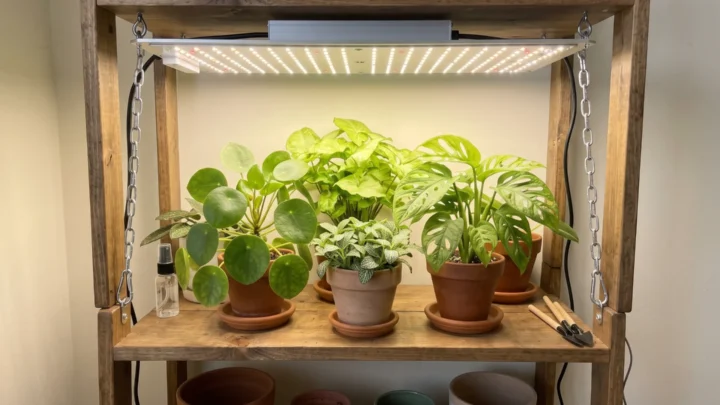
Pro Tip: Install your lights on adjustable rope ratchets or lightweight S-hooks and chains rather than zip-tying them permanently to the shelf above. As your seedlings grow taller each week, raise the fixture by an inch or two at a time so the gap between the bulbs and the top leaves stays consistent.
Choosing the Right Color Spectrum (Kelvin) for Seedlings
When shopping for bulbs or LED strips, you will see color temperature listed in Kelvin (K) alongside lumens and watts. Color temperature describes the balance of blue and red wavelengths emitted by the light:
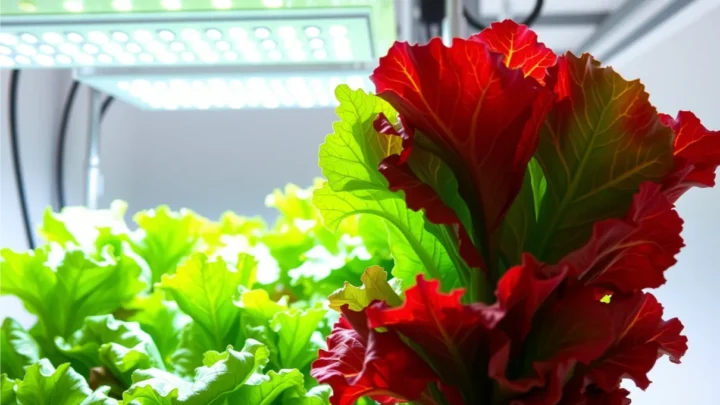
- 5000K to 6500K (“Daylight” or “Cool White”): Rich in blue wavelengths, which signal seedlings to grow thick stems, short internodes, and dense, dark green leaves. This is the single best spectrum for starting vegetable, herb, and flower seedlings indoors.
- 2700K to 3000K (“Warm White” or “Soft White”): Heavy in red wavelengths, which encourage flowering and fruiting in mature indoor crops but can cause young seedlings to stretch more than desired.
- Full-Spectrum White LEDs (3500K–5000K with added 660nm deep red): Balanced horticultural spectrum designed for seed-to-harvest growing; works great for seedlings as long as intensity (PPFD) is dialed in.
If you are buying budget-friendly LED shop lights from a local hardware store, simply check the box for 5000K or 6500K and at least 2,000+ lumens per tube. You do not need purple (“blurple”) grow lights—modern white daylight LEDs provide the full photosynthetically active radiation (PAR) spectrum seedlings need while letting you clearly inspect your plants for moisture levels, nutrient issues, or pests.
Light Schedules by Plant Type (Plus Regional Timing Notes)
While most seedlings thrive on 14 to 16 hours of light and 8 to 10 hours of uninterrupted darkness every 24 hours, slight adjustments help different crops perform their best. Plants need a dark period to complete respiration and move sugars created during photosynthesis down to their roots—leaving grow lights on 24 hours a day actually stresses many vegetable crops and can cause leaf yellowing (chlorosis).
Crop-Specific Lighting Guidelines
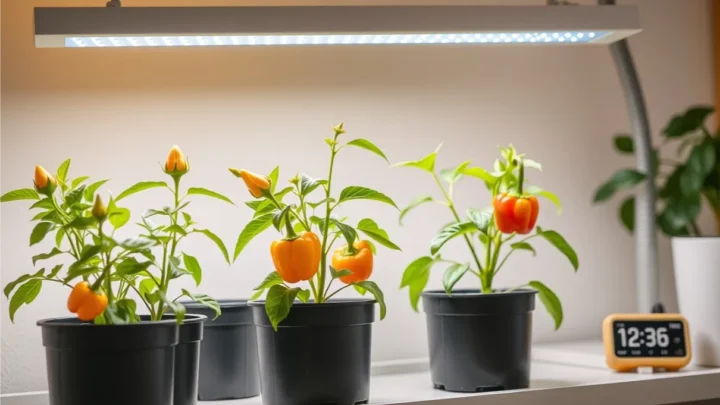
- Fruiting Vegetables (Tomatoes, Peppers, Eggplants): Aim for the upper end of the calculator—15 to 16 hours per day at 250–300 PPFD (DLI around 14–16). Peppers grow slowly at first and benefit from consistent warmth (70–75°F soil temp after germination) paired with bright, close overhead light.
- Brassicas & Cool-Season Crops (Broccoli, Cabbage, Kale, Lettuce): These crops are especially prone to stretching in warm indoor rooms. Give them 14 to 16 hours per day at 200–250 PPFD, and if possible, keep them in a slightly cooler room (60–65°F) once they sprout.
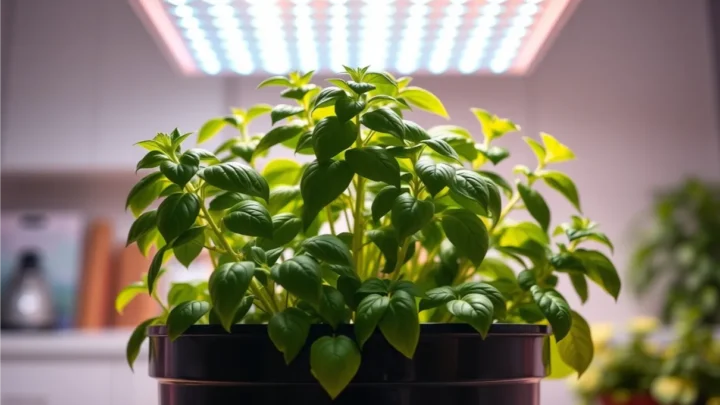
- Culinary Herbs (Basil, Parsley, Thyme, Cilantro):14 to 16 hours per day at 200–250 PPFD. Keep lights within 3 inches of basil in particular, as it stretches rapidly toward any gap in coverage.
- Annual Flowers (Zinnias, Marigolds, Petunias, Snapdragons):14 to 16 hours per day at 200–280 PPFD. Tiny surface-sown seeds like petunias and snapdragons need light right at the soil surface even to germinate, so turn your lights on the day you sow them.
Adjusting for Your Climate Zone and Indoor Conditions
Because last spring frost dates, outdoor temperatures, and indoor room conditions vary widely by region, always time your indoor seed starting around your local frost calendar rather than a generic date on a seed packet. You can check your exact average last frost date through your local county Cooperative Extension office or national meteorological/agricultural hardiness resources.
- Cold Northern Climates (USDA Zones 3–5): Spring stays cold longer, meaning your seedlings may spend 6 to 10 weeks under lights before outdoor hardening-off begins. Make sure your shelving setup has enough vertical clearance (at least 18 to 24 inches per shelf) so you can keep raising the lights as tomatoes and peppers size up.
- Warm Southern and Mild Coastal Climates (USDA Zones 8–10): Your indoor light window is often shorter—sometimes just 4 to 6 weeks—before seedlings move outside. Avoid over-fertilizing under lights so plants stay compact and manageable for transplanting.
- Dry Winter Homes vs. Humid Basements: Indoor heating dries out potting mix quickly under bright lights, while cool basements hold moisture longer. Water from the bottom when the top layer of seed-starting mix turns light brown, and run a small oscillating fan on low nearby to strengthen stems and prevent fungal damping-off.
How to Spot Light Problems Early (Visual Troubleshooting)
Even with the right calculator numbers, your seedlings will always give you real-time feedback. Check your trays once a day for these visual cues:
- Long, pale stems leaning toward one side: Light intensity is too low or the fixture is hung too high. Lower the lights to 2–3 inches above the foliage, increase the timer to 16 hours, or add an extra tube bar to widen coverage.
- Leaves curling upward like tacos or bleaching pale white/yellow: Light intensity is too strong or too close (common with high-wattage LED panels). Raise the fixture by 3–4 inches or dial back the dimmer by 15%–20%.
- Purplish undersides on tomato leaves: While often mistaken for a light burn, purplish undersides on young indoor seedlings usually indicate mild phosphorus lockup caused by cool room temperatures (below 60°F) rather than excessive light.
- Dark green, thick stems with leaves spaced tightly together: Your indoor seedling light calculator math is spot-on. Keep raising the lights gradually to maintain that exact distance until it is time to harden your plants off outdoors.
Frequently Asked Questions
How many hours a day should grow lights be on for seedlings?
Most vegetable, herb, and flower seedlings need 14 to 16 hours of light per day, followed by 8 to 10 hours of complete darkness. Using an inexpensive mechanical or smart outlet timer ensures consistent daily light cycles and gives seedlings the dark period they need for healthy root and cellular growth.
Can I use regular LED shop lights to start seeds indoors?
Yes. Standard 4-foot LED shop lights work very well for starting seedlings as long as you choose 5000K to 6500K (daylight) bulbs rated at 2,000 lumens or higher per tube, hang them 2 to 4 inches above the plants, and use two to four tubes per shelf depending on tray width.
How close should grow lights be to seedlings?
Standard LED shop lights and fluorescent tubes should hang 2 to 4 inches above the tops of the seedlings. High-powered full-spectrum LED grow panels (100 watts or more) produce much higher intensity and should generally hang 12 to 18 inches above the canopy—always check the manufacturer’s PPFD chart for exact hanging heights.
Do seeds need light to germinate?
Most common garden seeds (like tomatoes, peppers, squash, and beans) germinate in the dark and only need light the moment green shoots break through the soil. However, several small-seeded herbs and flowers—including lettuce, dill, petunias, snapdragons, and coleus—require light to germinate and should be pressed gently onto the soil surface rather than buried.
Why are my seedlings still leggy under a grow light?
Leggy seedlings under a grow light almost always mean the fixture is hung too far above the tray (losing intensity via the Inverse Square Law), the bulb has too few lumens/watts for the shelf width, or the light is turned on for fewer than 12 hours a day. Warm indoor room temperatures above 75°F paired with dim light also accelerate stretching.
Conclusion
Getting indoor seed lighting right does not require an expensive commercial setup or a degree in horticulture. Once you know your shelf’s square footage, match it with 20 to 30 actual LED watts per square foot (or a DLI of 12 to 16 $\text{mol/m}^2\text{/day}$), hang the fixture just a few inches above the foliage, and lock in a 15-hour daily timer, leggy seedlings become a thing of the past.
Before sowing your next tray, double-check your local average last spring frost date so your timing lines up with outdoor weather, gather your lights on adjustable hangers, and watch how quickly compact, stocky transplants take off.
Indoor Seedling Light Calculator
Find the right amount of grow light for healthier seedlings. Calculate your daily light exposure in seconds.
These are practical starting targets, not universal requirements. Adjust based on species and growth stage.
Enter the PPFD measured at the top of your seedlings, not the manufacturer’s maximum output. A PAR meter is the most reliable way to measure it.
Count the total hours your grow light is switched on each day.
💡 Your Light Recommendation
Your seedlings are receiving slightly less light than the selected target. Consider a small increase in daily lighting time.
Give seedlings a consistent dark period every day. Avoid running grow lights continuously. Monitor leaves for bleaching, curling, or stretching, and adjust light intensity and distance gradually.

Similar Posts