Pressure Canning Decision Guide
Botanical Horticulturist & Food Preservation Specialist at Brittle Bloom · Certified Master Gardener & Master Food Preserver · 12+ Years in Plant Propagation & Food Preservation
If you’re searching for a pressure canning decision guide, you’ve already figured out that home canning isn’t one-size-fits-all. The central question is simple: can you safely preserve your food in a boiling-water bath, or do you need a pressure canner? Get that wrong, and you risk more than wasted jars.
You risk botulism.
Clostridium botulinum is the reason behind every strict canning rule. These spores live in soil and survive the 212°F boiling point of water, but they die at about 240°F under pressure. As of 2026, the USDA Complete Guide to Home Canning remains the gold standard, and it’s the reference all our safety guidance below is based on.

Image source: Wikimedia Commons / Erik Pevernagie .mw-parser-output .messagebox{margin:4px 0;width:auto;border-collapse:collapse;border:2px solid var(–border-color-progressive,#6485d1);background-color:var(–background-color-neutral-subtle,#fbfcff);color:var(–color-base,#202122);box-sizing:border-box;border-inline-start-width:8px}.mw-parser-output .messagebox.mbox-small{font-size:88%;line-height:1.25em}.mw-parser-output .mbox-warning.mw-parser-output .mbox-speedy{border:2px solid var(–border-color-error,#b22222);background:var(–background-color-error-subtle,#ffdbdb);border-inline-start-width:8px}.mw-parser-output .mbox-serious.mw-parser-output .mbox-delete.mw-parser-output .mbox-stop{border:2px solid var(–border-color-error,#b22222);border-inline-start-width:8px}.mw-parser-output .mbox-issue.mw-parser-output .mbox-content{border:2px solid #f28500;background:var(–background-color-warning-subtle,#ffe);border-inline-start-width:8px}.mw-parser-output .mbox-query.mw-parser-output .mbox-style{border:2px solid #f4c430;background:var(–background-color-warning-subtle,#ffe);border-inline-start-width:8px}.mw-parser-output .mbox-shit{border:2px solid #960;border-inline-start-width:8px}.mw-parser-output .mbox-license{border:2px solid #88a;border-inline-start-width:initial}.mw-parser-output .mbox-legal{border:2px solid var(–border-color-notice,#666);background:var(–background-color-base,#fff);border-inline-start-width:8px}.mw-parser-output .mbox-honor{border:2px solid #ca3;background:var(–background-color-warning-subtle,#fcf4db);border-inline-start-width:8px}.mw-parser-output .mbox-growth{border:2px solid #8d4;background:var(–background-color-success-subtle,#d5fdf4);border-inline-start-width:8px}.mw-parser-output .mbox-move{border:2px solid #93c;border-inline-start-width:8px}.mw-parser-output .mbox-protection.mw-parser-output .mbox-message{border:2px solid var(–border-color-base,#aaa);border-inline-start-width:8px}.mw-parser-output .messagebox .mbox-text{border:none;padding:0.25em 0.9em;width:100%}.mw-parser-output .messagebox .mbox-image{border:none;padding-top:2px;padding-bottom:2px;padding-inline-start:0.9em;padding-inline-end:0;text-align:center}.mw-parser-output .messagebox .mbox-imageright{border:none;padding-top:2px;padding-bottom:2px;padding-inline-start:0;padding-inline-end:0;text-align:center}.mw-parser-output .messagebox .mbox-empty-cell{border:none;padding:0;width:1px}.mw-parser-output .messagebox .mbox-invalid-type{text-align:center}@media(min-width:720px){.mw-parser-output .messagebox{margin:4px 10%}.mw-parser-output .messagebox.mbox-small{clear:right;float:right;margin:4px 0 4px 1em;width:238px}}body.skin–responsive .mw-parser-output table.messagebox img{max-width:none!important}This work is free and may be used by anyone for any purpose. If you wish to use this content, you do not need to request permission as long as you follow any licensing requirements mentioned on this page. The Wikimedia Foundation has received an e-mail confirming that the copyright holder has approved publication under the terms mentioned on this page. This correspondence has been reviewed by a Volunteer Response Team (VRT) member and stored in our permission archive. The correspondence is available to trusted volunteers as ticket #2014123110008224. If you have questions about the archived correspondence, please use the VRT noticeboard. Ticket link: https://ticket.wikimedia.org/otrs/index.pl?Action=AgentTicketZoom&TicketNumber=2014123110008224 Find other files from the same ticket: (CC BY-SA)
Why Pressure Canning Decisions Are Life-or-Death (Well, Almost)
Botulism is rare, but the outcome is severe. Per CDC data, most home-canning botulism outbreaks trace back to improperly processed low-acid foods like green beans, potatoes, and meat. The toxin attacks nerves and can cause paralysis.
Emergency care usually starts with antitoxin, but recovery can be slow and costly.
That’s why this guide treats canning like a checklist. Every decision, from checking pH to venting steam, exists to keep one safety margin intact. When you follow a tested process, pressure canning is dependable.
When you improvise, you’re rolling the dice with people you feed.
The variables you’ll manage are few, but they’re non-negotiable:
- Acidity level. Foods above pH 4.6 must go in a pressure canner.
- Altitude. Higher elevations need higher pressure.
- Gauge type. Dial and weighted gauges demand different attention.
- Recipe origin. Only use processes tested by trusted food-safety authorities.
If all four line up, you’re done. If one is ignored, the risk jumps. Aggregated canning safety reports show that most failures come from skipping the boring steps, not from complicated ones.
One note: pressure canners don’t kill every microbe on earth. They target the pathogens that cause botulism and spoilage, using a combination of heat and pressure. That’s why you can’t swap in a multi-cooker or a regular stockpot.
Manufacturer manuals from Presto and All American repeat the same warning. Only a true pressure canner with a vent port and regulator can reach the required temperature consistently.
The Acid Test: Is This Food Low Acid or High Acid?
The first fork in the decision tree is pH. If a food’s pH sits below 4.6, it’s high acid. That means a boiling-water bath or steam canner is fine.
If the pH is 4.6 or higher, it’s low acid. That means the only safe home method is a pressure canner.
The names trip people up. Low-acid foods are not “low pH.” They are low in free acid, which makes them more alkaline. Potatoes, corn, carrots, beans, and all meats fall into this category.
So do soups and stews that combine them.
| Food category | pH level | Safe home-canning method |
|---|---|---|
| Most fruits, jams, jellies, pickles, vinegar-based condiments | Below 4.6 | Water bath or steam canner |
| Vegetables, meats, poultry, fish, seafood, broth, soups | 4.6 or higher | Pressure canner only |
| Tomatoes, when acidified with bottled lemon juice or vinegar | Usually below 4.6 | Water bath or pressure canner |
| Tomatoes, unacidified | Uncertain | Tested recipe only; pH can exceed 4.6 |
Tomatoes deserve a special callout. Modern varieties can be less acidic than old garden favorites, so official recipes always add bottled lemon juice or vinegar. That addition guarantees a pH below 4.6.
Skip that step and you’re back in botulism territory.
One more rule: never rely on taste, smell, or a home pH meter to decide. pH meters need calibration, and test strips are unreliable with colored liquids. The National Center for Home Food Preservation publishes tested recipes that account for acidity and dilution. Use those recipes and the acidity question is solved for you.
Choosing Your Pressure Canner: Dial Gauge vs Weighted Gauge
Once you know you need a pressure canner, the next decision is the gauge. There are two classic styles, and each suits different cooking habits.
| Feature | Dial-gauge canner | Weighted-gauge canner |
|---|---|---|
| Pressure readout | Needle on a dial | Rocking or jiggling weight |
| Comfort level | Requires checking the dial often | Makes a steady rattling sound |
| Altitude adjustment | Use small increments, like 11 PSI | Switch between 5, 10, or 15 PSI weights |
| Calibration | Needs annual testing; dials drift | No calibration needed |
| Best for | Exact control, low-altitude canners | Beginners, high-altitude kitchens |
Beginners usually take to a weighted gauge. Set the right weight, wait for the rock, and it keeps pressure from wandering. The tradeoff is flexibility.
If a tested recipe calls for 11 PSI and your weight only gives 10 or 15, you can’t match it exactly.
Dial gauges give a precise reading. You can hold the needle at 11, 12, or any point your altitude requires. The catch is that dials lose accuracy, so extension services recommend testing them once a year.
Many county extension offices do this for a small fee.
Material and size matter too. Aluminum canners heat fast and are lighter. Stainless steel canners are heavier, more durable, and often work on induction stoves.
Capacity is about batch size. A 16-quart canner fits four quart jars or eight pint jars. A 23-quart canner roughly doubles that.
Choose based on your stove’s heat output and how often you plan to preserve.
Both gauge styles are safe if the canner is in good condition and the instructions are followed. Manufacture specs determine which parts wear out, from gaskets to overpressure plugs. Replacing those parts on schedule is part of the decision.
Step-by-Step: Pressure Canning Low-Acid Foods Safely
Now comes the actual work. The steps below follow the process outlined in the USDA’s official guide and manufacturer manuals. Don’t skip any of them.
- Check the canner and jars. Examine for cracks, a warped lid, or a stuck vent pipe. Wash jars and keep them warm.
- Fill jars with hot prepared food. Leave the headspace listed in your recipe. Wipe the rims with a clean, damp cloth.
- Place lids and bands. Use new two-piece lids. Screw bands on fingertip-tight, not cranked down.
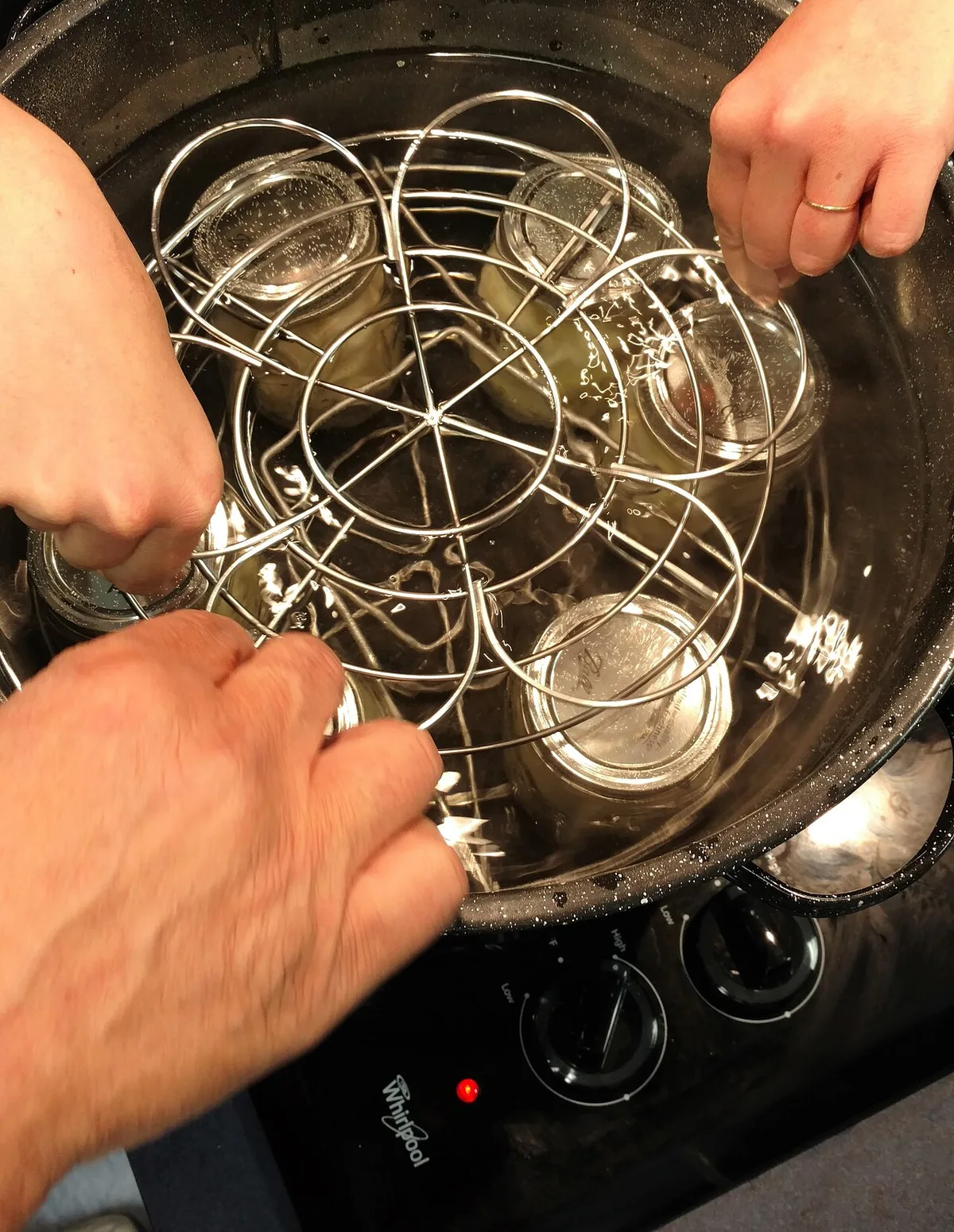
- Load jars onto the canner rack. Add hot water from the recipe. Lock the lid.
- Vent steam with the vent open. Let a steady, loud steam stream escape for 10 full minutes. This removes cool air pockets that cause false pressure readings.
- Close the vent and let pressure rise. Start your timer only after the dial hits your target or the weight starts rocking.
- Maintain steady pressure. For a dial gauge, keep the needle on the line. For a weighted gauge, set heat so it rocks a few times per minute.
- Process for the full time. Don’t reduce minutes for altitude or convince yourself “close enough” works. High altitude requires more pressure, not less time.
- Turn off heat and let the canner cool naturally. Wait until the gauge reads zero and no steam escapes when you open the vent.
- Lift jars out and cool for 12 to 24 hours. Set them on a towel, away from drafts. Press the center of each lid after they cool. If the lid pops or springs, no seal.
Altitude is part of the workflow. At sea level, 10 PSI gives you 240°F. Above 1,000 feet, a dial-gauge canner needs more pressure, usually 1 PSI per 3,000 feet.
Weighted gauges switch to the 15 PSI weight above 2,000 feet. The exact chart is in the official National Center for Home Food Preservation altitude guide.
For timing, look up the specific food in a tested source. Green beans, meat, and broth all have different processing minutes. Always use the recipe’s stated time, not a generic guess.
Common Pressure Canning Mistakes That Put Jars at Risk
Most canning failures share the same root cause: someone decided they knew better than the recipe. Here are the fixes for the ones we see most often.
- Using a water bath canner for low-acid foods. It doesn’t reach 240°F. The jars might seal, but spores survive.
- Skipping or shortening the 10-minute vent. Trapped air produces a false pressure reading, so your food under-processes.
- Trusting an uncalibrated dial gauge. If the needle is off by 2 PSI, your jars run at the wrong temperature.
- Ignoring altitude. At high elevations, water boils at a lower temperature. You need more pressure to compensate.
- Overpacking jars. Dense food doesn’t heat evenly because liquid can’t circulate.
- Opening the canner while pressure remains. Sudden pressure drops cause siphoning, lid warpage, and under-processed jars.
- Checking seals too early. Lids need 12 to 24 hours to fully set.
Botulism rarely announces itself. A jar can look perfectly normal and still be dangerous. Watch for bulging lids, leaking liquid, gas bubbles, or a foul odor when you open a jar.
If any of those appear, don’t taste the food.
Seal the suspect jar in a plastic bag and put it somewhere pets and kids can’t reach. Wash your hands, counters, and utensils with a diluted bleach solution. If anyone already ate some, contact a doctor or emergency services right away.
When in doubt, throw it out. That rule never fails.
Pressure Canning vs Water Bath, Freezing, and Dehydrating
Some foods are better preserved another way. Your decision depends on what you're storing and how your kitchen runs.
- Water bath canning handles high-acid foods like fruit, pickles, jam, and acidified tomatoes. It's faster, simpler, and the equipment costs less.
- Freezing keeps texture close to fresh for green beans, corn, peppers, and berries. It adds monthly energy costs, and a power outage risks the whole batch.
- Dehydrating suits herbs, mushrooms, peppers, and jerky. It's lightweight and shelf-stable, but intensity changes texture severely.
- Pressure canning is the only safe room-temperature method for low-acid foods. That covers meats, broth, soups, potatoes, and plain vegetables.
If you own a chest freezer, freezing is often easiest for produce. If you're short on space or preserving a large meat harvest, pressure canning is the dependable pantry option.
Old "good enough" methods still circulate. Some heritage recipes say you can water-bath green beans for hours to make them safe. Those recipes aren't USDA approved, and extended boiling doesn't guarantee a safe internal temperature.
Freezing wins on taste and texture for most vegetables you'll eat within a year. Pressure canning wins on shelf life, energy independence, and convenience. It's a tradeoff between quality and self-sufficiency.
Frequently Asked Questions
Can I pressure can in an Instant Pot or multi-cooker?
No. Most multi-cookers reach around 10 to 12 PSI but can't hold that pressure steadily during the full process. The USDA only approves canners with a vent pipe and a dial or weighted gauge.
Manufacturer manuals for multi-cookers also warn against home canning.
Do I need to add salt or vinegar when pressure canning?
Salt is for flavor, not safety. You can reduce it or leave it out entirely. Vinegar or bottled lemon juice is required when a tested recipe calls for it to acidify tomatoes.
Never skip an acid ingredient listed in a recipe.
How long does pressure-canned food last?
Plan for 12 to 18 months of peak quality. Sealed jars can stay safe much longer, but texture, color, and nutrients fade over time. Label every jar with the date and rotate so older jars get eaten first.
Can I change the seasonings in a tested recipe?
Yes, if you don't alter anything that affects safety. Swapping dried herbs and spices is fine. Never change the ratio of solids to liquid, the jar size, or processing time.
Adding flour, cornstarch, or extra fat changes heat penetration.
Where can I find safe, tested pressure canning recipes?
The National Center for Home Food Preservation publishes free, updated recipes. The USDA Complete Guide to Home Canning covers processing times, altitude charts, and jar sizes. University extension services also offer tested regional recipes.

Similar Posts