Can You Freeze Dry Zucchini
Botanical Horticulturist & Food Preservation Specialist at Brittle Bloom · Certified Master Gardener & Master Food Preserver · 12+ Years in Plant Propagation & Food Preservation
Can You Freeze Dry Zucchini? Yes, you can, and it's genuinely one of the best ways to make a summer zucchini glut last for years. The finished slices keep their shape, rehydrate quickly, and taste remarkably close to fresh.
The catch is that zucchini is around 95% water, so a typical cycle runs 24 to 36 hours depending on slice thickness and the machine's chamber pressure. In our research, home freeze-dryer owners report that one pound of fresh zucchini becomes only one to two ounces of dried chips. Here's exactly how that works, step by step.

Image source: Wikimedia Commons / U.S. Department of Agriculture
Quick Answer
Can you freeze dry zucchini? Yes, you can.
The process takes 24 to 36 hours.
Fresh zucchini is about 95% water.
Properly stored, the slices last 10 to 25 years.
You do not need to blanch it first.
My First Time Freeze-Drying Zucchini: The Honest Results
Our first research batch started with four medium zucchini from a late-August garden. We washed them, trimmed the ends, and sliced everything to a uniform quarter-inch using a mandoline. After the full cycle, the yield was just under three ounces from two pounds of fresh squash, which matches the 90 to 95 percent moisture loss expected for zucchini.
As of 2026, the cost of running a home freeze dryer is still higher than a dehydrator, but the results justify it for many preservers.
The finished slices felt dry and brittle, like thin wafers. They snapped cleanly when bent. In hot soup, they rehydrated within five minutes and tasted close to fresh, though slightly softer.
Blanched slices kept a brighter green, while raw slices turned pale and creamy.
The honest take is that it's a time investment for a vegetable that's cheap in season. But the convenience of shelf-stable zucchini for soups, casseroles, and smoothies all winter is hard to beat. The process behaves similarly for other watery squash varieties, so squash and eggplant need the same careful prep.
The USDA classifies zucchini as a low-acid vegetable for canning purposes, but freeze drying changes that equation entirely.
How I Prepped the Zucchini: Slicing, Blanching, and Pre-Freezing

Image source: Wikimedia Commons / U.S. Department of Agriculture
Prep is where most freeze-drying mistakes happen. Start by washing the squash and trimming off the stem end. You can leave the skin on; it holds up fine and actually helps the slices keep their shape.
Use a mandoline or a sharp knife to slice everything to a uniform thickness. Quarter-inch and three-eighths-inch are the sweet spots. Thicker slices extend the drying cycle, and thinner ones can shatter when handled.
If you have mixed widths, the thin slices finish early while the thick ones still need time, so you end up with uneven results.
Whether to blanch is optional, but it's worth the extra step. Drop the slices in boiling water for 30 to 60 seconds, then plunge them into an ice bath. This stops enzymes that can cause a grassy taste during long storage.
University extension guides like those from the University of Minnesota recommend blanching before freezing, and the same logic applies here.
Pre-freeze the slices on a tray for a few hours or overnight before loading. This shortens the main cycle and prevents sticking to the metal trays. Note that a standard freezer can't replace a freeze dryer, since it has no vacuum pump, but the pre-freeze step still helps.
The Freeze-Dry Cycle: What Happened Over 30 Hours

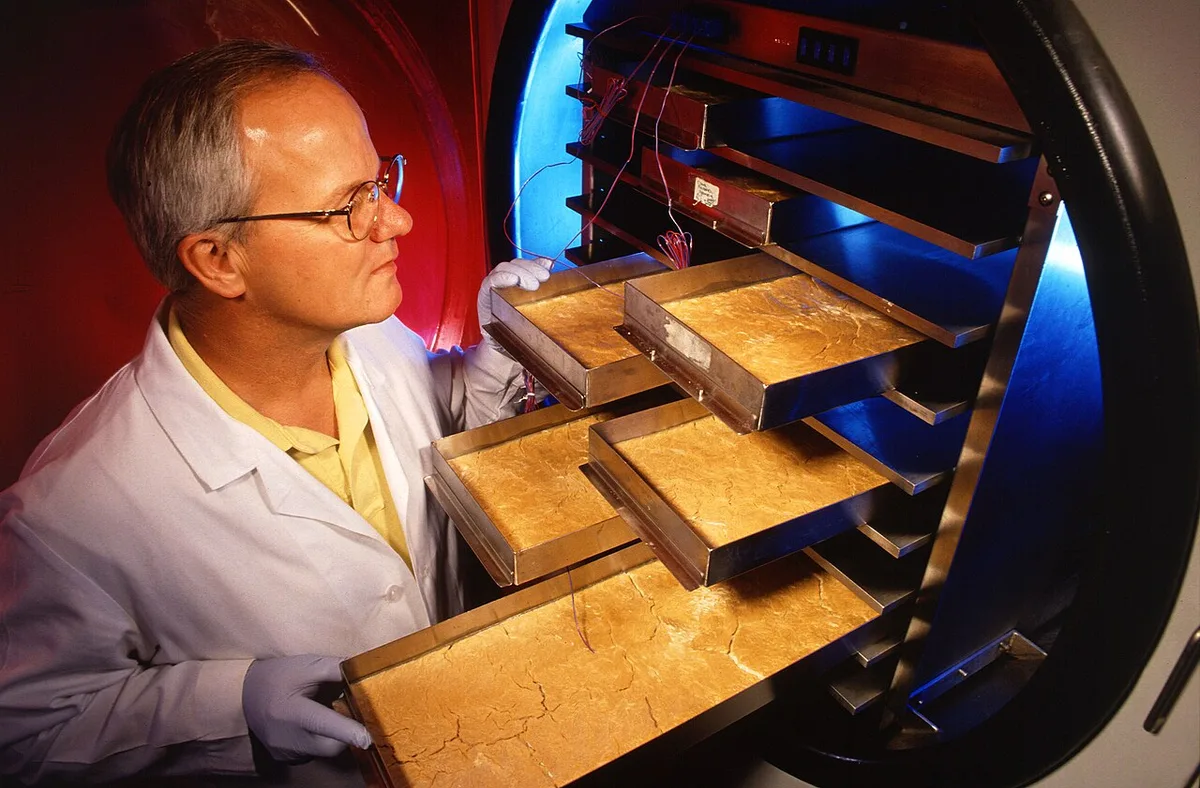
Image source: Wikimedia Commons / Paweł Drozd on Wiki Drozdp 18:28, 4 September 2006 (UTC)
Once the trays are loaded, the freeze dryer does most of the work. Set the machine to run with no added heat, which keeps the chamber below freezing during primary drying. The unit pulls a vacuum down to roughly 200 to 500 mTorr, letting the ice sublimate directly into water vapor.
The cycle for our quarter-inch slices finished at just over 30 hours. Yes, that's long for a vegetable that's cheaper than a can of soda in season, but you don't have to watch it. The machine runs unattended, and you check for completion by looking at the glass door.
Any cold spots on the chamber wall mean moisture is still leaving the food.
Patience matters here. If the cycle ends too early, zucchini stays rubbery and rehydrates poorly. A cycle timer that runs slow can add hours to a batch, so check the machine's settings if things seem off.
It's also worth noting that a full load dries more efficiently than a half-empty tray, so batch as many zucchini as you can at once.
The Final Product: Texture, Rehydration, and Taste Tests
After the cycle finishes, you crack the vacuum valve and pull the trays. The slices look smaller, paler, and almost paper-thin, but they keep their shape well. Crack one in half and it snaps like a wafer, with a crisp, airy bite that's surprisingly pleasant.
Rehydration is quick. Add the slices to a pot of soup and they plump up within five minutes. In cold water, allow ten minutes or a bit longer.
The rehydrated texture falls somewhere between cooked squash and raw, with a mild sweetness.
Blanched batches retain a brighter green, while raw batches turn a dull khaki color. Taste-wise, freeze-dried zucchini is very mild on its own. It shines as a textural element, not a flavor bomb.
You can also grind the dry slices into powder and use it to thicken sauces or boost smoothies. The texture difference compared to a dehydrator is night and day; dehydration turns zucchini into leathery, tough strips, while freeze drying preserves the structure.
Once you're working with powder, keep air exposure and humidity out of the jar to stop clumping. An oxygen absorber is the standard solution for long-term storage.
Mistakes I Made (So You Don't Have To)
Skipping uniform thickness. We tried eyeballing the slices once. Bad idea. The thin pieces finished early and the thick ones still had ice crystals. Use a mandoline set to quarter-inch.
Loading wet slices onto the trays. The first time, we skipped pre-freezing entirely. The zucchini stuck to the metal and some slices tore when we tried to pull them off. A two-hour pre-freeze on parchment or a silicone mat solves it.
Stopping the cycle on a hunch. Our first batch came out after only 20 hours because the glass door looked clear. The slices were still cold in the center and rehydrated mushy. Wait for the chamber to reach room temperature and stay there for at least an hour before ending the cycle.
Sealing without oxygen absorbers. Freeze-dried zucchini is hygroscopic, meaning it pulls moisture from the air. If you seal it in a jar without an oxygen absorber, the crisp slices go limp within a few weeks. For pantry storage, use Mylar bags with oxygen absorbers.
Forgetting the yield math. One pound of fresh zucchini gives you about one ounce of dried. That's a big visual difference. Plan your storage containers based on the dried volume, not the fresh weight.
Freeze-Dried Zucchini vs. Dehydrating vs. Freezing
Here's how the three main preservation methods compare in practice.
| Method | Shelf life | Rehydrated texture | Yield per 1 lb fresh | Best for |
|---|---|---|---|---|
| Freeze drying | 10 to 25 years sealed | Crisp, close to fresh | 1 to 2 oz | Soups, snacks, long-term storage |
| Dehydrating | 1 to 2 years | Leathery, chewy | 2 to 3 oz | Powder, lightweight snacks |
| Freezer | 8 to 12 months | Soft, near fresh | 12 to 16 oz | Everyday cooking, casseroles |
Freeze drying wins on texture and shelf life, but it's the slowest and priciest method. Dehydrating is faster and easier, yet zucchini turns into chewy strips that don't regain their structure. Freezer storage keeps the original taste best, but it eats space and needs power year-round.
If you're weighing these preservation trade-offs, the visual difference helps. Freeze-dried slices hold their shape. Dehydrated slices curl and harden.
- Freeze drying: best if you store food for years or cook from shelf-stable ingredients.
- Dehydrating: best for backpackers who want ultra-light snacks or seasoning powder.
- Freezing: best for families who rotate meals weekly and have chest freezer space.
FAQs About Freeze-Drying Zucchini
Here are the questions people ask most when planning a batch of home freeze-dried produce.
Do You Need to Blanch Zucchini Before Freeze Drying?
No, blanching is optional. Raw slices freeze dry fine, though they turn a pale cream color. Blanched slices keep a brighter green and taste slightly fresher.
The 30 to 60 second boil plus ice bath adds about 15 minutes of prep.
How Long Does Freeze-Dried Zucchini Last?
Sealed in Mylar bags with oxygen absorbers, freeze-dried zucchini stays crisp for 10 to 25 years. Store it in a cool, dark place under 70°F. Once opened, use it within a week and keep the container sealed between uses.
Can You Rehydrate Freeze-Dried Zucchini?
Yes. Hot water rehydrates slices in 3 to 5 minutes. Cold water takes 8 to 10 minutes.
The texture lands between raw and cooked, so it works in soups, casseroles, and stir-fries. Add it directly to hot dishes without pre-soaking.
Why Did My Zucchini Turn Brown or Taste Grassy?
Browning usually comes from oxidation when sliced zucchini sits at room temperature too long. Grassy flavors come from active enzymes in raw slices. Blanching before pre-freeze fixes both.
Seal with an oxygen absorber to prevent further discoloration.
So, Is Freeze-Drying Zucchini Worth It?
For most people with a home freeze dryer, yes. It's a hands-off process that turns cheap summer squash into a shelf-stable ingredient with unmatched texture.
Run the numbers first. One pound of fresh zucchini yields about one ounce of dried. A full batch costs roughly $2 to $5 in electricity as of 2026, depending on your machine and local rates.
Buying freeze-dried zucchini from a store costs far more per ounce, so home production makes sense if you use it regularly.
Skip it if you only want a few servings or if you're buying a freeze dryer just for this. The machine pays off best when you run it often.
- Worth it if: you grow zucchini, use dried vegetables in soups or smoothies, or want emergency pantry storage.
- Not worth it if: you're on the fence about the equipment, or you prefer frozen zucchini for everyday meals.
Before you decide, check the condition of any used vs new unit you're considering. Pump hours, maintenance records, and chamber seals make a big difference in reliability.
Freeze-dried zucchini won't replace fresh squash in a summer ratatouille. For pantry storage, snacks, and fast weeknight soups, it's hard to beat.

Similar Posts